Disappearance of Srila Bhakti Siddhanta Saraswati Thakur | HH Bhanu Swami Maharaj | ISKCON Japan | Dec 7, 2017
nama oṁ viṣṇu-pādāya kṛṣṇa-preṣṭhāya bhū-tale
śrīmate bhaktivedānta-svāmin iti nāmine
namas te sārasvate deve gaura-vāṇī-pracāriṇe
nirviśeṣa-śūnyavādi-pāścātya-deśa-tāriṇe
jaya śrī-kṛṣṇa-caitanya prabhu-nityānanda
śrī-advaita gadādhara śrīvāsādi-gaura-bhakta-vṛnda
Hare Kṛṣṇa Hare Kṛṣṇa Kṛṣṇa Kṛṣṇa Hare Hare
Hare Rāma Hare Rāma Rāma Rāma Hare Hare
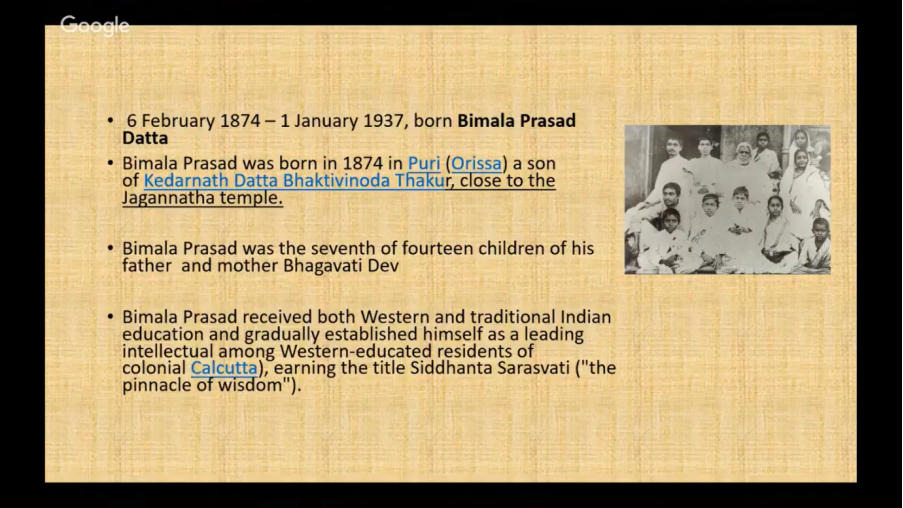
HH Bhanu Swami Maharaj: 1874. And actually he didn’t have a very long lifespan, only about 63 years. So his birth name was Bimala Prasad Datta. Datta was Bhaktivinoda Thakur’s surname. He was born in Puri, where Bhaktivinoda Thakur served as a magistrate. And Bhaktivinoda Thakur’s house is quite close to the Jagannath Temple. So, Bhaktivnoda Thakur had 14 children [Laughs]. And Bimala Prasad or Bhaktisiddhanta Saraswati was the seventh. So, he was in the middle. So, at that time, Bhaktivinoda Thakur was also preaching Caitanya Mahaprabhu’s philosophy. So, of course Bhaktivinoda Thakur was later transferred back to Bengal, and of course, Bhakti Siddhanta Saraswati Thakur also went there, and he was raised with Western and traditional education mixture.
So, at that time in Bengal, which was gradually being westernized by the British, there were several movements going on. Because of the English education, many of those people who graduated, that is the modern educated young Bengalis, began to think of Hinduism as very primitive. So, some of the people rejected Hinduism and became more Western, Christian, etc [Laughs]. Others tried to reform Hinduism, modernize it [Laughs]. So, it was quite convenient for them to follow the Advaita path and publicize that as the future of the whole world [Laughs]. And thus the educated population did not think much of Bhakti and Caitanya Mahaprabhu.
But there sprang up a group of Bengalis who supported Caitanya Mahaprabhu’s movement. And Bhaktivinoda Thakur was one of those persons.
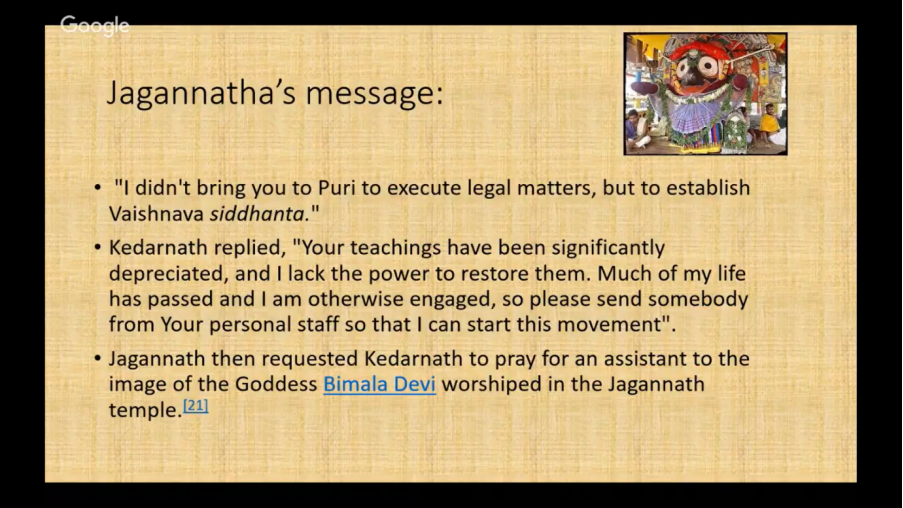
So when he was in Puri, Jagannath, he had a dream about Jagannath [Laughs]. So, Jagannath told him, I didn’t bring you to Puri to do legal things, but to establish Vaishnava Siddhanta. But then, Bhaktivinoda Thakur replied that, all these teachings, Krishna’s teachings have become very weakened and I don’t have much power to revive this movement. So, I am very old and I’m very busy, so you should send somebody [Laughs]. So, Jagannath then told Bhaktivinoda Thakur to pray that, pray to Bimala devi, that’s a form of Durga Devi actually in the temple of Jagannath to send an assistant.
So after that, his wife gave birth to one child, and they called him Bimala Prasad, because it was the answer to Bhaktivinoda’s prayer to have an assistant [Laughs]. So, he was actually a very intelligent child. At the age of nine, he had memorized the whole Bhagavad Gita. So, he seemed to have a photographic memory, he would just look at something and he could memorize it. So, in the early 1880’s, Bhaktivinoda Thakur taught him how to do Hare Krishna Japa [Laughs]. In the 1880’s, how old was he? May be, something when he was 6, 7, 8, 9 age.
And in 1887 he joined one college. So, he studied Western type of subjects [Laughs], but he also one side he studied Sanskrit, Mathematics, and Astrology. Astronomy, Astrology. And he excelled in this Astronomy and Astrology quite a lot, so, he got that title, Siddhanta Saraswati, because of that. And later on, he began to print many astronomical works, like Surya Siddhanta and Siddhanta Siromani and some astrological works also.
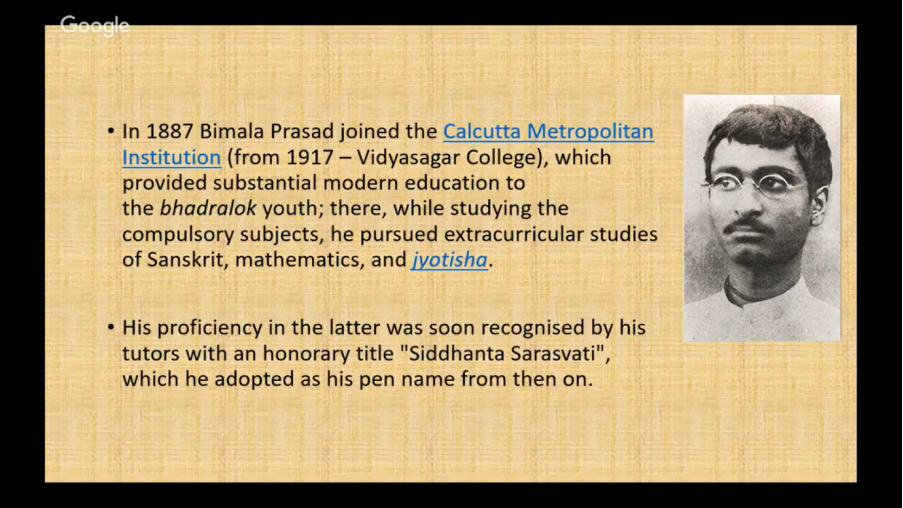
And then he entered Sanskrit college, which was quite a respectable college at that time. Then he studied Indian philosophy and also ancient history. But in 1895, he quit the college. Apparently, he got into an argument with the principal of the college [Laughs], who was also very learned in Astrology and Astronomy [Laughs]. They had an argument [Laughs].
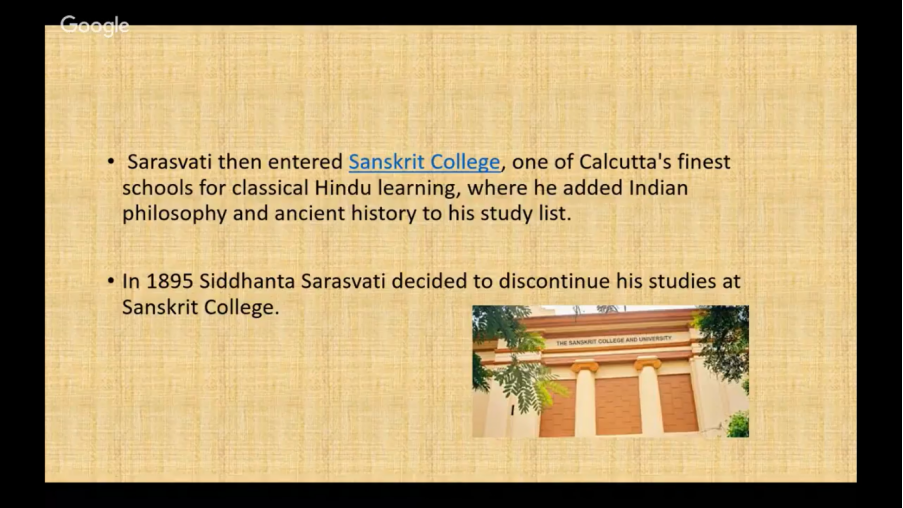
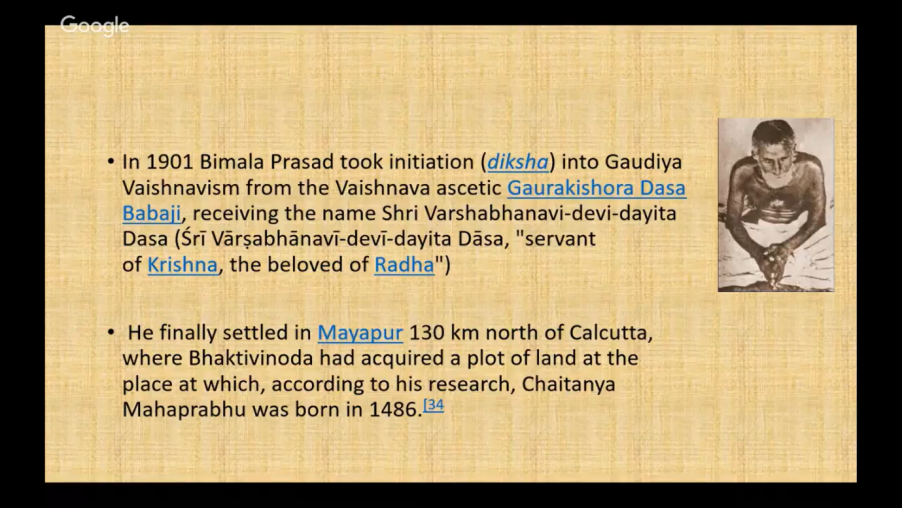
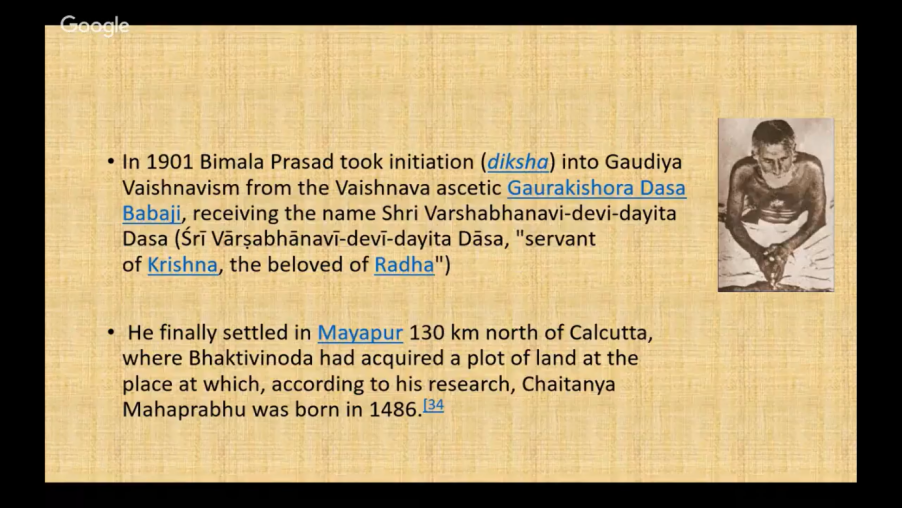
So, he actually got many good jobs, doing research and then taking care of libraries, etc. But then he began to lose interest in that, and he became more interested in Vaishnavism. And in 1901, which makes him about 25 years old I guess, he, under the guidance of Bhaktivinoda Thakur, his father, he took diksha from Gaura Kisora Das Babaji. And he got his name Sri Varshabhanavi Devi Dayita Das. So it means servant of Krishna, who is the beloved of Radha.
So, he lived in various places, but eventually he settled in Mayapur. Bhaktivinoda Thakura had discovered the birthplace of Caitanya Mahaprabhu, so and he bought some land there. So, Bhakti Siddhanta Saraswati Thakur decided to live there.
So, at that time, Bhakti Siddhanta took a vow to chant one billion names [Laughs] of Hare Krishna [Laughs]. It took ten years. It took ten years [Laughs]. So, he said he used to live in a grass hut there and just keep chanting and chanting and chanting.
In 1911, he spoke at a conference in one town in Bengal called Midnapore. There was a controversy about Vaishnavas. So, if you are not born as a brahmana but you became a Vaishnava can you worship a Salagram sila? And could these persons who are not born as brahmanas take diksha, Vaishnava diksha? It was basically a challenge from the brahmanas [Laughs]. So, they called many learned Vaishnavas from Vrindavan and Bengal to speak there and then they had some brahmanas, smarta brahmanas there also. So, Bhaktivinoda Thakura could not go to speak, though he was invited, so he sent Bhakti Siddhanta Saraswati.
So, Bhakti Siddhanta Saraswati Thakur spoke there several times, and it was actually very convincing. And his main point was that, an initiated Vaishnava is superior to [Laughs] the brahmana ultimately [Laughs]. So, of course, he has quoted from scriptures to support himself. Although, we can say he was victorious there, this began a big enmity [Laughs], some hatred between the local brahmanas and Bhakti Siddhanta Saraswati, Navadwipa brahmanas against Bhakti Siddhanta Saraswati. That went on throughout his whole life after that.
In 1913, he established a printing press in Calcutta. And he published Caitanya Caritamrta with his own commentary. So, he became quite interested in printing Vaishnava works and his own writings, with the printing press.
But then, in 1914, Bhaktivinoda Thakur passed away. So, he transferred his press from Calcutta to Mayapur and then to Krishna Nagar. And there he completed the Caitanya Caritamrita. And then, the next year or so, Gaura Kishore Das Babaji disappeared.
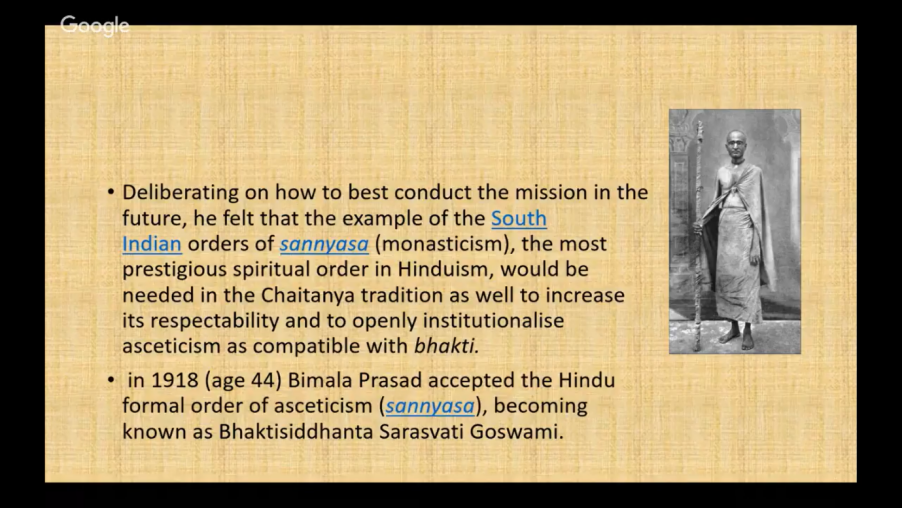
So, then he was quite [Laughs] disturbed by all of that [Laughs]. So, he began to think deeply about how to spread Caitanya Mahaprabhu’s mission. So, he had been to South India, and he saw that there were Vaishnava sannyasis there. Whereas, in Lord Caitanya’s movement, there were no sannyasis. So, then he decided that actually Lord Caitanya’s movement needed sannyasis also. So, then he took sannyasa, he put himself into sannyasa ashram and then he [Laughs] initiated others as sannyasis also. So, this was in 1918.
So, in 1918, Bhakti Siddhanta Saraswati Thakur established a Center in Calcutta. It was originally called Calcutta Bhaktivinoda Asana, then it became the Sri Gaudiya Matha later on.
Devotee : He shifted to Mayapur and then?
HH Bhanu Swami Maharaj : No, this was Calcutta. This is the place where Prabhupada met Bhakti Siddhanta Saraswati Thakur. It’s in North Calcutta, Ultadanga road. That was in 1922. Four years after he established it. So, based on this model, then he established other places like sent out sannyasis around India and even to England and Germany and Rangoon [Laughs] and they established similar centres there.
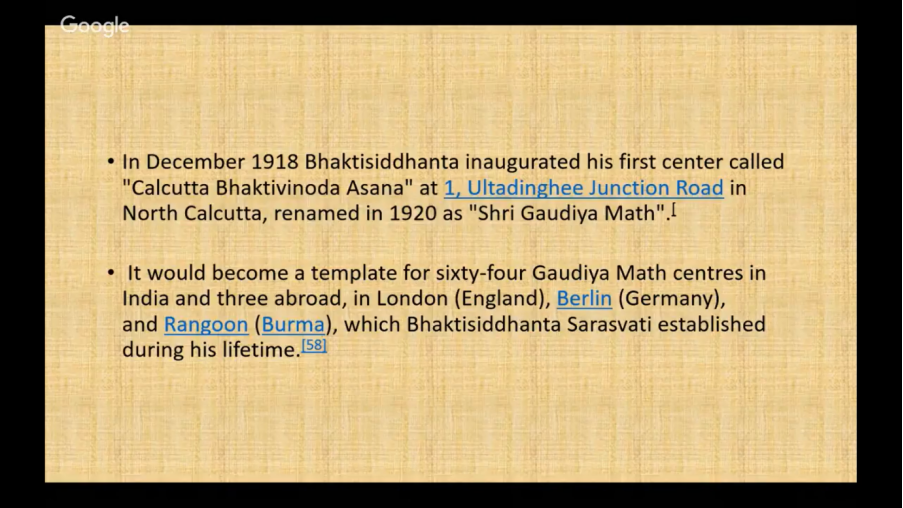
So, they began preaching in Calcutta and all the other big cities and it became quite popular.
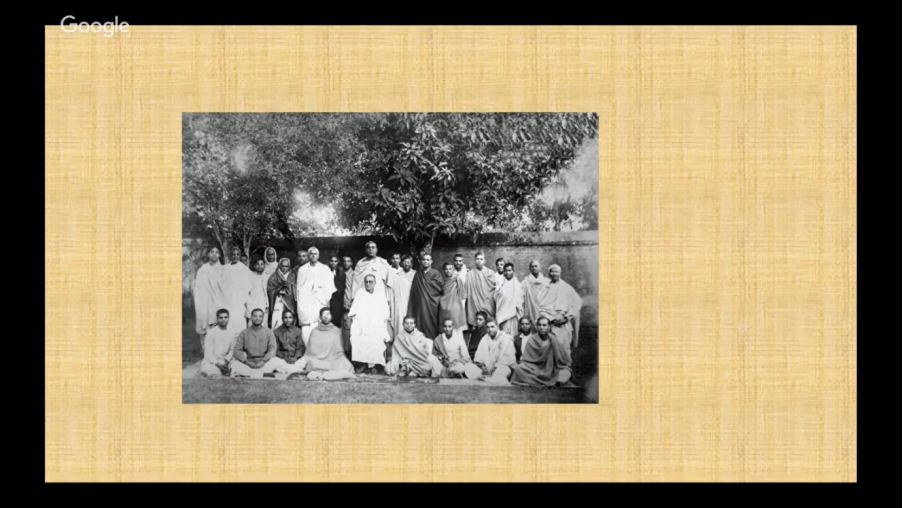
And he established even a daily newspaper [Laughs], and a weekly newspaper, and a monthly periodical. And as well, they published many books.
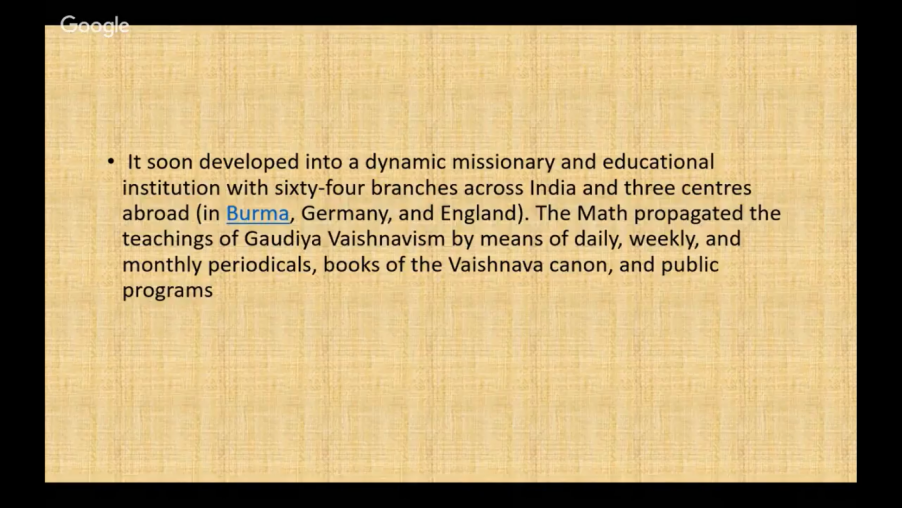
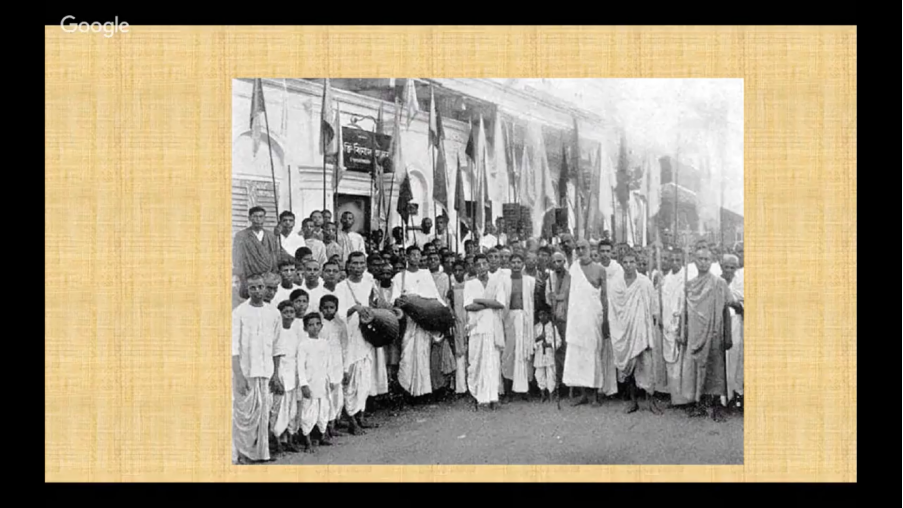
Okay so, there were many challenges also, one was the Mayavadi philosophy [Laughs]. It became very prominent among the intelligentsia, the intelligent people, educated people. And in the modern times, it took the form of Vivekananda [Laughs]. He became very, very popular at that time. Rama Krishna and Vivekananda.
Then, of course, there was the challenge of the smartas, he already had that, 1911, he had this meeting with these, and they were always opposing the brahmana community. And there another challenge was with, we can say within the Gaudiya sampradaya , it is with the, apa sampradaya, people who claim to be Gaudiya Vaishnavas but were actually not following Lord Caitanya’s movement. But after Lord Caitanya’s disappearance, then we had some great persons. Nityananda was there. After Nityananda, we had Narottama Dasa Thakur or Srinivasa Acharya, etc. But gradually, new groups began to form and they distorted some of the teachings. So he had to counteract that [Laughs].
So, he had to preach very vigorously. Very very [Laughs] strongly he had to preach.But at the same time, he was willing to, though philosophically we can say conservative, he was willing to use modern means to preach. So, he found that the printing press was a very good means of preserving the Gaudiya literature and also propagating it. And of course, he established an institution, he has registered a society, etc.
These are all modern things [Laughs].
So, he was willing to use cars, trains, or whatever for transport. Of course, people would criticize also [Laughs]. But he didn’t mind that [Laughs].
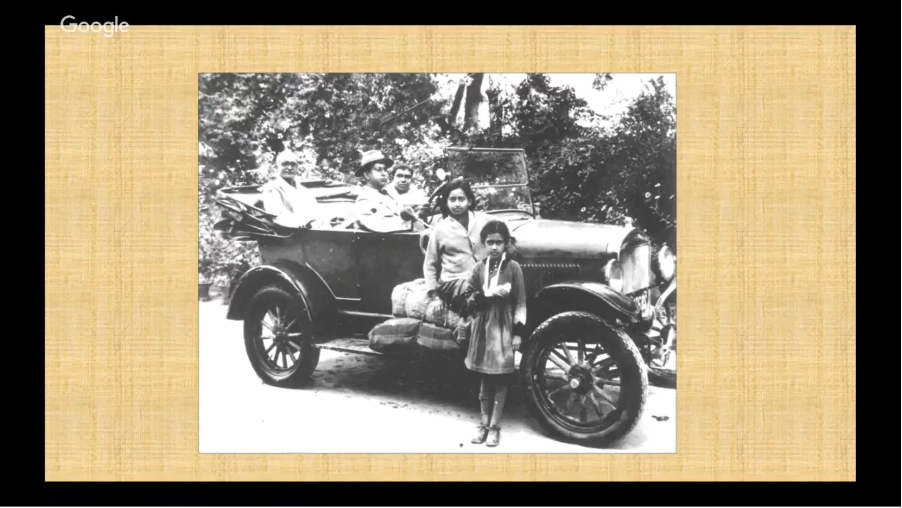
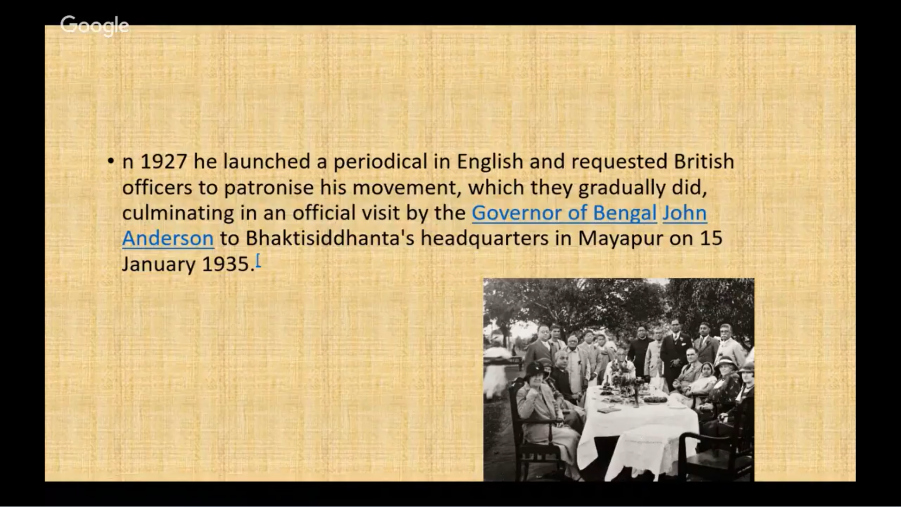
And the sadhus in general, they shouldn’t be attracted to modern things or whatever. You should walk everywhere, things like that. General tradition is there. Even like 20 years ago, one of the Madhva sannyasis went to America. That caused a big controversy in the Mutt. I think one argument was that you shouldn’t cross the water. If you cross the water, then you’re impure [Laughs]. So, he was not only using modern equipment etc, but he wanted to preach to other persons, so he had a periodical in English in 1927 and then, he tried to get the support of the British as well.
Devoteee : He got support from the government?
HH Bhanu Swami Maharaj : And he invited the governor of Bengal, an Englishman, and he came to Mayapur [Laughs]. So, this is actually done in a very short period of time, it was only in, by 1918 he came to Calcutta and established this first Gaudiya Matha. So, within 10 years or something, he had got such support that he actually could get the governor to go to Mayapur even [Laughs].
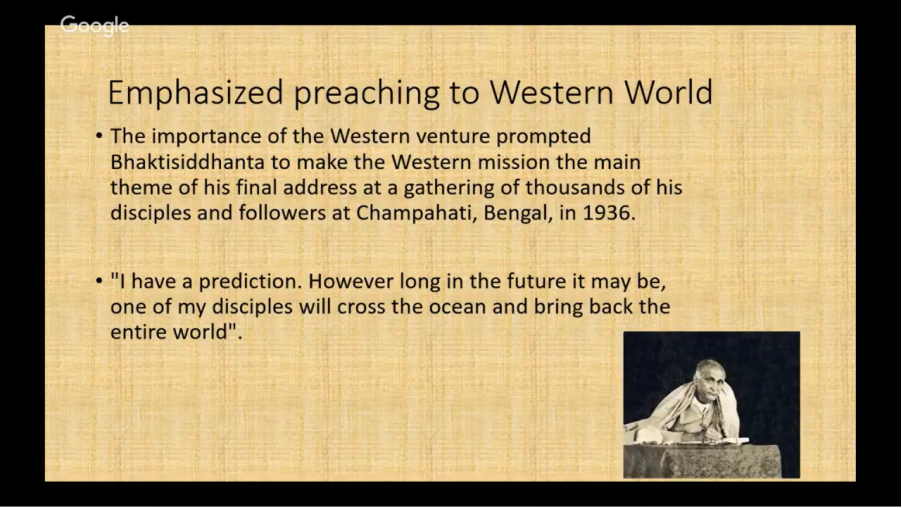
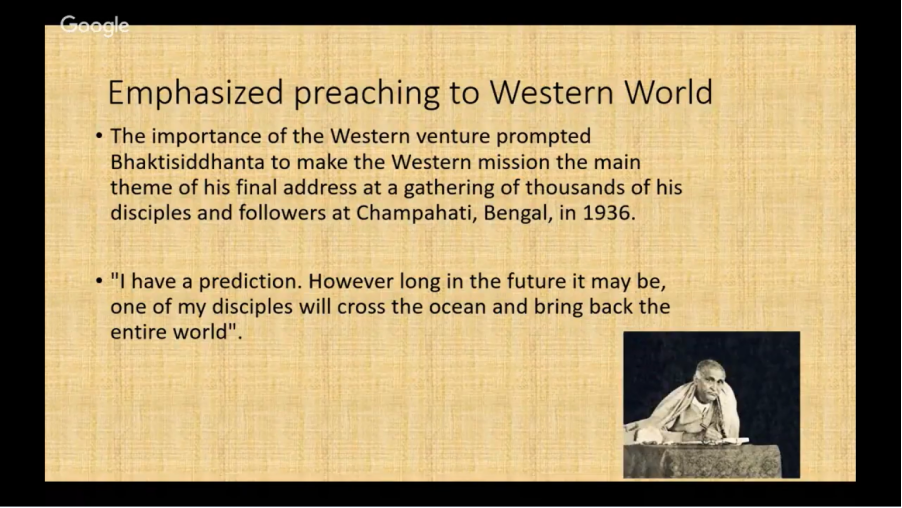
So, not only he was preaching to the British in India and English speaking people, he actually sent Bon Maharaj, one of his sannyasis to England to preach. And he made two devotees in Germany and they came to India [Laughs]. So, Bhakti Siddhanta Saraswati Thakur was quite interested in preaching in the West but in his lifetime, not much happened. Bon Maharaj returned and it was two Germans and that was all that happened. But in 1936, he said I have a prediction. However long the future may be, one of my disciples will cross the ocean and bring back the entire world.
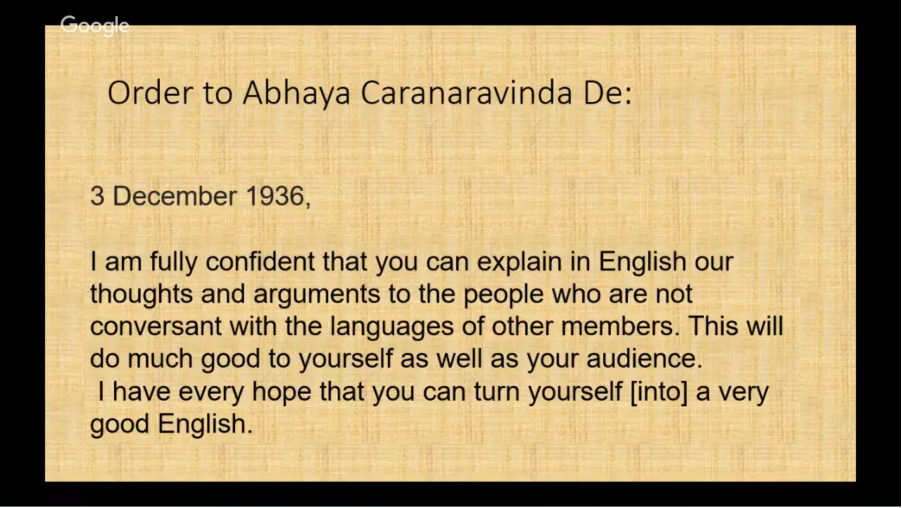
And then, same year, December, he wrote to Prabhupada [Laughs], Abhaya Charanaravinda De, I am fully confident you can explain in English our thoughts and arguments to the people who are not conversant with the languages or other members. This will be much good to yourself as well as your audience. I have every hope you can turn yourself into a very good English preacher whatever like that. So, he was giving an order to Prabhupada to preach in English Language.
But then in January, 1st, next year, right after that, one month later, he [Laughs] he disappeared [Laughs]. He was 63 years old. So, actually within a very short period of time, he made a, he expanded a movement, made a very big movement. However, after his disappearance, then he didn’t appoint one person as the leader and there was some competition there and gradually, the Gaudiya Matha broke up into different groups. So, when Prabhupada first met Bhakti Siddhanta Saraswati Thakur at that North Calcutta, first Gaudiya Matha, then, at that time, Bhakti Siddhanta Saraswati Thakur encouraged him to preach to the English speaking public.
Later, Prabhupada took initiation in what’s that? 1933. So quite late actually, he took [Laughs]. Because he disappeared in 1937 [Laughs]. So, he took about after 10 years after meeting, he took initiation. And then he got this letter, 36, 3 years later, he got that letter. So, again, he got this instruction to preach to the English speaking public after initiation. So, of course, Prabhupada was a grhastha and for some years, he was working, travelling, doing this and that, whatever. So, he could not participate in the Gaudiya Mutt, and of course it began to divide up [Laughs]. But he always remembered this order of Bhakti Siddhanta Saraswati Thakur. So may be it was after this, it was another 20 [Laughs], 30 years [Laughs] before [Laughs] it began to manifest again in preaching in the Western world etc [Laughs]. But Prabhupada always attributed his success to following that order of his Guru. So finally, his prediction came true [Laughs], Bhakti Siddhanta Saraswati’s prediction came true. Okay. Hare Krishna.
Q & A:
1.) Maharaj, you said, in Caitanya Mahaprabhu’s pastime, there were no sannyasis?
Well, Lord Caitanya’s time, there were, they, 10 sannyasis gathered around Him in Puri. But they had come from elsewhere, probably from Mayavadi sampradaya [Laughs] or something probably Brahmananda Puri and Paramananda Puri. Those were sannyasis. There were 10 sannyasis in Puri. But after Lord Caitanya, we have like Narottama Das Thakur and Nityananda. And then there were basically grhasta lines of diksha. And there were no sannyasis, or even brahmacharis after that point, for so many hundreds of years.
Devotee: Most probably they are also [Not clear].
HH Bhanu Swami Maharaj: Babaji. they didn’t take sannyasa. So, in a sampradaya, by and large, they said, oh, well, Lord Caitanya probably doesn’t like… He took sannyasa. But after that, because there were no sannyasis, then more or less it was tradition. Gaudiyas don’t take sannyasa [Laughs] or something like that [Laughs]. And it’s anti-Vaishnava or something like that. So, because obviously most of the sannyasis around there were Mayavadi sannyasis. But He saw in South India, He saw Ramanuja sannyasis, Madhva sannyasis, Vaishnava they also take. So that would be good to make an institution with sannyasis.
Devotee: For preaching?
HH Bhanu Swami Maharaj: Preaching. Yeah. .
Devotee: Because the Vaishnavas, they don’t care. Because even sannyasis are material.
HH Bhanu Swami Maharaj: Yeah. And the other type of sannyasi simply renounces everything. So, this is a different type of sannyasa.
Devotee: The Vaishnavas, Gaudiya Vaishnavas they don’t care. But again Bhakti Siddhanta, for preaching reasons, he took.
HH Bhanu Swami Maharaj: Yeah.
Devotee: Prabhupada also following that. How do you think that now for our society, for this principle of sannyasa, for preaching?
HH Bhanu Swami Maharaj: For preaching to the world, it doesn’t really matter. Because who are the famous people? Ravi Shankar, he’s not a sannyasi. You know, people don’t, Western culture doesn’t understand what a sannyasi is anyway. Anybody wearing a long robe and long hair, okay, he’s a sadhu [Laughs].
Devotees: [Laughs].
HH Bhanu Swami Maharaj: And he could stick on orange cloth or whatever color cloth, it wouldn’t matter really. Or even Rajneesh or somebody, you know, they, puts on long robes and they respect him as some sort of holy person or something. In modern world, it’s not such a thing. But in India, conservative India, the sannyasi was respected. So, however, we do have movements like Vallabha , basically no sannyasis in that movement. Vallabhacharya movement, they don’t have sannyasis. So, you can get along without it. But particularly in the modern world, for preaching in the Western world, it’s not a real necessity to do so. It kind of emphasized in ISKCON, but I think it’s only a convention. Because it’s a kind of customary or something like that. Sannyasis are preachers or whatever like that. So out of that type of attitude, then sannyasa is important. But otherwise, even with, among devotees in one sense, anybody could preach there. It doesn’t really matter.
2.) Bhaktivinoda Thakur’s other children [Not clear]?
One other son became a quite a well-known devotee, Lalita Prasad. He was still alive when Prabhupada went to Mayapur. He met him at one time. He lived in Virnagar, which is near Krishna nagar, down on the railway line.There’s a town called Virnagar. So, he had his ashram there and he used to do preaching, whatever like that. He had some disciples in Bangladesh and Bengal also, not so many, a few. He wrote a few little works also, basically doing Raganuga bhakti.
However, that, he was the brother of Bhakti Siddhanta Saraswati Thakur, he criticized him [Laughs]. He was being too modern [Laughs] ,
Devotee: Even if he was his brother?
HH Bhanu Swami Maharaj: Yeah. He used to criticize him a lot for all these things. Riding in a car, whatever like that [Laughs]. So I don’t know about other brothers, I don’t think [Not clear].
Devotee : [Not clear].
HH Bhanu Swami Maharaj : Most probably, none became famous as vaishnavas, only two.
Devotee : Bhakti Vinoda thakur wife also?
HH Bhanu Swami Maharaj : We don’t hear about her much. What’s her name? Bhagavati, Bhagavati yeah.
Devotees: Srila Bhakti Siddhanta Saraswati Thakur Maharaj ki jai!!! Srila Prabhupada ki jai!!! HH Bhanu Swami Maharaj ki jai!!!