Srimad Bhagavatam Text – 3. 14 .7 – 9 | H.H Bhanu Swami Maharaj | Sridham Mayapur | Feb 18, 2025
ŚB 3.14.7
अथात्रापीतिहासोऽयं श्रुतो मे वर्णित: पुरा ।
ब्रह्मणा देवदेवेन देवानामनुपृच्छताम् ॥ ७ ॥
athātrāpītihāso ’yaṁ
śruto me varṇitaḥ purā
brahmaṇā deva-devena
devānām anupṛcchatām
Translation
This history of the fight between the Lord as a boar and the demon Hiraṇyākṣa was heard by me in a year long ago as it was described by the foremost of the demigods, Brahmā, when he was questioned by the other demigods.
ŚB 3.14.8
दितिर्दाक्षायणी क्षत्तर्मारीचं कश्यपं पतिम् ।
अपत्यकामा चकमे सन्ध्यायां हृच्छयार्दिता ॥ ८ ॥
ditir dākṣāyaṇī kṣattar
mārīcaṁ kaśyapaṁ patim
apatya-kāmā cakame
sandhyāyāṁ hṛc-chayārditā
Translation
Diti, daughter of Dakṣa, being afflicted with sex desire, begged her husband, Kaśyapa, the son of Marīci, to have intercourse with her in the evening in order to beget a child.
ŚB 3.14.9
इष्ट्वाग्निजिह्वं पयसा पुरुषं यजुषां पतिम् ।
निम्लोचत्यर्क आसीनमग्न्यगारे समाहितम् ॥ ९ ॥
iṣṭvāgni-jihvaṁ payasā
puruṣaṁ yajuṣāṁ patim
nimlocaty arka āsīnam
agny-agāre samāhitam
Translation
The sun was setting, and the sage was sitting in trance after offering oblations to the Supreme Personality of Godhead, Viṣṇu, whose tongue is the sacrificial fire.
Purport
Fire is considered to be the tongue of the Personality of Godhead Viṣṇu, and oblations of grains and clarified butter offered to the fire are thus accepted by Him. That is the principle of all sacrifices, of which Lord Viṣṇu is the master. In other words, the satisfaction of Lord Viṣṇu includes the satisfaction of all demigods and other living beings.
HH Bhanu Swami Maharaj:
So, this is a chapter about the pregnancy of Diti and how a big demon was born. So, I didn’t want to speak about pregnancy or fire sacrifices [Laughs].
So, I took the first verse which talks about how the story of Hiranyaksha was told long ago. So, Brahma, he was questioned by the demigods and then he began to speak. So, therefore, I will speak on how knowledge is handled down by the process of speaking. So, the title of this is ‘Respect’, because everybody can hear. But unless we have proper respect, we don’t hear properly [Laughs]. So, of course, this idea of hearing is implicit in the Bhagavatam itself. And we’ll see from the beginning of Bhagavatam, it’s all about people hearing. Suta instructs the sages and they’re listening. He is speaking, they ask questions. We have Narada instructing Vyasa, Vyasa is listening. Vyasa instructs Sukadeva, he is listening, etc. And Sukadeva Goswami, he instructs Pariksit.
And the whole Bhagavatam, the rest of the Bhagavatam after the first canto is Pariksit hearing, submissively from Sukadeva Goswami. So, the whole Bhagavatam is based on this transmission of knowledge through the hearing process. And it must be done properly, as I said. And in fact, if we trace our Sampradaya, which is mentioned in the beginning of the Bhagavad Gita, we find this is a parampara, but we see it is a succession depending on hearing, which we say is a Siksha Sampradaya. It’s not based on Diksha at all. It’s based on hearing. So, the Sampradaya itself is a Siksha Sampradaya based on the hearing process. And what are we getting? We are getting knowledge through that process. And of course, knowledge is most significant for us in advancing in devotional service.
So, we have a whole series of whatever like this, up until the present time. We have all these different personalities. And of course, our Acharyas like Bhaktisiddhanta Saraswati Thakur and Srila Prabhupada could have chosen a Diksha Sampradaya to trace, because all of our previous Gurus had Gurus and they had Gurus by Diksha as well. But he didn’t do that. He traced a Siksha Sampradaya to emphasize the fact that the passing of knowledge is very important for us more than the passing of mantra through Diksha. So, I’ll get a little more into that later.
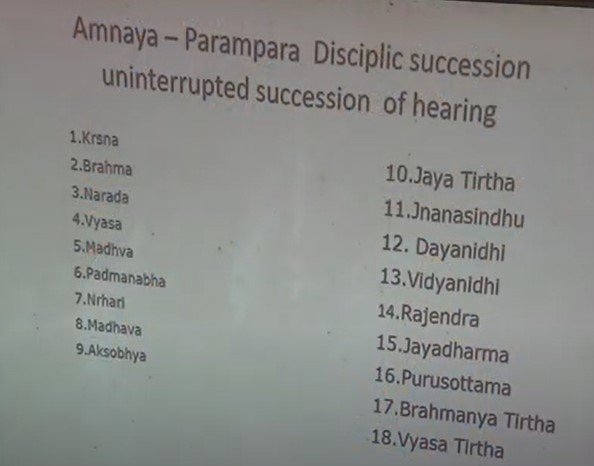
And as I said, the title of this presentation is ‘Respect’. So, to get knowledge, we have to respect properly. As we see in Bhagavad Gita in the fourth chapter, it talks about Pranipat. You get knowledge from the Guru, one who knows, by Pranipat, which means falling down [Laughs], completely and then asking pertinent questions and then serving. So, that’s the process, general process of getting knowledge. Not only spiritual knowledge, even material knowledge. We have to have this sort of submissiveness, surrender, respect, etc. for the person who’s hearing. And this is reflected in many quotations that we have when we talk about Gurus, etc.
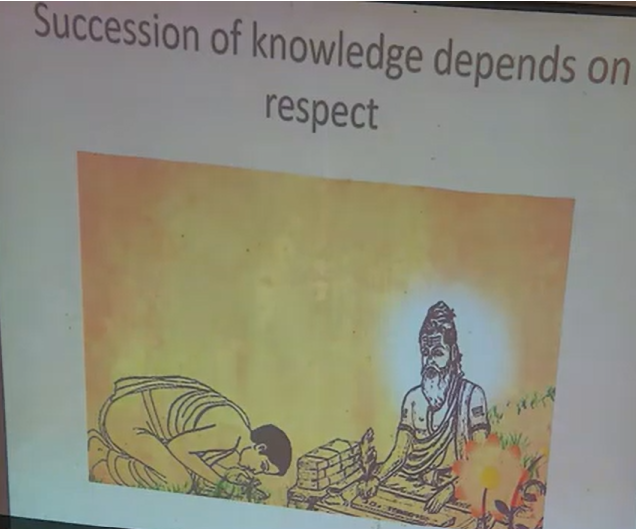
So, it’s very famous from Svetasvatara Upanishad, “To the great soul who has Bhakti for the Lord and Guru, the meaning of what is spoken in the Upanishads is revealed”. So, you have to have equal devotion for Guru as you have for God. So, in other words, respect is very necessary. Of course, the whole essence of scripture is to respect the Lord, but then to do that, we have to respect Guru. So, this idea of respect for the speaker or the Guru is emphasized a lot in Upanishads, which is part of the Vedas. And this is where we get many of our quotations from.
But, of course, it comes up even in Bhagavatam. So, we have this famous quote, “Ācārya Maṁ Vijāniyām”. One should know the Ācārya as myself. In other words, Guru is non-different from Supreme Lord and don’t disrespect him in any way, etc. So, the same type of idea is there, not only in Sruti, but in Smriti as well. That is, Bhagavatam and other Puranas, Mahabharata, etc. You’ll find this repeated. So, it’s not surprising that in our Sampradaya, we’ll have this concept of worship of the Guru and great respect for the Guru.
Of course, one interesting thing here is that this particular quote, this one here in the Bhagavatam, is actually a commentary or instruction for the Brahmachari. And the Brahmachari, of course, he could be a devotee, may not be a devotee. And the person who’s teaching will be the ashram teacher. Some teacher there. And he is the one who gets respected like God. And he may not be teaching Vaishnava philosophy. So, Jiva Goswami says, if you’re practicing Karma [Laughs], if you’re getting knowledge of Karma kanda from your Guru, you have to respect him like God [Laughs].
And of course, this is carried over in the material world. So, if you have a music teacher traditionally, like a sitar teacher, then you have to treat him like God also. Of course, it’s material knowledge, but you treat him like God also. So, even in the material level, you give respect to your teacher. And of course, in the family also, we have the father. Father and mother are like God [Laughs]. And that’s carried over. Even the guest is like God, atithi seva, You treat the guest like God himself. So, it’s a common concept of respect. So, getting more particular, when we come to Gurus or teachers, then we have a parampara based on siksha, as we trace our parampara. Or you could do it on diksha.
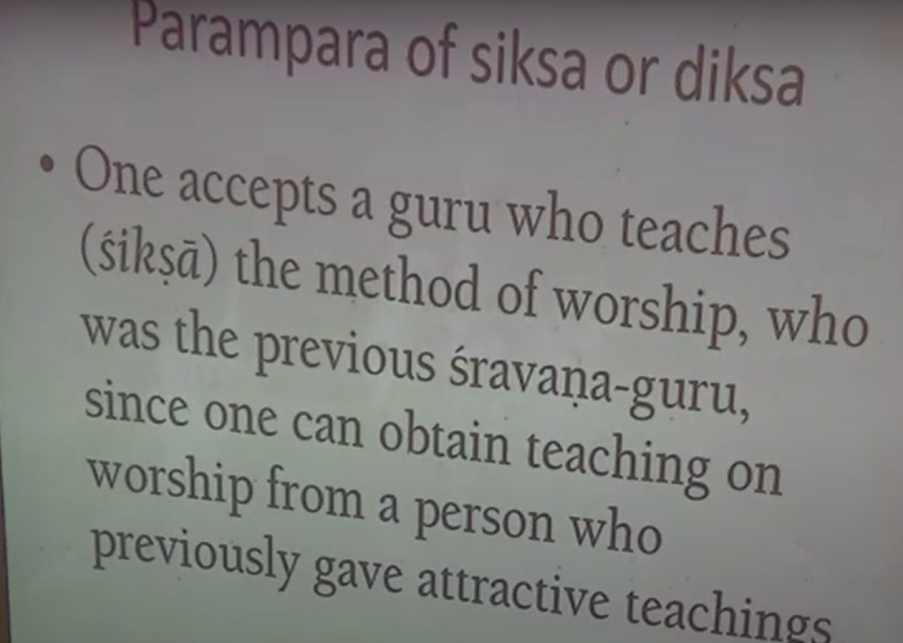
But, of course, in ISKCON, we kind of blur the distinction between siksha and diksha, between diksha Guru and his functions, etc. But, it’s not so unclear. If we go back 500 years or previously, the distinction was quite obvious [Laughs]. So, these are discussed, of course, in works like Bhakti Sandarbha, etc. in which Jiva Goswami defines the different types of Gurus. He talks about the siksha Guru. He teaches the method of worship. I think he was actually a shravana-guru. You just hear general knowledge, then you get more particular knowledge of how to worship the Lord. And then you may select that person for further teachings. And then you may go for mantra, which is the diksha Guru. So, simply because we got a Guru, doesn’t mean he’s a diksha Guru.

He becomes a diksha Guru, when you get the mantra. And by mantra, we don’t mean Hare Krishna mantra, because we get that without a Guru at all [Laughs]. Before you start entering even an ashram or brahmacharya ashram or whatever, you’re chanting Hare Krishna or whatever. So, you’re not getting that from any particular person [Laughs]. But, this is the mantra you get, which is secret, which we say in second initiation is your mantra, the Krishna mantra. So, that’s the mantra Guru, the one who gives you that. So, that’s the diksha that they talk about in scripture.
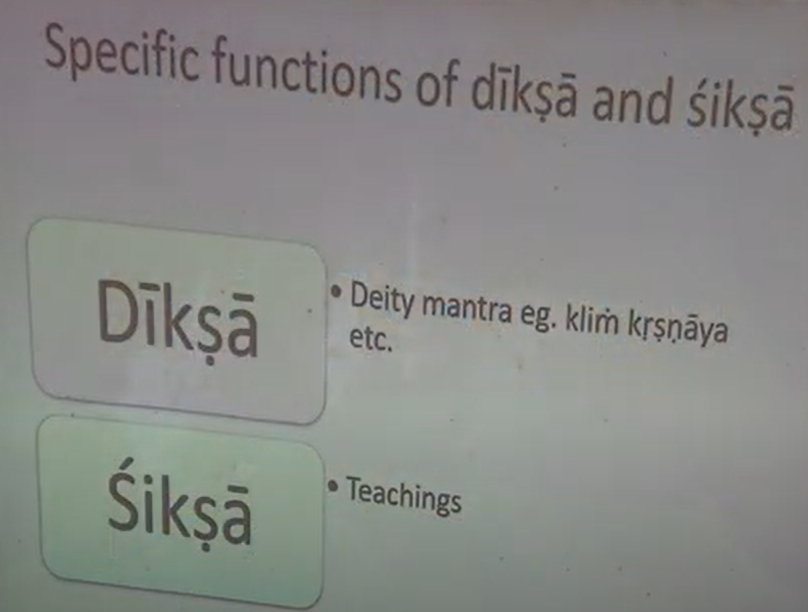
When Lord Caitanya took diksha in Gaya, he got a mantra, ten-syllable mantra, and he didn’t tell it. He didn’t say, everybody chant this mantra [Laughs]. He never revealed it to anybody. Nityananda got a ten-syllable mantra from his Guru. He didn’t tell anybody. That’s the mantra, that’s the diksha. So, anyway, that’s the literal function of diksha Guru is to give the mantra. And the function of the siksha Guru would be to give the teachings.
Of course, there’s overlap because the diksha Guru also becomes a siksha Guru if he starts teaching as well. But sometimes, as we see in our parampara, they’re not giving mantra at all. We’re tracing a siksha parampara. So, he’s not giving the mantra. He’s giving teachings. So, that’s a different type of thing. So, it’s also distinct. So, we have two types of Gurus. And they’re supposed to be respected equally.
Previous to the publication of Chaitanya Caritamrita, I don’t know what year it was in, but probably 1970-something. Guru was Guru, that was all [Laughs]. And Prabhupada was the Guru [Laughs]. We didn’t have an idea of siksha, diksha, whatever. Only initiation, Prabhupada was the Guru. But then the Caitanya Caritamrita came out. And at the beginning, Adi Lila talks about siksha and diksha. They’re both equal and they have different functions. So, that’s where we got the idea originally. Before that, we didn’t even have an idea about that. So, there is that distinction, even in Caitanya Caritamrita. And, in any case, everybody gets respected.
So, in Krishna Bhajanamrita, a work written later on, follower of Lord Caitanya, we have all Vaishnavas considered as Guru or spiritual master. So, in one sense, yeah, we have to respect everybody. Of course, the Vaishnava respects every living entity. This is one of the Angas of Bhakti [Laughs]. Don’t disturb any living entity. And give respect to the trees and the animals and the cows and whatever, human beings and the Brahmanas, whatever. So, we respect everybody. But especially we respect the Vaishnavas, because they are the transmitters of Bhakti.
So, in one sense, they’re all Gurus. But then we do select particular persons for getting mantra and that’s the diksha Guru. And for getting instructions, that’s the siksha Guru. So, we have special persons we call siksha and diksha Guru. And we give special honor to them, special respect. And, of course, the only distinction is we have one mantra Guru. Why one mantra Guru, when you can have so many siksha Gurus? One explanation, of course, is that one particular person may be specialized in a certain type of knowledge. Maybe he knows Bhagavatam, another knows Bhagavad Gita, whatever.
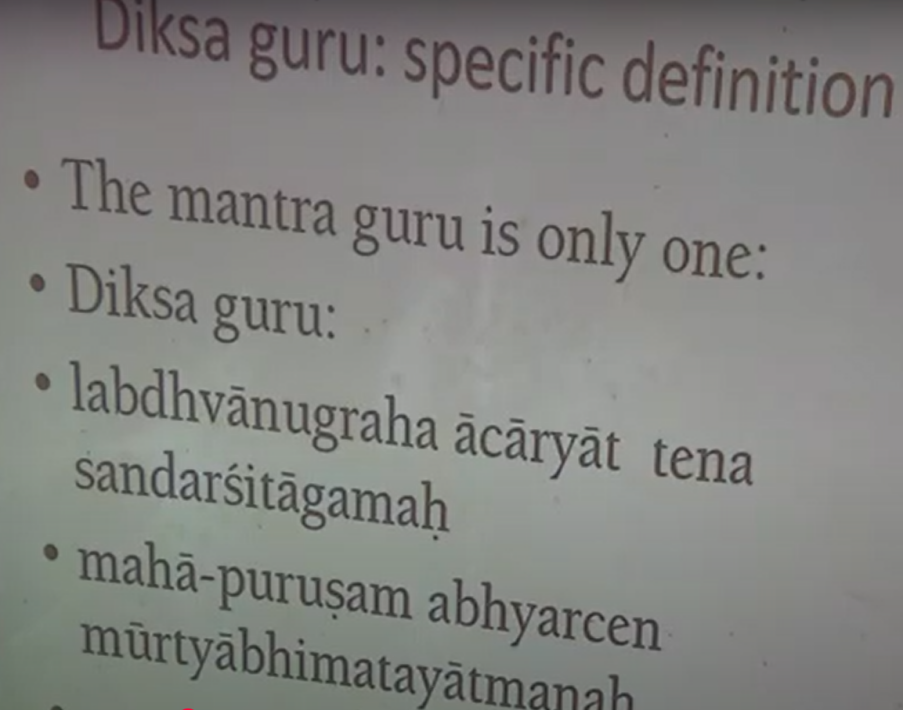
So, you go to different persons for different siksha, whatever. Somebody may know Raganuga Bhakti, you go to him for that. Somebody may know something else in terms of Bhakti, you go to that person. So, you have many siksha Gurus. Why not the same for diksha? Well, technically we should only worship one deity. We shouldn’t spread our attention around [Laughs]. So, you go to one Guru and get a Krishna mantra. You say, I don’t like that mantra. You go to another Guru to get a Narasimha mantra. Okay, I like that. Then you change your mind. I want a Ram mantra. You go to another Guru, get a Ram mantra. So, you want to worship all sorts of deities. So, that’s not considered proper. You take one Guru, select one mantra, worship one deity [Laughs].
Okay, anyway. Just a little more on that. So, one takes only one diksha Guru. So, the idea, of course, is that you’re getting a mantra from that Guru and that makes him the diksha Guru. I’m just emphasizing that. So, it’s not that simply because somebody teaches you, he becomes your diksha Guru. No, he’s your siksha Guru. If you get that mantra from him ‘Klim Krishnaya..’ etc., then that’s diksha. So, that’s when we talk in scripture, when we speak of diksha Guru, that’s what it means. Now, in ISKCON, of course, we use it in a more general term. So, I’m not talking about that. I’m talking about what Bhagavatam or other works are talking.
So, what is the qualification? We get another famous verse here – ‘śābde pare ca niṣṇātaṁ, brahmaṇy upaśamāśrayam‘.
tasmād guruṁ prapadyeta
jijñāsuḥ śreya uttamam
śābde pare ca niṣṇātaṁ
brahmaṇy upaśamāśrayam
– Srimad Bhagavatam – 11.3.21
So, what is the qualification? Hearing and chanting about the Lord [Laughs]. ‘Pare brahmani’, This is Vishvanatha’s interpretation. Nisnatam means ‘thoroughly conversant with’. ‘Sabde’ means ‘devotional scriptures’.
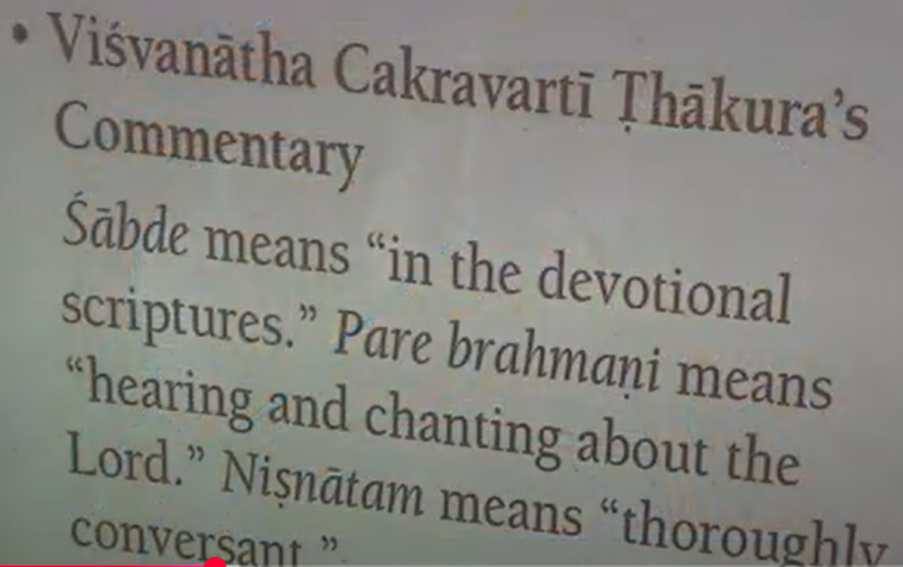
So, of course, originally you could take this as meaning, okay, ‘Sabde Parameh’, okay, Vedas, you have to know the Rig Veda. Then you’re a Guru. But we say, no, know Bhagavatam. If you know Bhagavatam, devotional scripture, Bhagavad Gita with commentaries of our Acharyas, then you’re the Guru [Laughs]. So, and the other idea is that ‘Pare Brahmani’, well, they say, well, you concentrate on the Supreme Brahman. You want to take this literally. Okay, then this looks like you are an impersonalist. So, he takes the words, no, it means you’re hearing and chanting, absorbed in hearing and chanting, devotional processes. So, in this way, it becomes a very devotional type of qualification. So, hearing and chanting about the Lord and conversant with scriptures – bhakti scriptures, that is. Okay. So, that’s a very general qualification.
And then we can say, who can be a Guru? Anyone who is conversant with scripture, etc. We see this in 11th Canto again. Conversant with bhakti scriptures, etc. And fully tranquil. So, but then, what does fully conversant mean? And we have, of course, very general statements like this in Caitanya-caritamrta. Anyone who knows Krishna, he’s a Guru. He could be a brahmana, vaisya, sudra, kshatriya, sannyasi, grhastha, anybody. But he should know Krishna. But what does knowing Krishna mean [Laughs]? It’s a very general term [Laughs].
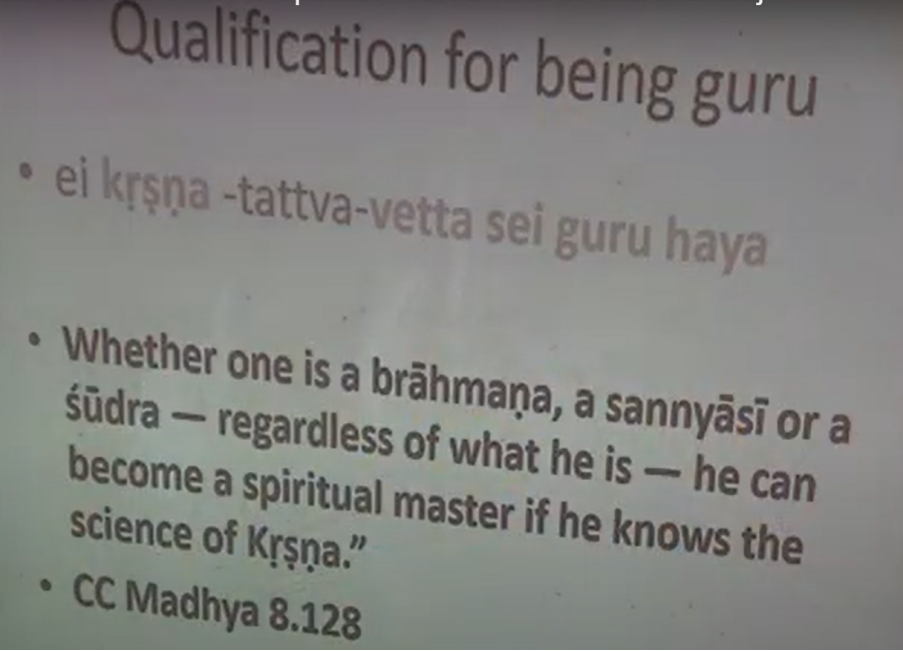
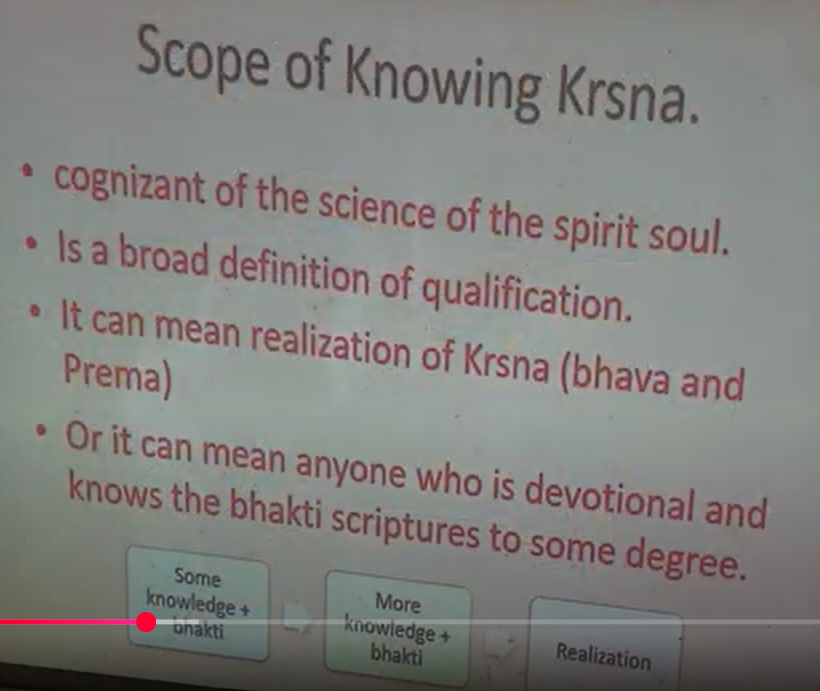
And of course, I think Prabhupada, in his explanation, says, to spread Krishna consciousness, one need only be cognizant of the science of the spirit soul. But again, that’s very general. What does that mean? How cognizant are we [Laughs], to become a Guru? So, we have, you know, a scope, a wide scope, when we say knowing Krishna, being Krishna conscious, etc. We have knowing a little bit, and maybe knowing the Bhagavad Gita. Then we have another level, knowing Bhagavad Gita and Bhagavatam, Nectar of Devotion, etc. Another level, then we maybe know other scriptures, maybe know the Sandarbhas. And then, of course, higher than that is realization. Who is realized? In other words, do you have Bhava or Prema? That could be another level of knowing Krishna. So we have a very general definition. It could include all of these. Obviously, then we would say, well, it’s better to have someone who is in Bhava or Prema, someone who has realized Krishna [Laughs]. But the definition is very broad, so we could include others as well.
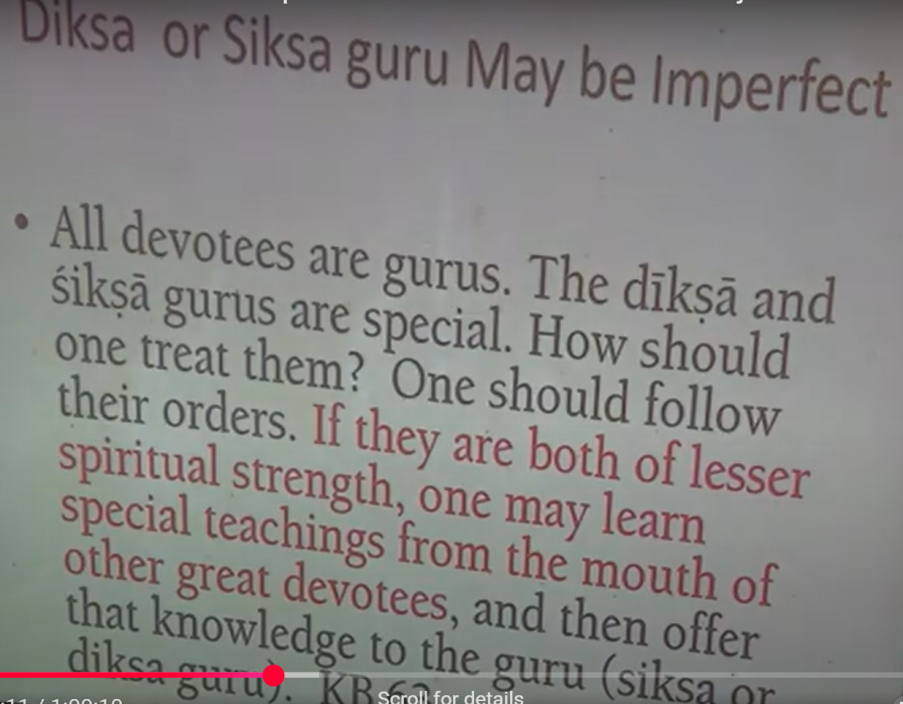
So, just to make it clear that the idea of Guru, whether Siksha or Diksha, can include not just the perfect stage of you know, Uttama adhikari or whatever, in Bhava or Prema. We have statements like in Krishna Bhajanamrita, that say that the Gurus may not be perfect, which means they are not on that stage of Bhava or Prema. So the Diksha and Siksha Gurus are special. How should one treat them? One should follow their orders. If they are both of lesser spiritual strength, which means they are not on the highest level, one may learn spiritual teaching from the mouth of other great devotees and then offer that knowledge to the Guru. So you give respect to your Guru, but you may find someone who is more advanced. So in other words, he is not at the highest level of Bhava or Prema or whatever.
And he also says the father, Guru or husband should be worshipped even if they do not have great qualities. So still, even if your Guru is not on that highest level and there are some faults in him, still give respect, because he has given you the mantra or he has given you some knowledge. So the respect is always should be due there.
Oh, this is from Bhakti Sandarbha. “If possible, those who desire excellence in Bhakti and surrender should particularly and constantly serve the lotus feet of Guru or Gurus who teach the scriptures about the Lord, who teach mantras about the Lord, that’s Siksha and Diksha. His or their mercy is the root of destruction of anarthas, difficult to give up by various methods and the root of receiving the greatest mercy of the Lord.”
So Jiva Goswami also stresses that somehow or other we have to give proper respect to our Gurus – Siksha and Diksha Gurus. And there is a very nice statement here in Srimad Bhagavatam. “One conquers Rajas and Tamas by predominance of Sattva. One conquers Sattva by being indifferent of the results of action. These are just in the gunas. One conquers all these obstacles quickly and easily by devotion to Guru.” [Laughs]. So we should accept a Guru, be devoted to a Guru and get rid of all of our problems.
But as I said, then we have these Gurus on different levels. They may be on the highest level of realization, some knowledge or more knowledge or whatever, more realization. So, it’s not so clearly defined in many places, but Bhaktivinoda Thakur gives a very interesting analysis. “Concerning the bestowal of devotional energy by the mercy of devotees, something should be mentioned. The power of prema-bhakti is unlimited and thus the prema-bhakta is the merciful and transfer his power to any type of person.” So one in prema can give prema. In other words, he can bring a person, no matter what background, to the highest level [Laughs].
So we have the example of Narada Muni giving mercy to the hunter who was completely unqualified, had no bhakti, had nothing. But he did develop, by contact with Narada Muni, he developed faith and he followed his instructions and he had bhava in three months. So great devotees have great power, natural.
And then Bhaktivinoda Thakur talks about a person who has bhava. “The bhava-bhakta being merciful can instill power in the sadhana-bhaktas, so they can assume a position similar to his own. So if they’re already doing sadhana, then bhava-bhakta can bring them up to bhava stage. And by the strength of the personality, the bhava-bhakta can raise materialistic people who are not doing sadhana at all, to the level of Ruci at least, raise other people up as well.”
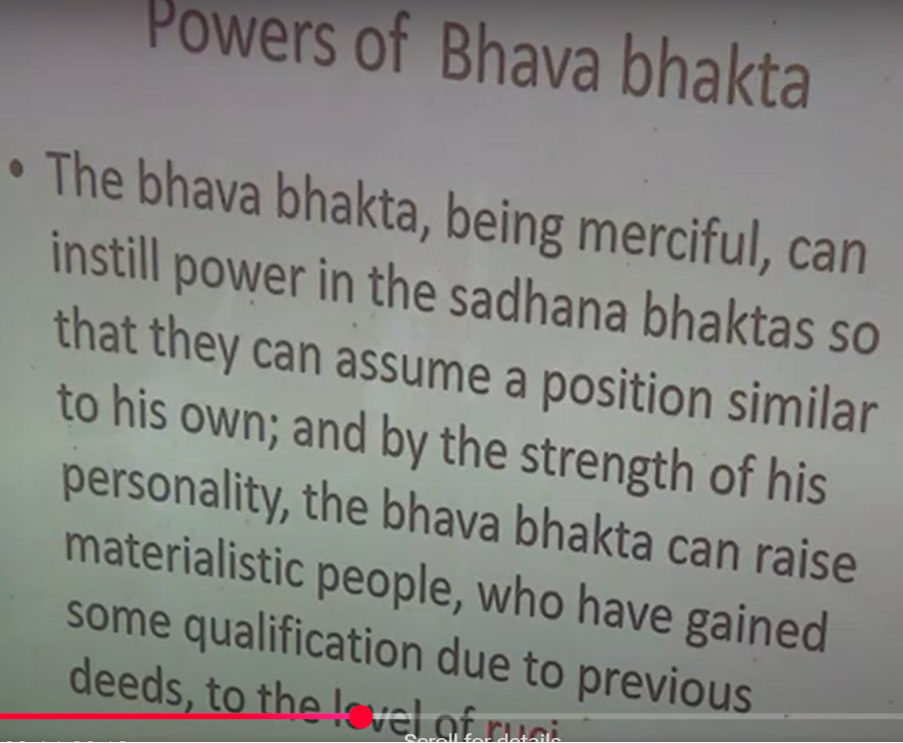
And Vaidhi and Raganuga sadhana-bhaktas can instill faith in materialistic people who have attained qualification of previous deeds. In other words, they have some faith, but they didn’t know their teachings and example. So in other words, if you’re doing sadhana-bhakti, either Vaidhi or Raganuga, by your teachings and example, you can raise people up to some degree. So we have three different types.
In Madhurya Kadambani of Vishvanatha Cakravarti Thakura, then he’s talking about bhakti in general and how devotees are the conduit of mercy of Krishna in the material world. Now Krishna can come directly as avatar or whatever, but usually He’s not available, maybe once in a yuga or something.
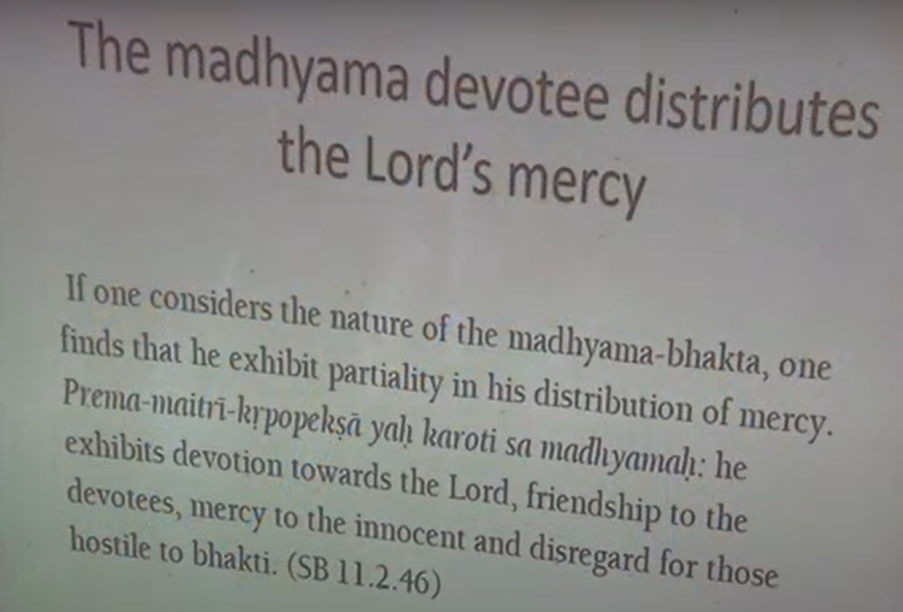
So in the meantime, He uses the devotees to distribute his mercy. So we have Krishna, and then we have the devotee. He becomes a conduit of mercy. So all devotees, in one sense, could be conduits of that mercy. And we know, of course, if they’re Uttama adhikaris in Prema, very good conduits, because they’re so advanced and no anarthas. So the mercy of the Lord flows very wonderfully. And we see that Bhaktivinoda Thakura says, one in Prema can give Prema [Laughs]. He gets that much mercy. That much mercy of Krishna is coming through directly. And those who are lesser, then to some degree, but less.
So there, Vishvanatha Cakravarti points out that the Madhyama adhikari is the one who makes distinctions and he wants to give mercy to the innocent people. He avoids the demons and he worships the Lord and he’s friendly with devotees. So he says this is the ideal person. The Uttamadhikari is very rare and he may not even give up mercy because he doesn’t even make distinctions.
So it’s the Madhyama adhikari who makes distinctions between this is a person who’s qualified for bhakti, this person is a demon, so I’m not going to preach to him, etc. So he is more common than the Uttama adhikari. So he’s the most common conduit of Krishna’s mercy, to give up mercy in the material world. So he’s giving it up like that.
So he’s like, in other words, we have copper wires. So copper wire is common, because it’s a good conductor, but it’s not too expensive. That’s like the Madhyama adhikari. If we want a real good conductor, we may have silver or gold, but obviously nobody’s going to have gold wires in their house or silver wires in their house [Laughs]. It’s too expensive. But it’s a very good conductor, definitely. Maybe your electricity bill will be less or something. But we don’t use it because it’s not practical. So the Uttama adhikari is there, but he’s rare and he may not even give you mercy, because he’s often in his trance or whatever. So generally it’s the Madhyama adhikaris who are giving out the mercy. He may not be perfect, but at least it’s coming through. So we have to give them a respect. So therefore, He gives his Kripa Shakti, the Lord himself gives his Kripa Shakti to all his devotees, but particularly goes through the Madhyama.
The Kanistha actually is possible, but generally the Kanistha doesn’t even want to preach because he doesn’t even recognize the devotees. He doesn’t have enough knowledge. So it doesn’t really act as a good conduit at all. Maybe it’s like an iron wire or something [Laughs]. Okay, so thus the Madhyama devotee is the one who is the regular conveyor of the Lord’s mercy in this material world like that.
And the devotee is not actually doing anything on his own. It’s because of Krishna. But Lord Krishna gives independence to the devotee to distribute His mercy, that’s Krishna’s mercy, as that devotee pleases. So he says, okay, you give out the mercy as you like. I’m not going to tell you what to do. So that’s the mercy of Krishna. He gives it to that devotee and says, you give it out as you like. So therefore, these persons are the regular preachers, Gurus, etc. in the material world, the Madhyama devotees.
There’s an interesting concept in Nectar of Devotion also because we have the idea of an uttama. Now the regular definition of uttama adhikari in Bhagavatam in the 11th canto is one who has bhava or prema and sees the Lord everywhere, doesn’t make distinctions, and sees everything as Krishna’s mercy. So that’s a very exalted state. So everyone has to be an uttama adhikari to be a Guru.
But there’s another uttama mentioned in Nectar of Devotion and that is one who’s doing vaidhi sadhana bhakti. He can be an uttama, because of his great proficiency in scripture and logic and his firm conviction. So he’s considered uttama in sadhana bhakti itself because he can convince people nicely and he has good knowledge. So this is another type of uttama which may correspond to what Prabhupada says in Nectar of Instruction where he talks about, okay, this person is a Vaishnava (audio not clear) – uttama adhikari because he has chanted sixteen rounds following regular principles, he knows the scripture, etc. So he’s got proficiency in bhakti so we can call him uttama.
So that’s more or less corresponding to this definition of an uttama in Nectar of Devotion. Okay, so, in this way these types of devotees are the ones who are giving out the knowledge. And in Caitanya Caritamrita also we see a similar type of statement.
There are two kinds of instructing spiritual masters. One is a liberated person, fully absorbed in meditation, devotional. Other is he who invokes disciples’ spiritual consciousness by means of relevant instructions. So it’s not that all Gurus have to be on the highest level. We have another level of Gurus, not in Prema, but he’s giving instructions to people. Okay, so because we do have different levels of Gurus, then the respect also is going to be different.
They’re all non-different from God, because they all got Krishna’s mercy and they’re all distributing that mercy. So in that sense they’re all non-different. But we do have some are better conductors than others. Some are on a higher level than others. So accordingly we have to give different levels of respect. So the superior Guru gets more respect and the lesser Guru gets less respect. This is all obvious also. Yeah. Okay.
So, we see that I pointed out that the Madhyama devotees are the ones who are usually giving out the mercy in the material world. They could be on various levels. They could be on Anartha Nivrtti, they could be Nishtha, Ruci, or Asakti. So but according to their level of advancement, we’re going to give different levels of respect.
Prabhupada gives this example. The bona fide Guru is the postman delivering a message. He doesn’t open the mail and write his own opinion. So you’re just delivering the message of Krishna. So in other words we are a transparent via media. Prabhupada says in one place. That we are the ideal person, a devotee because we’re giving the message exactly as it is without distorting the message at all. So we’re good conductors of Krishna’s mercy.
Okay. And so as Bhaktivinoda Thakura said that the persons in Raganuga or Vaidhi Sadhana can instill faith in materialistic people by giving their teachings and example. So this is an example of a person who’s not on the highest level but he can be a Guru because he’s giving proper instructions.
So they’re non-different from the Lord because they’re giving out the mercy of Krishna. The instructions of the Lord are non-different from Krishna also. And Prabhupada mentions that in many places. But nevertheless, according to the level, we have to give different respect.
In Krishna Bhajanamrta, the example is given. Father is like the Guru. So you worship your father as God. But his older and younger brothers are also worshiped like God. They’re also Gurus. But the father of one’s father, that is our grandfather, great relative, is worthy of greater respect. He’s also Guru but he has double the worship of the father. In other words, the person on the higher level gets much more respect.
So in our movement, coming back to our movement, we have Prabhupada. He’s the grandfather of Gurus, so he gets the most respect. And we can’t interfere with that. We can’t put everybody else up on the same level. So the problem in ISKCON is that we identify people as Gurus and then they get a name, a Diksha Guru in ISKCON. And then somehow, they get that status of non-different from God and that becomes the highest level. They automatically attain the highest level.
Though, technically, we should just say they are giving the teachings, in that sense they are Guru. Not because they are non-different and therefore they have prema suddenly. Simply because they’re called Diksha Guru they’re on the highest level of prema. It doesn’t make sense. In other words, we should be practical and see the level of our devotees and accordingly give respect. Everybody has to be given respect. We’re giving respect according to the position.
So we should recognize even our Gurus and put them on a madhyama level or a postman level. Yeah. So, the reason I’m bringing all of this up is because ISKCON has had problems. And one of the big problems is Diksha Gurus [Laughs]. But not so much a Siksha Guru as a Diksha Guru. What we call the Diksha Guru in ISKCON. Not technically a Diksha Guru in scripture but what we call Diksha Guru in ISKCON. We had many fall downs and that caused huge disruption throughout Europe and America and other places. Even India, Yeah. Major problems. And then book distribution goes down. Devotees leave, etc., etc., etc. It was a big catastrophe that takes 20 years to recover from, because of the idea of who your Guru is.
So, if we have this idea my Guru is up there and he’s a perfect person and we worship him like God to an extreme, then we’re going to get some very big problems like this when the Guru falls we have a really big crisis of faith. We get groupism based on loyalty to Diksha Guru and this, of course, disrupts the harmony of ISKCON. We got, you know, our managerial system the Prabhupada set up and you’re supposed to follow that system yet we have loyalty to the Guru separately and then the disciples don’t listen to the authorities they listen to the Guru instead. So we get competition there. We have canvassing for disciples. Having more disciples is a better Guru or something, that’s the idea [Laughs], which doesn’t really work as a quote to that later on. Gurus become competition to the managerial structure as I said and then Prabhupada’s position is minimized. So we get whole different groups coming up independent of the structure of ISKCON itself and it can cause a lot of problems.
So we got Krishna, yes, we’re going to do that, but even any perfect Jiva is not going to Krishna, yes, we’re going to do that but even any perfect Jiva is not going to claim that I know everything and I can give you all advice on everything. But somehow the disciples, because Guru is God, they project all of this upon him and they don’t listen to anybody else. So this is not very healthy.
We get an artificial projection of perfection to the Guru and it’s unhealthy for the disciple to have this type of artificial respect and artificial position. It’s a false expectation. It’s also not good for the Guru because then he gets to believe that also.
And then the whole idea is that because of this high position given to the Guru, the Guru gets such following, then the Guru gets money, a Guru gets position, a Guru gets power, the position of Guru becomes, to attain that position becomes a goal. But it’s a materialistic goal. So the success in ISKCON will be to become a Diksha Guru. Huh? That’s success. Why? Because I got power, I got followers, I got money and whatever. So this is a complete disruption of the process of Bhakti [Laughs]. So in the Nectar of Devotion itself, Rupa Goswami actually mentions this when he’s discussing in the beginning. He says, “If our Bhakti depends on being a Diksha Guru, we should be aware of the following”.
And so he says “Bhakti which is accomplished by dependence on wealth, followers or objects cannot be considered as an anga of Uttama Bhakti because it destroys the pure nature of Bhakti situated far from Uttama Bhakti”. So if we’re attached to making disciples or whatever, then this is a sign that it’s not proper Bhakti. Now definitely we want to increase the number of devotees, etc. But simply if you attach to the devotees or the followers because as a Guru you can make all these devotees, that becomes an Anartha. And therefore it’s not spiritual at all.
So therefore, this whole idea about Diksha Guru being God, etc., it comes from scripture of course, as I said. We have scripture like this [Laughs]. Disciples can always quote this, I’m just following scripture. Guru is like God and of course every day we’re singing in Mangala aarti [Laughs], ‘Sakshad Haritvena’. Guru is non-different from God and so therefore they’ll take this literally. That’s true. These are true statements. And we can never deny them. But we do have to understand scripture. We have to look at all the scriptural statements, we have to look at the explanations of the Acharyas to come to a proper conclusion.
So that’s what I tried to do here. I gave the statements, but I said there’s this statement here, this statement here, there’s levels of Guru, there’s levels of respect. So yeah, you can respect your Guru as God, but even that being like God has various levels to it. And accordingly, we have to, for a healthy advancement, see the Guru in the proper place, not artificially project him on a higher level.
So in other words, we can do that, worship Guru nicely, but it has to be also moderated according to the level. Now the GBC has already recognized some of this problem. We wrote a paper, ‘Parallel lines of authority’ long ago. It’s also part of the curriculum I think for the disciples. Somehow it doesn’t sink in spite of that [Laughs]. So the GBC also passed a few later resolutions on this. So we do understand if the problem is there and statements have been made, but somehow the message does not sink in.
So maybe we have to make a more explicit statement that all of our Gurus, anyone who takes that title of Guru, whatever, not only doesn’t imply, but we’re not claiming, and nobody should claim, that they are on a higher level than they are. They’re on a certain level, somewhere in the madhyama category because they’re teaching, etc., but we’re like the postman, that’s all. And because we are loyal postman, we get respected, we get worshiped, but we don’t get the same worship as Prabhupada, we don’t get the same worship as Krishna.
Some of this, of course, is kind of a result of how the devotees were so enthusiastic about Prabhupada when he was present, and so we would worship him with everything we had, because he was on a very high level and we have Vyasa Puja books and Guru Puja ceremonies, Vyasa Puja ceremonies, etc., etc., so many things. So it’s natural that we just want to copy everything for all the Gurus, but this is not a logical conclusion [Laughs]. Then we simply copy everything. Some things maybe we can copy, some things we should not copy. So therefore this idea about the worship, we have to moderate it. That’s the whole idea. And not only moderate, we have to moderate our concept of who our Guru is. So we can’t have artificial expectations. So, the Guru is worshipped because he delivers spiritual knowledge in the form of scripture as a Diksha Guru, and he gives the Diksha mantra as a Diksha Guru.
That’s enough to get the worship, because he’s a bona fide Vaishnava. In that sense, he’s the saviour of disciple, but actually he’s only assistant. He’s like the postman. He’s the assistant to the prime saviour, and that’s Srila Prabhupada in our movement. So, we should not assume simply by getting the title Diksha Guru, suddenly we assume special powers to deliver people. No. That’s an illusion. So we should give up that type of concept. Okay.
Fine. Great. Okay.
Q&A
1) In ISKCON, Shiksha, generally that means advice on missionary issues like my service or problems I’m facing. Is it correct to assume prior to, let’s say, Bhakti Siddhanta Saraswati Thakur, our acharyas have written about Shiksha and Shiksha Guru can we assume that, that is more specifically related to scriptural study?
Yes. I think mainly it’s scriptural. Like we have someone like Ramanujacharya had, I think, 15 Shiksha Gurus [Laughs]. So it’s because they taught different areas of knowledge, scriptural knowledge on different things, like one would teach the Tamil Veda, one would teach logic, one would teach something like that. So when we say Shiksha mainly, and what Jiva Goswami uses the term in Bhakti Sandarbha, he’s giving Shiksha on method of worship [Laughs], not something on how to deal with your family.
In fact, generally probably the Gurus would avoid that as much as possible and just do, you know, leave that to other people [Laughs] to give advice on other things and just give the scriptural things, whether it’s mantra or scriptural knowledge. So Shiksha would mean more just teaching scriptures – Bhakti scriptures.
2) Hare Krishna Maharaj, so this is specifically with respect to.. In early 90s, you were authorized to become an initiating Guru, but you have refrained from doing that. So what would be your reasons for doing that and number two, do you plan to initiate in future?
Well, one is the reason, the thing is that the idea of what a Diksha Guru was unclear, by followers or disciples, when they artificially project things upon the Guru which are not true. The other is probably in ISKCON itself in general, maybe in the GBC itself, the idea or the function of the Guru is a little unclear [Laughs]…. what they’re doing. So if we give an exact statement like you’re only the postman, that’s all you’re doing, it would be very clear.
Now that actually is done in other Sampradayas like Madhva Sampradaya. They say actually okay, we have our Gurus, what are they doing? And even they’re no fault, they’re pretty you know, strict in their sadhana, they know all the scriptures and they know all Madhva’s commentaries, etc. But we’re not doing anything really. We’re just assistants. We’re not the deliverer. We leave it up to our founder Madhvacharya, let him deliver and we’re just kind of helping and bringing people like that. And the same in the Ramanuja Sampradaya. They’re simply assistants, that’s all. And they make an explicit statement like that. So there’s never any competition for the founder.
3) Hare Krishna, you mentioned that a Sikhsa Guru can give first initiation and still not be the Diksha Guru. And you also mentioned that the Diksha Guru gives a private mantra. So in our case, Srila Prabhupada gave his Diksha Mantra and people use it pretty openly.
So it’s a two-part question that a Sikhsa Guru can give first initiation and not be qualified as a Diksha Guru. But these Guru mantras have become like not private.
Well, it’s a little sticky area [Laughs]….
Technically, of course, what we call first initiation, it’s not the essence of initiation, because you’re not getting that mantra by which you’re qualified to worship the deity. So in that sense, it’s pretty clear. We say only when you get second initiation you worship the deity. So that the Diksha mantra is there to worship the deity. So in that sense, we say, okay, that’s Diksha. But then we say first initiation is also a Diksha. So this makes it a little more complicated.
So it’s Diksha in a little bit of a sense because you get a name. Krishnadas or whatever. And Krishnadas or getting a name is part of what we call Panchasamskara which is, we can say, Pancharatrik, part of Pancharatrik initiation. You get a name, you get Tilak, you get branded, you get the mantra, you get the name, Krishnadas, and then you do worship. So five samskaras are there. So we’re getting the name. So in a sense, it’s part of initiation in the Pancharatrik sense. But if you didn’t get the mantra, you wouldn’t be qualified to worship the deity. So therefore, it’s not the main part of the Diksha. So it’s like Diksha part one, we can say. In that sense.
But we are taking vows and doing so many things. So in one sense, it’s kind of like a formal Siksha ceremony in a sense also. And we’re vowing to chant sixteen rounds at that time. So it’s kind of like a Siksha ceremony.
There is the problem, okay, we want to make Siksha Guru equal to Diksha Guru in ISKCON. And of course we say that, and it’s in the scriptures like Chaitanya caritamrita, but it’s very kind of difficult to do because we don’t have a formal process of recognizing a Siksha Guru whereas we do have for a Diksha Guru.
So, a proposal could be there that you could have a similar ceremony [Laughs], as first initiation without giving the name and it would be a Siksha Guru [Laughs]. Which would be bona fide in one sense because there is no scriptural vidhi or rules on how to become a Siksha Guru. There is nothing there. But you could have a formal ceremony of some sort of vows and whatever you want to do. You could do without the name [Laughs].
4) Hare Krishna, So, Maharaj, as you say that the Diksha Guru is just someone who is a postman and just giving us the…
HH Bhanu Swami Maharaj: Even the Siksha Guru is [Laughs].
Devotee: Yeah. Now, we are saying, okay, you re-deliverance as Prabhupada, this is what the Ritviks are saying. This is the same thing that the Ritviks are saying.
HH Bhanu Swami Maharaj: No, no. There is something something different.
Devotee: Why? Do they say the same thing?
HH Bhanu Swami Maharaj: So, no. What the Ritviks say is you get your Diksha Mantra from Prabhupada.The Diksha Mantra, second initiation comes from Prabhupada. That’s what they are saying. And so they play a tape. And Prabhupada gives you the Diksha Mantra. So he is your Diksha Guru. So I’m not saying that.
Devotee: But if the Diksha Guru cannot deliver someone and only Prabhupada is the deliverer, I don’t see any difference.
HH Bhanu Swami Maharaj: Well, I think it may be a little shocking to us to say that, okay, Prabhupada is delivering and we are not doing anything or whatever, but this would actually be the attitude of a true devotee. That we are powerless. We are nothing. We are just a servant of the servant of the servant of the servant. We can’t do anything. Isn’t it [Laughs] ? And as I said, ultimately, even the person who is elevated in Prema, he is also not, he doesn’t consider himself doing anything because that’s Krishna doing everything, ultimately. It’s Krishna’s power acting through him. So in a sense, we are all like little puppets for Krishna [Laughs]. So in that sense, of course, the postman idea is, Prabhupada gave that example [Laughs]. Just the postman. And Prabhupada says about himself, I’m just the postman.
Devotee: The Guru has to be transparent. It’s the link up.
HH Bhanu Swami Maharaj: To be a good postman, you have to be qualified also. You have to be transparent via media. So you have to have sincerity, devotion, whatever. Loyalty, whatever.
5) Hare Krishna Maharaj. You brought up this interesting point that in the Nectar of Devotion, it speaks about Uttama as a sadhaka also. So I had been perplexed because in the Nectar of Instruction, and it finally seems to have been resolved now, but still I have a question. In the Nectar of Instruction purport where Srila Prabhupada speaks about Diksha, sorry, initiation, the first part of the purport, he seems to be referring to someone performing sadhana strictly and referring to him as Uttama.
But towards the end of the purport, where he speaks about Uttama Guru and the Madhyama Guru and the Kanishta Guru, there he seems to be directly deriving from Srila Bhaktisiddhanta Saraswati Thakur where he speaks about a fully self-realized Uttama.
HH Bhanu Swami Maharaj: Which is also there in Bhagavatam in the Eleventh Canto definition of Uttama.
Devotee: So what is that purport finally referring to then? Because in the initial stages he’s referring to Uttama.
HH Bhanu Swami Maharaj: Well, that makes a controversy that we don’t really know because it’s taking two different concepts of Uttama there.
Devotee: Thank you.
6) Hare Krishna Maharaj, I wanted to ask if you could kindly discuss further this concept of Guru as postman. Because this seems to be a central area that ISKCON is not digesting. You mentioned earlier that GBC has passed a number of initiatives. But this Guru as postman, it seems challenging to digest.
Okay. Yes [Laughs]. Well, Prabhupada made the statement…..[Laughs]. He said it about himself. Now there is, I think there was because with the Ritviks there was a meeting once and they were presenting this idea that, you know, Prabhupada’s deliverer were not the deliverer, etc. So then the counter argument based on that, I think a little paper was written actually to say, ‘Who is the deliverer?’.
And the conclusion was everybody is the deliverer. Which is also true because your Shiksha Guru, your Diksha Guru, Prabhupada, Harinam, scripture, Krishna, they’re all contributing definitely like that. But at the same time, just for let’s say, reality’s sake [Laughs], we should place ourselves in a humble position [Laughs], and say I’m only the conveyor of the message, basically like that as the postman. I don’t open the envelope and start changing the message or whatever like that. So that’s the basic function. And as I said, the parampara we have, Shiksha, they’re passing on the same message of Bhagavatam to the present day without distorting it. That’s what we’re doing.
Devotee: And that can be done by a Madhyama Adhikari.
HH Bhanu Swami Maharaj: Yeah, as Vishwanath Chakravarti says, the Madhyam is the main person who is giving out mercy on the world. The common person.
Devotee: So you’re sharing with us that we should have the understanding that most if not all of our current ISKCON Gurus are most likely on the Madhyam Adhikari platform.
HH Bhanu Swami Maharaj: Yeah, and we’re postmen. [Laughs]
7) So what are the obstacles in the hearts of disciples that cause some of us to find the idea that our Diksha Gurus are possibly not less than Uttama Adhikaris?
HH Bhanu Swami Maharaj: What makes them think they are or not?
Devotee: Yeah, what are the obstacles in our hearts? Because many of us were fixed in this idea of my Guru is an Uttama Adhikari.
HH Bhanu Swami Maharaj: And if I take a Guru, he’ll be the highest. So it’s kind of natural that if we’re going to accept a Guru and take him as an absolute authority, then we want to put him on the highest level. So that’s there. And he may be also. But at the same time, we have to be a little bit realistic and go by scripture and see who is an Uttama, what are his characteristics, who is on Bhava, who is on Sadhana, etc.
And also the Guru himself, what does he claim? Is he claiming he’s got Prema? Is he claiming he’s seeing Krishna directly every day? Or whatever…or is he just saying, I’m doing Sadhana? So we do have to have a little bit of reality also in our respect. So that’s what I’m trying to present. We respect, because they are doing the service to Krishna, being the medium for Krishna’s mercy. And we have to respect everybody for that. At the same time, we can’t artificially project as a disciple. We shouldn’t artificially project at a certain level.
So just to make it so the disciple doesn’t feel guilty about it, maybe we do have to make a GBC statement so that they’re protected. Okay, I’m just following the GBC. My Guru is on this level. Okay, fine. It’s not my fault. It’s the GBC’s fault if they make a statement [Laughs].
8) Hare Krishna Maharaj. Thank you for the nice presentation. My question is in regards to the deliverer situation. Couldn’t we say that ultimately Krishna is the deliverer?
HH Bhanu Swami Maharaj: Yeah, that was the conclusion of the paper also.
Devotee: By the logic that Srila Prabhupada is the deliverer, we can say Srila Bhakti Siddhanta is the deliverer, Bhakti Vinod Thakur. So Krishna is delivering us through the scriptures, through the Guru, through the Mahamantra, through prasadam, through so many things right?
HH Bhanu Swami Maharaj: So ultimately it’s Krishna. As I said, the Madhyama adhikari is simply the medium of Krishna’s mercy. Krishna is ultimately delivering through the Madhyama adhikari, etc. But within the hierarchy of worship within our Sampradaya and within ISKCON, then we’ll more or less go to the more direct person, that would be Srila Prabhupada.
9) Hare Krishna Maharaj. Thank you for the wonderful class. Maharaj, my question was like my understanding, like I’m a neophyte, so I feel that you gave a wonderful class, but as a disciple we feel like we need to give all the respects and all our loyalty to our both Shiksha Guru and the Diksha Guru.
But at the same time when you spoke about that it might affect you know like developing false expectations and with respect to the Guru, when it is seen like that. So how do we know like at the same time we are giving all our respect and loyalty to the Guru, but not affecting ISKCON in a positive way.
Yes, so this is our dilemma of course, we say I’m giving all my respect to the Diksha Guru, how can I respect anybody else or whatever, but as I said here the idea was that you respect your father and the father’s brothers and you give more respect to the grandfather.
So respecting everybody, but we have different types of respect we are giving. So within ISKCON, yes, we should never restrict the devotion of disciple to a Guru, but it has to be within certain bounds, there has to be some moderation of that because we are living in a society which has many Gurus and we do have a managerial structure also. So if you simply put all of your faith in Guru and follow only his orders then this would be the cause of disruption, because if the Guru gives you instructions on where to preach and how to preach, whatever, but the managers of ISKCON say no, don’t do that, you are going to have a conflict. So we do have to adjust our idea of absolutely following Guru to accommodate the rules of ISKCON and also as I said the reality of the level of our Gurus.
Devotee: Hare Krishna, Thank you everybody !