Brhad Bhagavatamrta -3| HH Bhanu swami Maharaj | ISKCON Japan | 6th Dec 2017
jaya rādhā-mādhava kuñja-vihārī
gopījana-vallabha giri-vara-dhārī
yaśodā-nandana vraja-jana-rañjana
yamunā-tīra-vana-cārī
Hare Kṛṣṇa Hare Kṛṣṇa Kṛṣṇa Kṛṣṇa Hare Hare
Hare Rāma Hare Rāma Rāma Rāma Hare Hare
Jaya Prabhupāda Jaya Prabhupāda
Prabhupāda Jaya Prabhupāda
nama oṁ viṣṇu-pādāya kṛṣṇa-preṣṭhāya bhū-tale
śrīmate bhaktivedānta-svāmin iti nāmine
namas te sārasvate deve gaura-vāṇī-pracāriṇe
nirviśeṣa-śūnyavādi-pāścātya-deśa-tāriṇe
jaya śrī-kṛṣṇa-caitanya prabhu-nityānanda
śrī-advaita gadādhara śrīvāsādi-gaura-bhakta-vṛnda
Hare Kṛṣṇa Hare Kṛṣṇa Kṛṣṇa Kṛṣṇa Hare Hare
Hare Rāma Hare Rāma Rāma Rāma Hare Hare
HH Bhanu Swami Maharaj: Hare Krishna. [Conversation aside]. So, this whole story is a conversation between Jaimini and Janmejaya, and within that we have, Pariksit speaking to his mother. So, first of all, Uttara asked Parikshit what’s the essence of everything? And then Pariksit replied by telling the story of Narada Muni and how Narada Muni searched out everywhere for who is the highest recipient of mercy [Laughs]. So, it was concluded that the Gopis of Vrindavan were the greatest recipients of Krishna’s mercy.
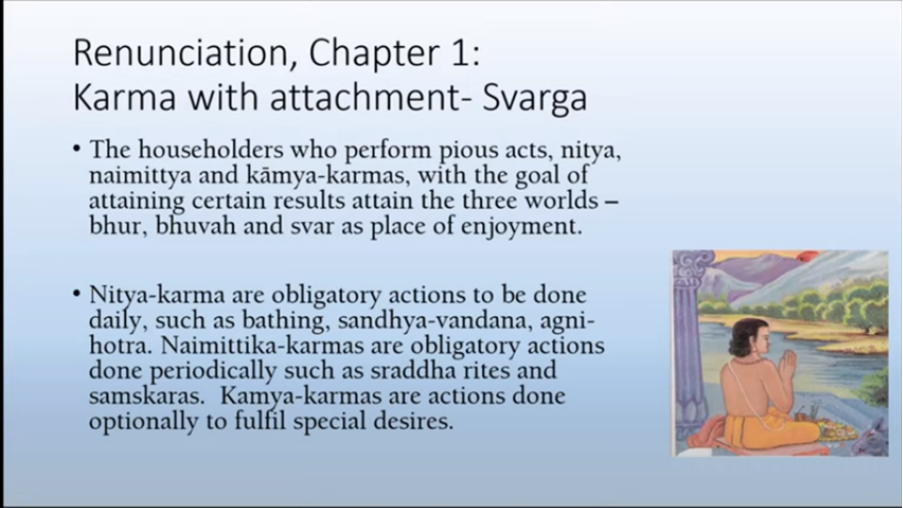
So, now another story begins. This is the second part of Brhad Bhagavatamrta. The first one was called Finding Out the Essence, and this one is called Glories of Goloka. So, now Uttara begins to ask Pariksit another question, but first she gives a long explanation [Laughs] that lead up to her question. So, she starts by describing regular dharma, where householders do pious acts and nitya, naimittika and kamya karmas, and then they get results of going to Bhuvar and Svargaloka, etc, for enjoyment.
- Nitya Karma : So, as part of the varnashram system, there are what are called nitya karmas, or activities that one must do every day. Nitya means daily. So, these daily activities are obligatory actions that you do daily. I think bathing using mantras, doing sandhya vandana, that is, you recite your Gayatri mantra with introductory prayers and then closing prayers, fire sacrifices, etc. These are daily activities that a brahmana especially should do.
- Naimittika Karma : And naimittika karmas refers to periodic activities. They’re not done everyday, but sometimes may be a few months once, you do one of these activities, such as shraddha rites and samskaras.
- Kamya Karma : And then we have kamya karmas, which means we do certain activities to fulfill specific desires. For instance, if you want to have children, then you do some specific sacrifices and vratas, etc, for that. So, the normal householder follows dharma with desire to get some elevation and go to Svargaloka.
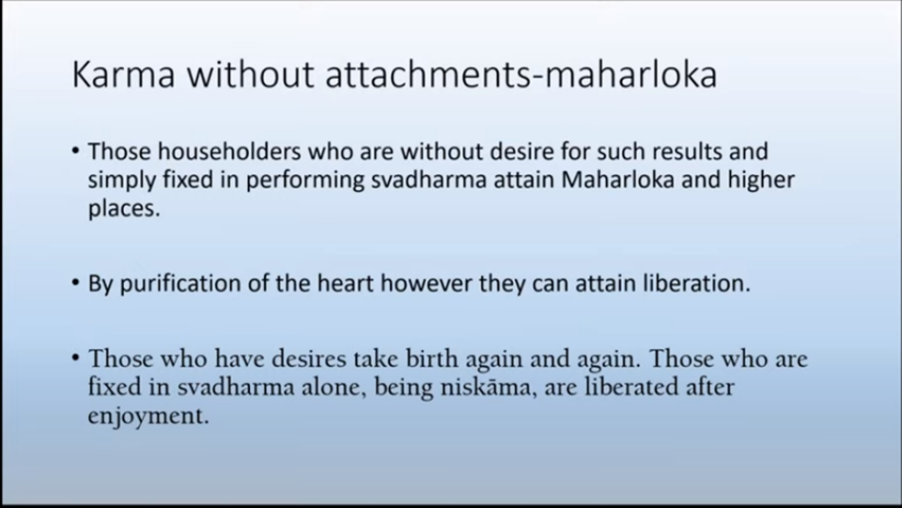
If the householder becomes very detached and does not want those results, but he simply does activities as part of duty as svadharma, then he goes beyond Svargaloka. He can go to Maharloka and Janaloka. And if they purify themselves further, then they can get liberation. So, those with desires take birth again and again. Those that start niskama and stop the desires, then eventually they get liberated.
So, those with desires may go to Svargaloka, and then if you start getting more purified, you go to Maharloka, Janaloka, Tapaloka, Satyaloka, and if you are completely pure, then you can get moksha, liberation.
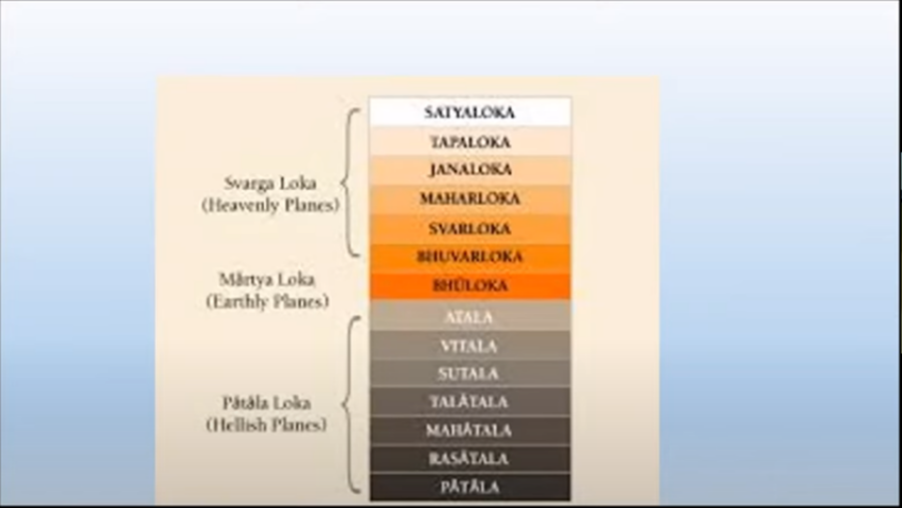
And if one is brahmachari, vanaprastha and sannyasi, then because they are all detached, they don’t have any desires for Svargaloka etc, they can go to Maharloka, Janaloka, Tapaloka, Satyaloka.
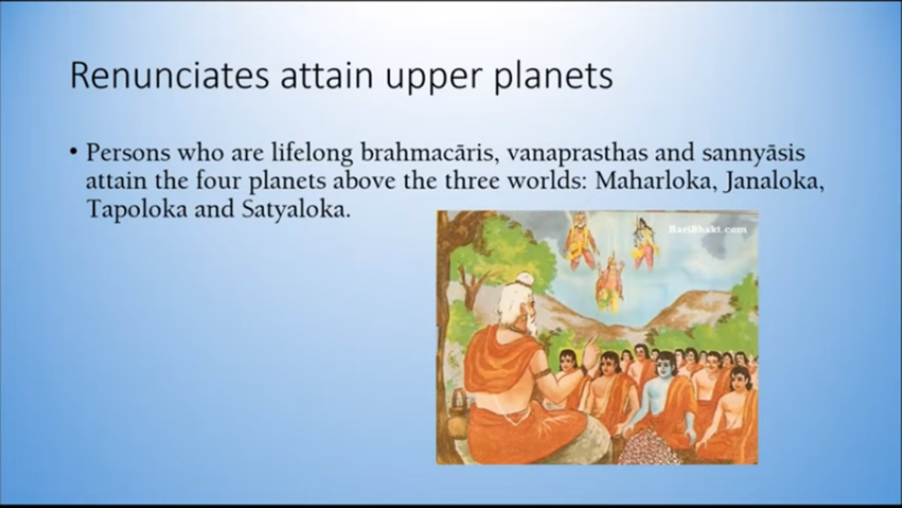
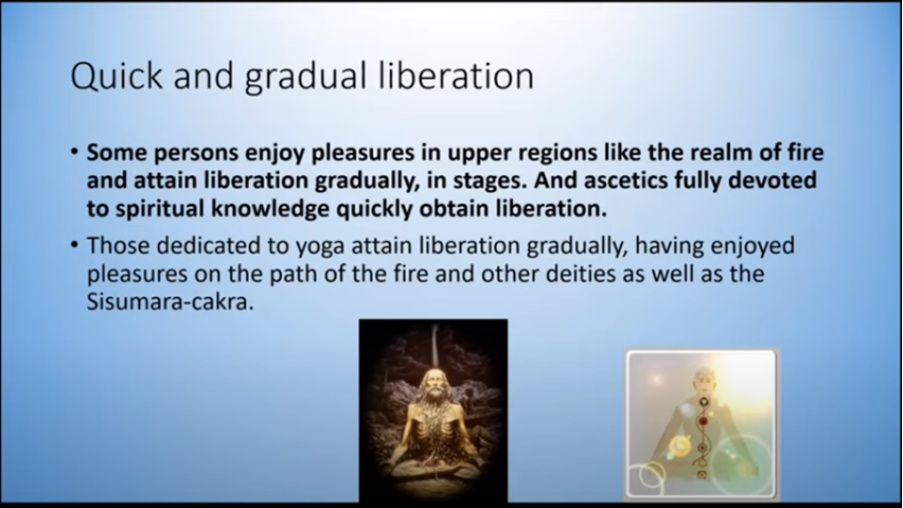
So, you can actually get liberation in two ways. You can go a gradual process or a quick process. So, the gradual process is used by many yogis, and they go through upper planetary systems gradually, they get a little enjoyment in these places, etc, and finally they get liberation. Other persons who are completely renounced, and completely dedicated to spiritual life, can get quicker liberation.
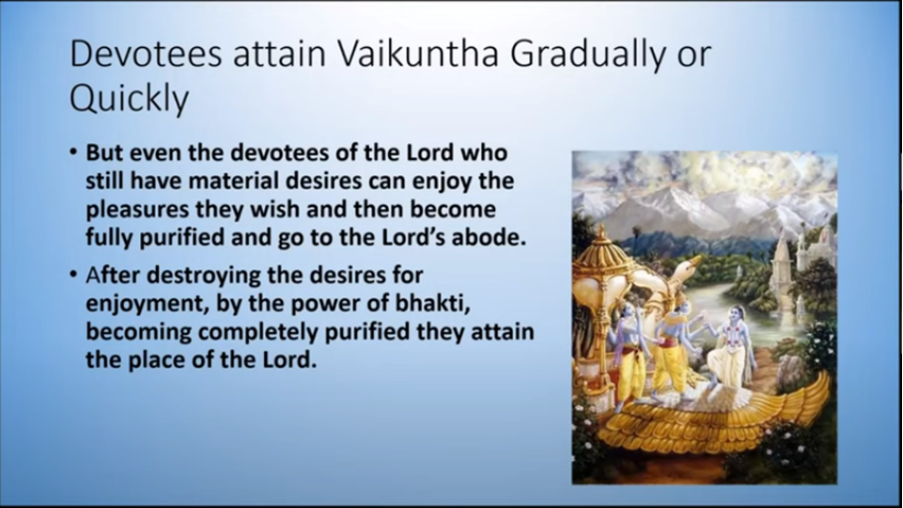
Similarly, devotees may have desires also, material desires, so they can also gradually elevate [Laughs] in different planetary systems, and then go to the Lord’s abode in Vaikuntha. If they practice pure bhakti, then they can go very, very quickly.
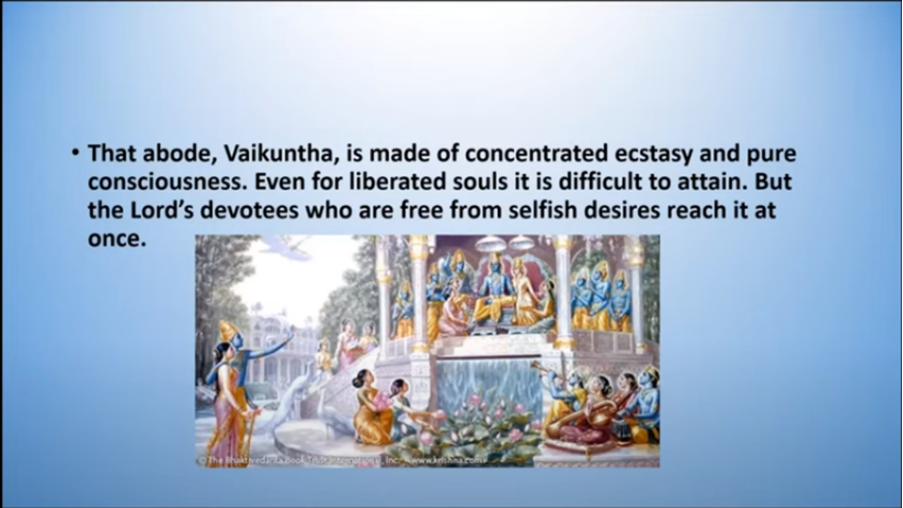
So, even liberated souls have difficulty going to Vaikuntha, but devotees get there very easily.
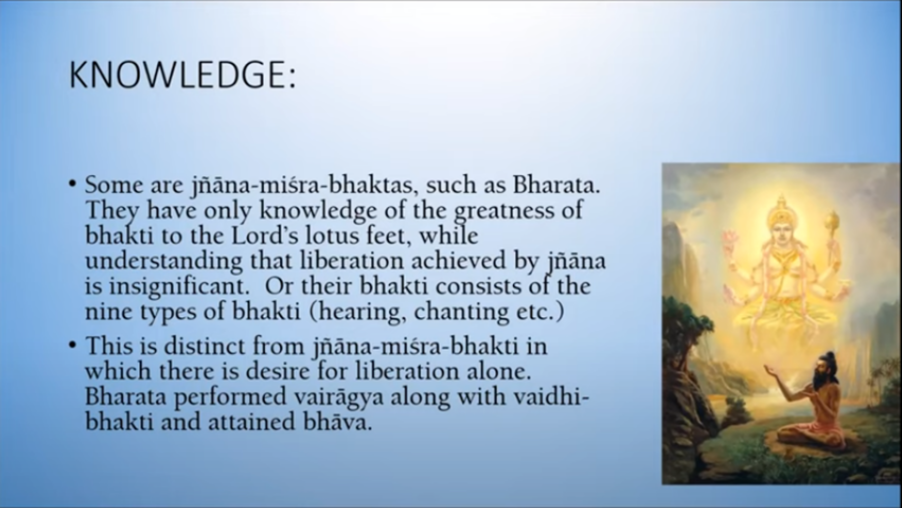
So, Uttara begins to describe different types of devotees. There are some devotees who are attached to knowledge, so a little bit of jnana is mixed with their bhakti.
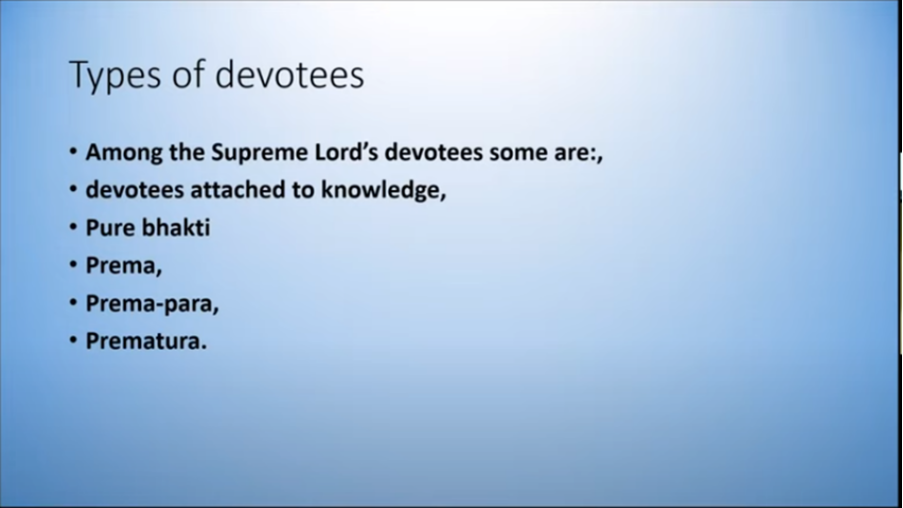
So, he gives an example like Bharat, on austerities, etc. So, they don’t desire just mukti and merging in Brahman, they want the Lord, but there’s a little bit of jnana mixed in their bhakti.
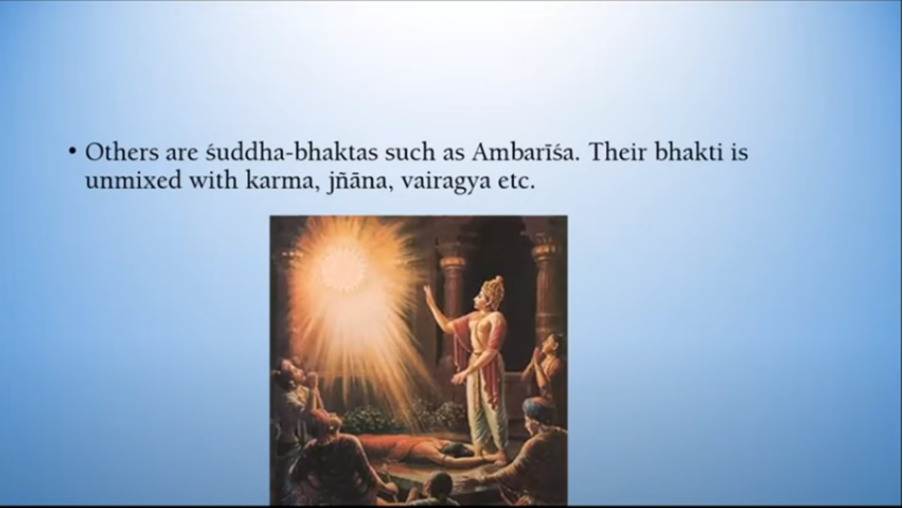
Then we have persons who do unmixed bhakti, pure suddha bhakti like Ambarish.
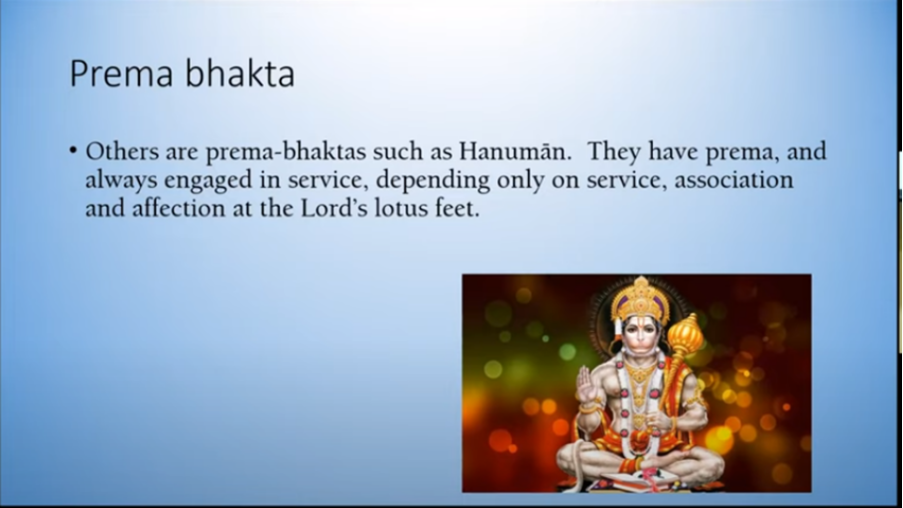
Then we have prema bhaktas like Hanuman, who have attained a very high state of prema. And they’re always engaged in service to the Lord.
Then we get devotees called prema-para devotees, who have a more intimate relationship to the Lord, like Arjuna with Krishna, or the Pandavas with Krishna. So, this is prema with some intimacy and basically it’s with Krishna.
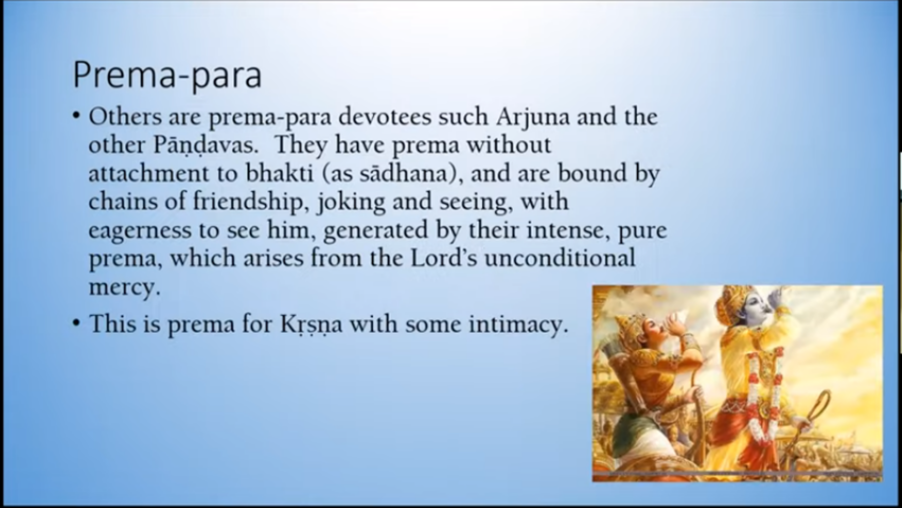
And above this, we’ve got the prema-atura bhaktas, who are very intimate with the Lord, and are constantly with the Lord, like Uddhava and the Yadavas.
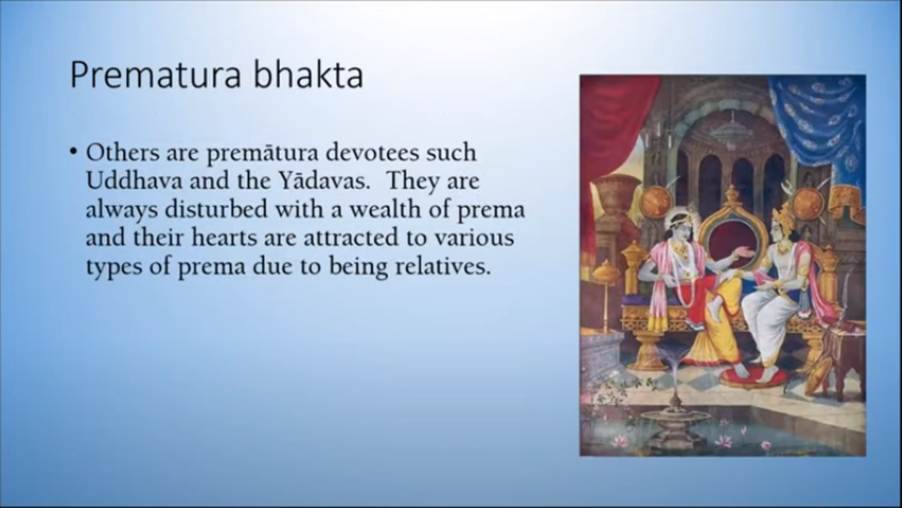
So, we have various levels of devotees, so they don’t all get the same result. According to their type of bhakti and prema, they get different results. At the same time, if they get to Vaikuntha, there’s no real hierarchy of higher and lower, they more or less, they feel equal.
What happens to the devotees of Krishna, who have very, very strong bhakti and they only want to be servants of Radha. What happens to them?
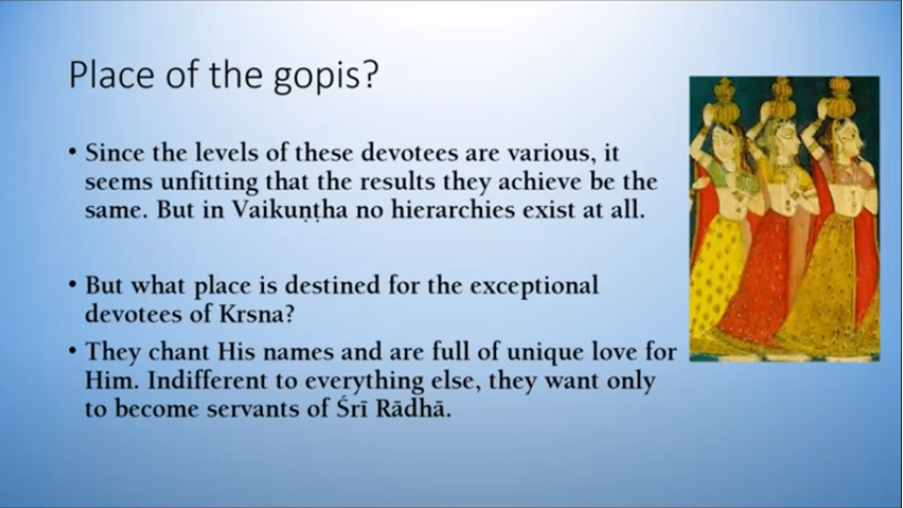
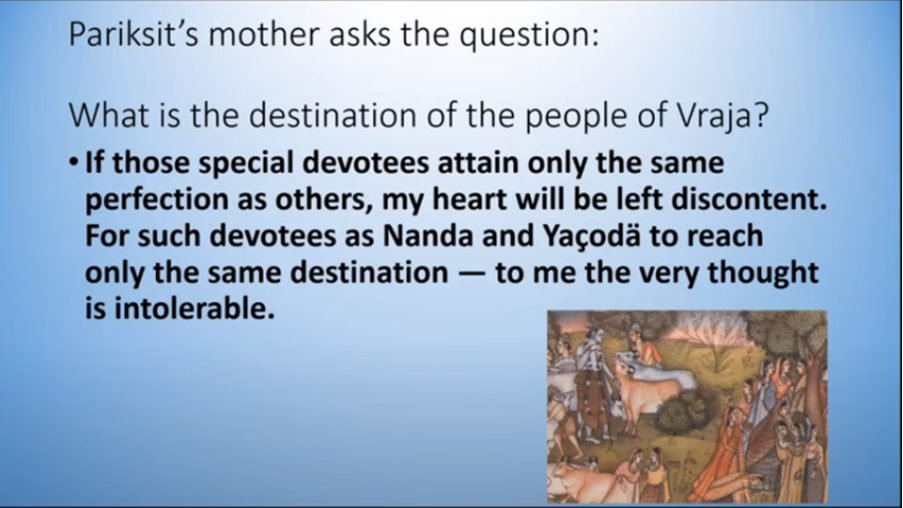
Do the people of Vrindavan, do they get the same result as everybody else or do they get something special? Do Nanda and Yasoda get the same destination as everybody else? So then, of course, Uttara says they shouldn’t, they should get something much superior but then she’s asking this to Parikshit, what is the destination of [Laughs] persons like Nanda and Yasoda and Gopis etc, they stay here in the material world or they get a higher place than Vaikuntha or what happens?
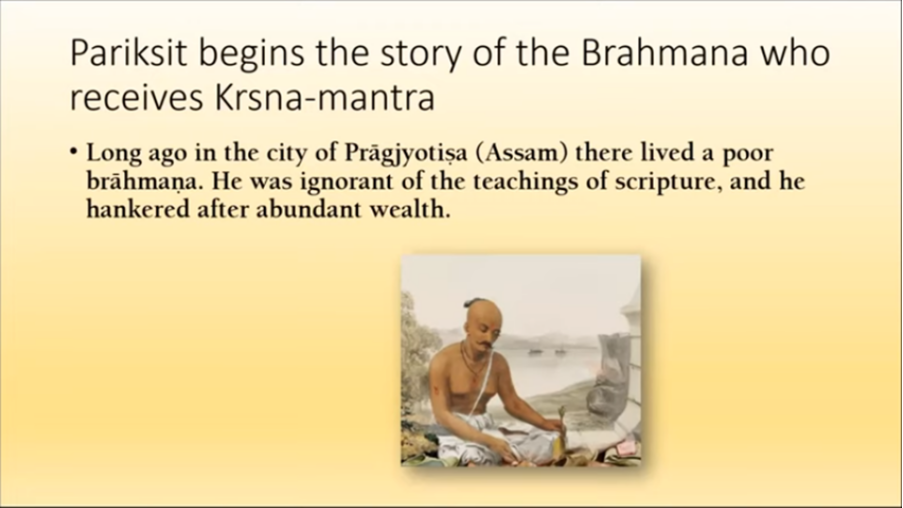
So, to answer this question, Parikshit begins to tell a story. So, this is another story within a story [Laughs]. So, it’s one of the brahmana when he meets Gopakumar and then Gopakumar begins to tell his story to this brahmana [Laughs] about what happened to him. So anyway, there was in Assam, Pragjyotisha, that’s in Assam, and Assam is kind of far northeast India, quite far from Bengal and there was a poor brahmana. So, he was a brahmana, but he was ignorant of the scriptures. And he wanted to get a lot of money [Laughs].
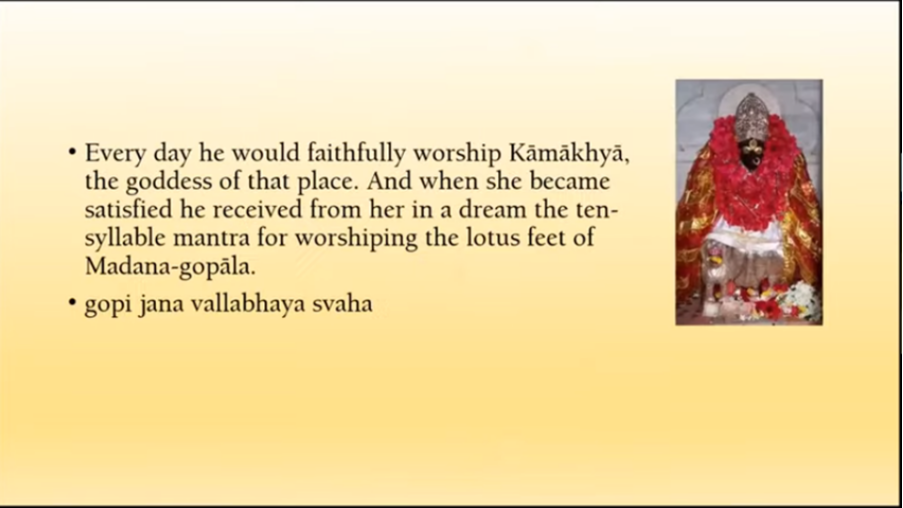
So he worshipped Kamakhya, that is a form of Durga in that place in Assam. So, she became very satisfied with his worship and she appeared to him in a dream. And she gave him a ten syllable Gopala, Madana Gopala mantra [Laughs]. So, the actual mantra is never described there [Laughs], the ten syllable mantra it says. But in the commentary of Sanatana Goswami there he quotes a little verse which explains the syllables of the mantra, but it is not normal language. It doesn’t say, it starts with go and then there’s p like that. They use rather strange words to describe each syllable, like a code. It’s like a secret code [Laughs]. And if you don’t know the code, you couldn’t figure out what the mantra was. So in other words, scriptures record mantras, but they also put them in some coded language. So unless you don’t know that language, you don’t know what the mantra is. You can’t figure out what it is [Laughs]. But the actual mantra is Gopijana Vallabhaya Svaha. If we figure out what those syllables mean in the description, it’s Gopijana Vallabhaya Svaha, ten syllable mantra.
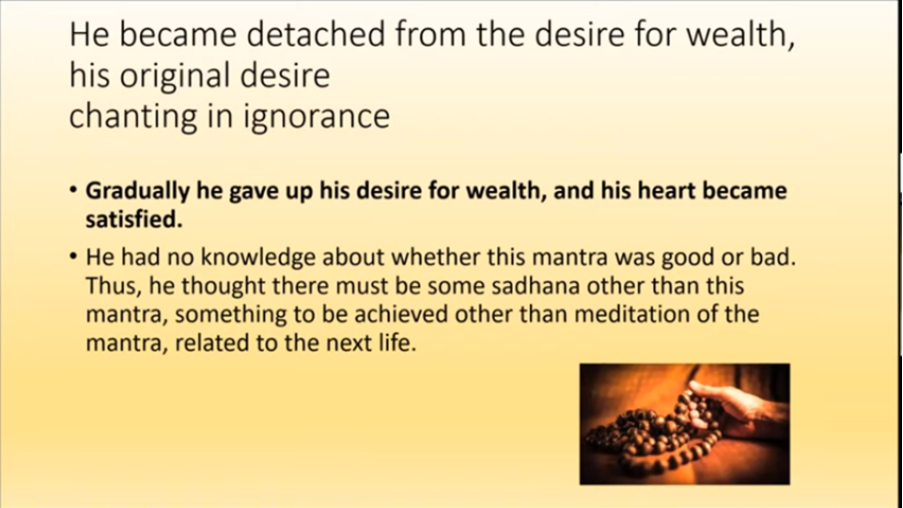
So, he began chanting that mantra according to the order of Durga Devi, but he didn’t know what the mantra was for. He didn’t know how to chant it properly. He didn’t know what the goal was, etc. This is like Namabhasa [Laughs]. He got some effect, but not the final effect. So he got purified and he lost his desire for wealth.So he had the mantra, but he said, may be there’s something better than this mantra. What do we achieve with this mantra? May be something better is there. You know like this, so, he didn’t quite know what to think of this mantra, but he chanted it anyway.
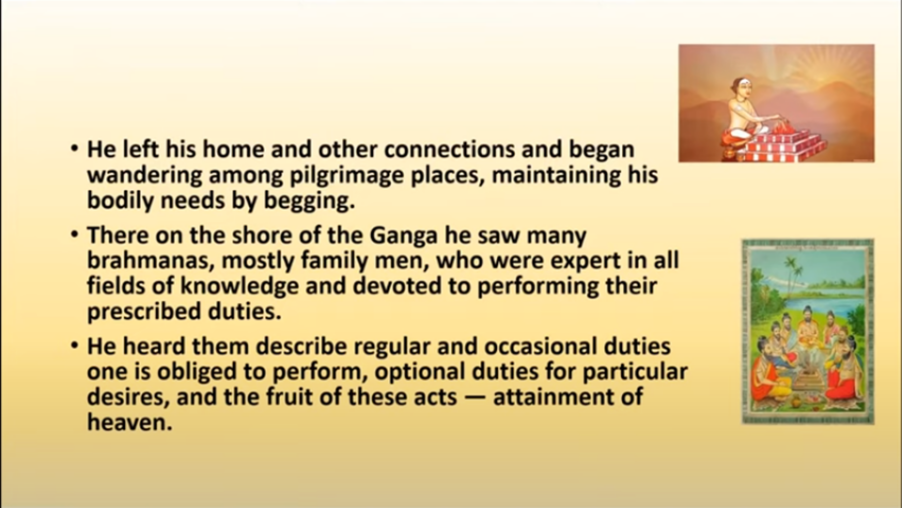
So he became very detached, and he started wandering to different tirthas, holy places, and he would beg to maintain his body. When he was wandering in the bank of the Ganga, he saw a group of brahmanas. And most of them were householders. And they were very learned. And they were performing all of their duties as a brahmana. And then he heard them speak about doing your nitya, naimittika karmas, and your kamya karmas. And then they said, we do all of these activities, then we can go to Svargaloka.
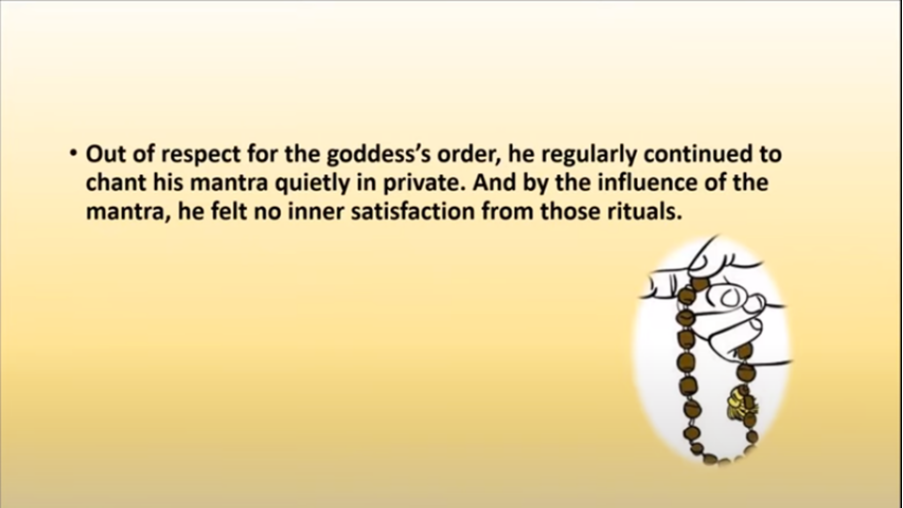
So, he was a little attracted for some time, but then he continued to chant his mantra, because Durga Devi had given him this mantra, so he continued to chant privately when the brahmanas weren’t watching him [Laughs]. So, because of the power of the mantra, he was not attracted to those rituals, and he wasn’t attracted to Svargaloka.
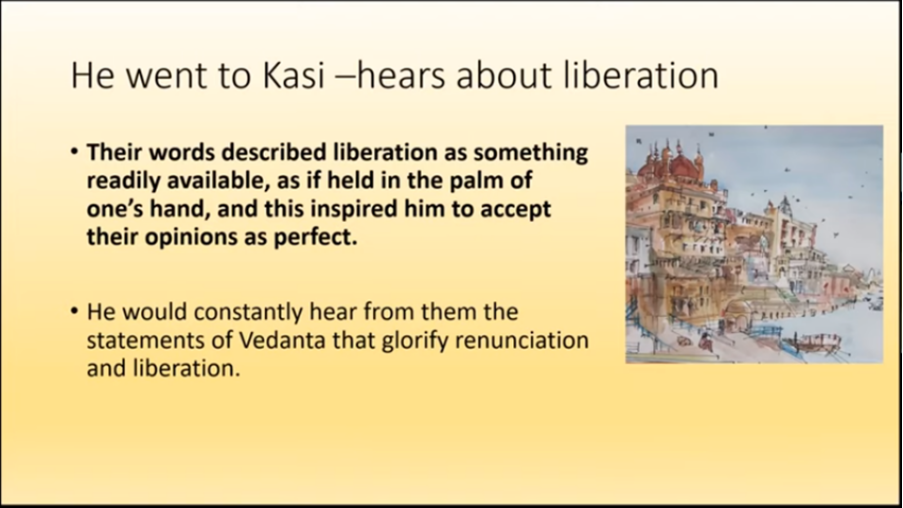
So, he left that place, and he went to Kasi, that is Varanasi. There, the brahmanas were speaking about liberation. And they said, it’s very easy to get liberation. So he listened, and he began to accept their opinion. So, he heard them glorify renunciation, giving up everything, and liberation.
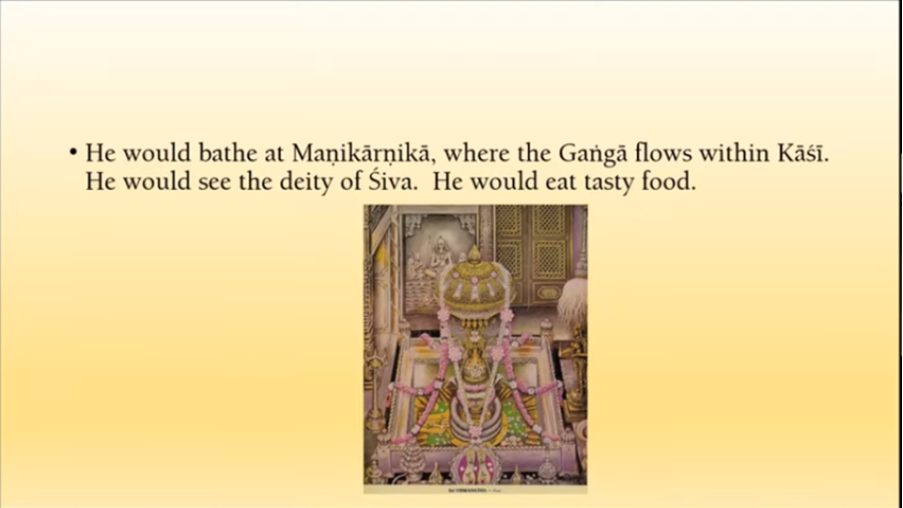
This was a famous bathing place there, Manikarnika, and he would bathe there everyday in the Ganga. And there’s also a very famous deity of Shiva there in Kasi, Vishweswara, Vishweswara Shiva. A very famous deity is there, in Kasi. So he would go see the deity, and then he would eat some tasty food [Laughs], and survive that way [Laughs].
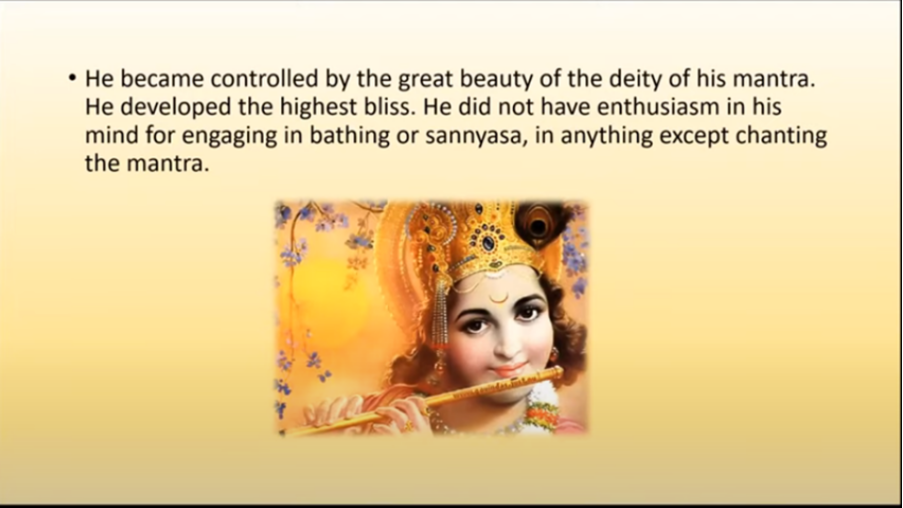
But he continued to chant his mantra, his Madana Gopala mantra and he became very attracted to the deity that is Krishna deity and that mantra. Then he got the highest bliss from this. So then, he was not so enthusiastic about liberation, or bathing and sannyasa etc, and he just wanted to chant this mantra.
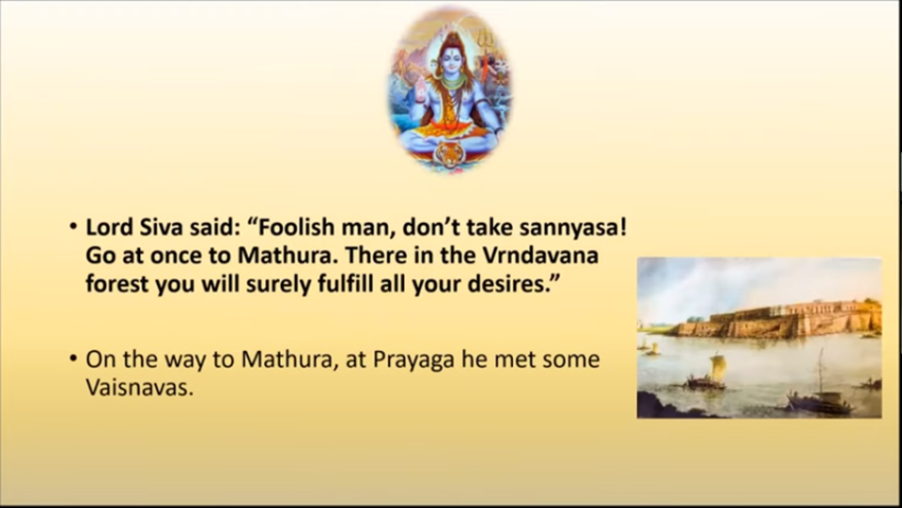
So, finally Shiva spoke to him. He said, you don’t take sannyasa, you go to Mathura [Laughs]. You go to the Vrindavan forest and there your desires will be fulfilled. So, he started going to Mathura, so he was in Varanasi, and he was going towards Mathura, but he came to Prayag or Allahabad on the way and then he met some Vaishnavas there.
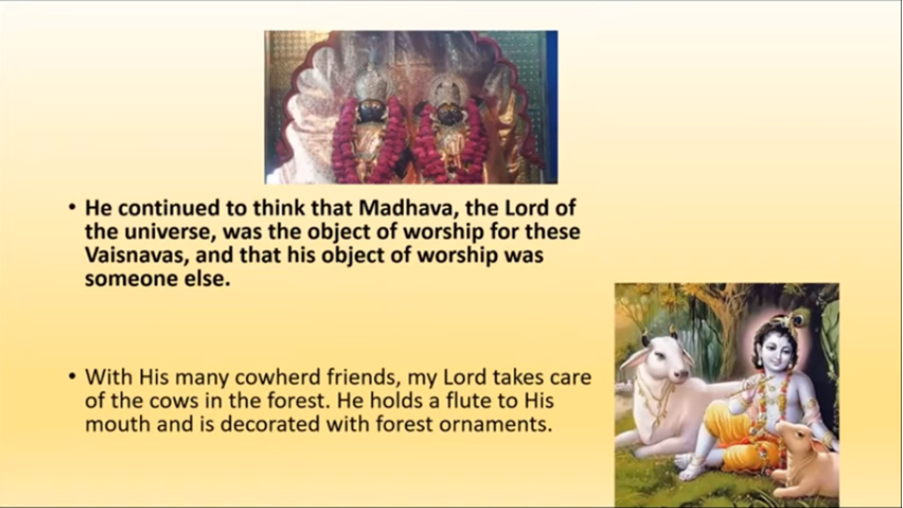
And those Vaishnavas were worshipping the deity of Madhava, that’s the Bindu Madhava deity. And he was attracted to that worship. But at the same time, then he thought, I have a deity mantra, and this deity of my mantra is different from that deity [Laughs]. It was different [Laughs]. It’s different. The deity there is different from the deity of my mantra.
So, he said, in my mantra I have this Krishna and He’s got His cowherd friends and the cows in the forest, He has a flute in His house, He is decorated with the forest ornaments, but this deity here is much different [Laughs].
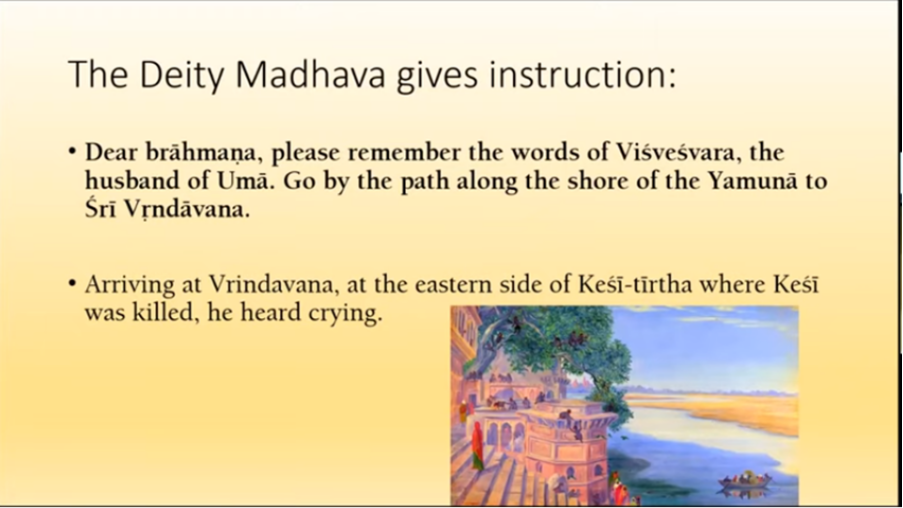
Yeah, Krishna is different from that deity. So then, the Madhava deity gave him some instruction. So He says, you remember the words of Shiva? He said, you go to Vrindavan, so you go there [Laughs], go on the Yamuna and go to Vrindavan. So, he continued on his way, and he got to Keshi tirtha. That’s where Keshi was killed. And there in the forest, he heard somebody crying out.
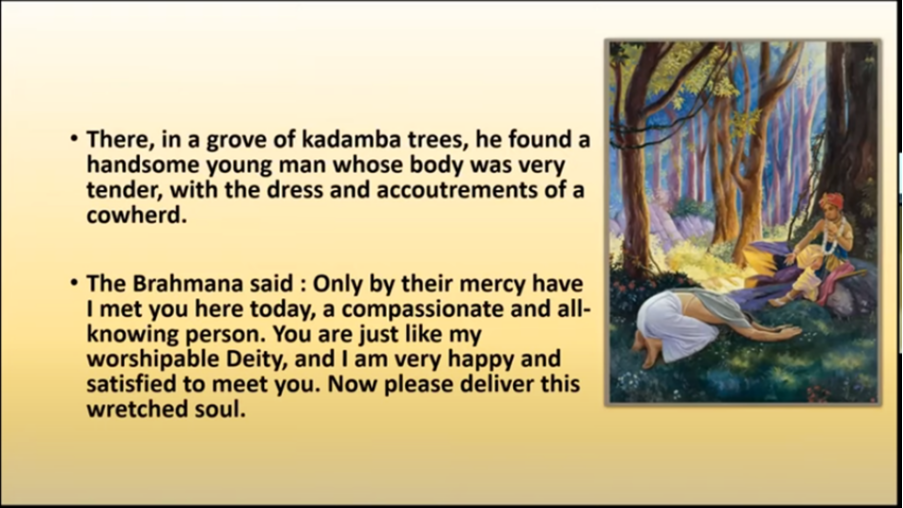
So, he searched around, and then in a Kadamba forest, he saw a young cowherd boy [Laughs], who’s dressed like a cowherd. So this is Gopakumar. He met Gopakumar. So, this is the Gopakumar. After Gopakumar had all of his experiences and had gone to the spiritual world, and gone everywhere [Laughs], he’d come back, and he was sitting there, and he was crying in ecstasy. This is when the brahmana met him.
So, this Gopakumar looked something like his, deity of his mantra, because he realized this Krishna and his [Laughs] is very similar, so he was pretty happy.
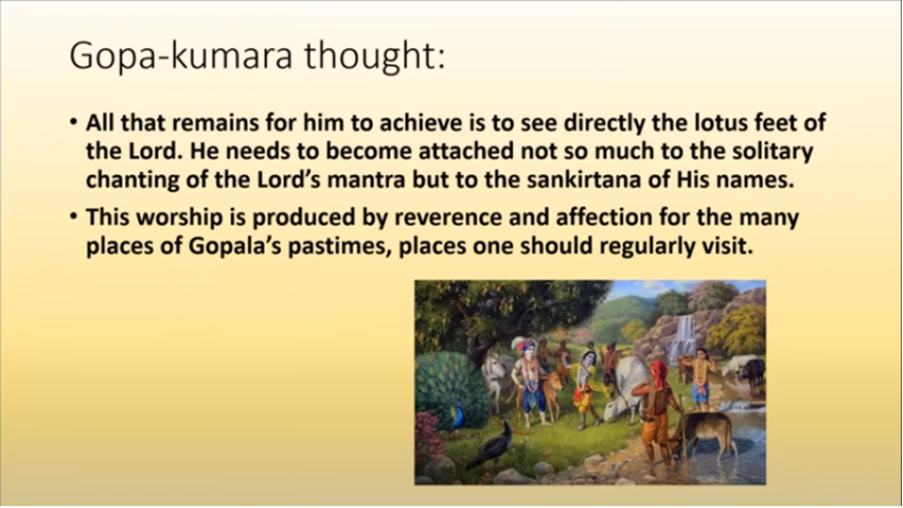
So then, Gopakumar was thinking how to educate this person [Laughs]. So then, he thought that actually he should directly see Krishna. But to do that, he should not just chant this mantra, but he should do Sankirtan, of Krishna’s name, Nama Sankirtan, and this is very powerful to get darshan of Krishna. And he should stay in the places where Krishna had His pastimes.
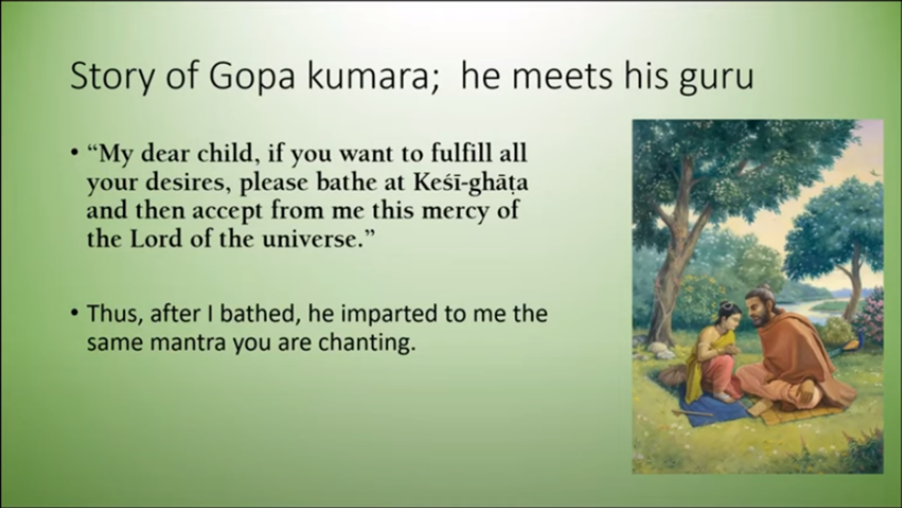
So then Gopakumar begins to tell his own story of how he realized Krishna, and he tells this story to the brahmana. So, Gopakumar was a cowherd in Vrindavan on earth. And one day he saw this saintly person there. So, this person told him to bathe in the Keshi ghat and then get the mercy of Krishna. So that Guru then gave him the same mantra that the brahmana was chanting, the Madana Gopala mantra. Later on, the Lord explains, actually I became the Guru [Laughs]. The Lord himself became the guru and gave the mantra [Laughs].
Okay, so when you get the mantra, the mantra of course is secret, it’s given secretly by the Guru to the disciple. And generally, traditionally, when they get these mantras, then they have to learn the method of chanting. So there’s a bija of the mantra, there’s a deity, [Not clear] deity of the mantra etc, you have to do nyasas with the mantra, place the syllables of the mantra on your body, and there’s karanyasa and anganyasa and things like this you have to do, before you start chanting the mantra. There’s many things you have to do, to purify yourself before you begin chanting. So anyway, he began to explain, but he was starting to explain who is the, you know, what this mantra means, you know about Krishna. And then when he started describing Krishna, he fainted [Laughs]. He cried and fainted and whatever [Laughs]. And then he disappeared.
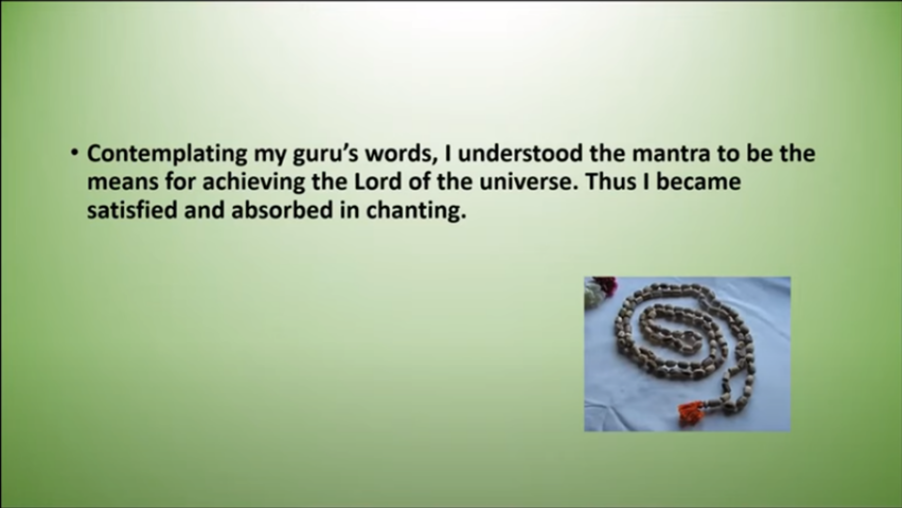
Okay, so then at least he understood, okay this is a mantra about the Supreme Lord etc, and began chanting. [Discussion aside]. So anyway, he began chanting the mantra and he understood its about the Supreme Lord.
So he also became completely disinterested in all relatives etc, etc [Laughs]. And he just wandered on the bank of the Ganga chanting this mantra.
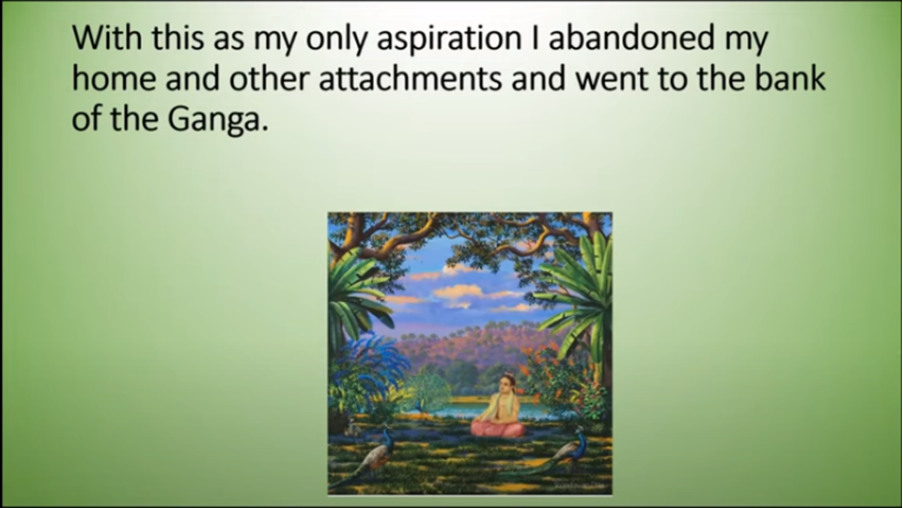
And as he was wandering on the bank of the Ganga, then he saw a poor brahmana who was worshipping a Salagrama, but he was worshipping very simply because he was very poor. So, he began praising the brahmana for his worship. But it was very simple worship. So the brahmana said, actually if you want to see real worship, you go to this city where there’s a king and he does very, very nice worship of Vishnu. So, you can see the Lord of the Universe there. The king is worshipping the Lord of the Universe. You go there and you’ll be very, very satisfied.
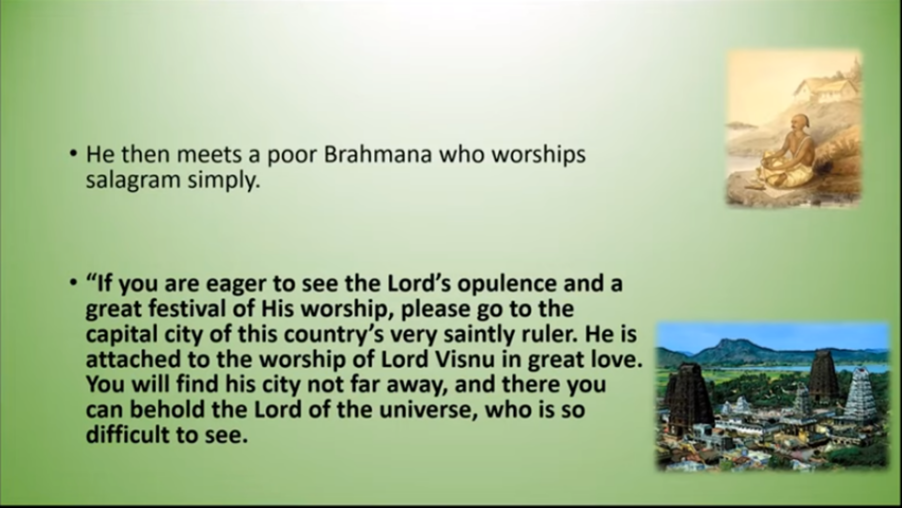
So Gopakumar went to that city, he saw everything, he saw the deity, he saw the nice worship and he was very happy. The king of the country had no son [Laughs]. So, the king became very attracted to this Gopakumar and his very good qualities, he treated him like a son [Laughs] and he adopted him as his son. And then the king died.
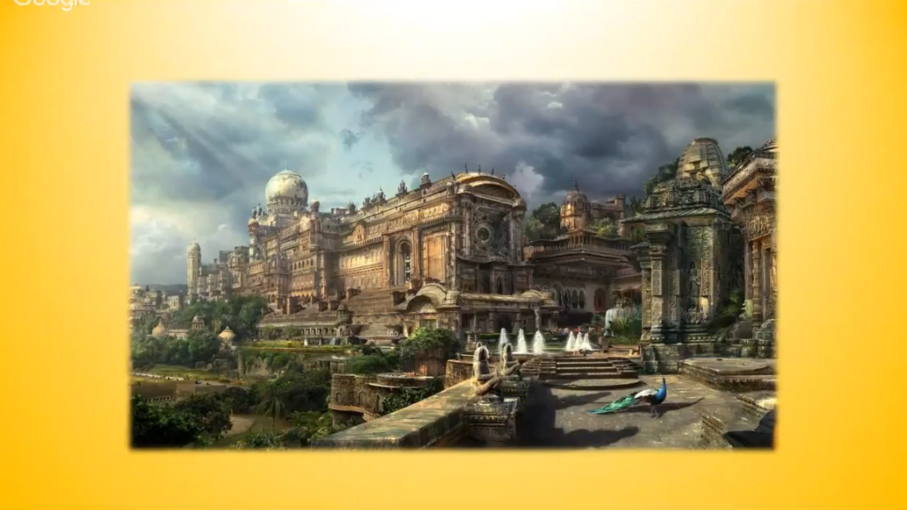
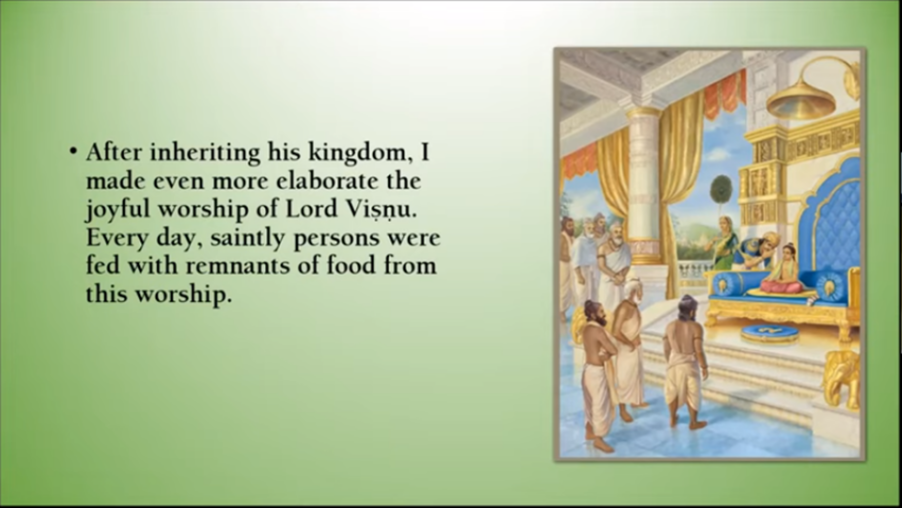
So, Gopakumar became the king [Laughs] of the kingdom [Laughs]. So, he, of course, did his duty and he was worshipping the Lord, he improved the worship of Vishnu even more. And then he would feed all of the saintly people with the prasad from the deity.
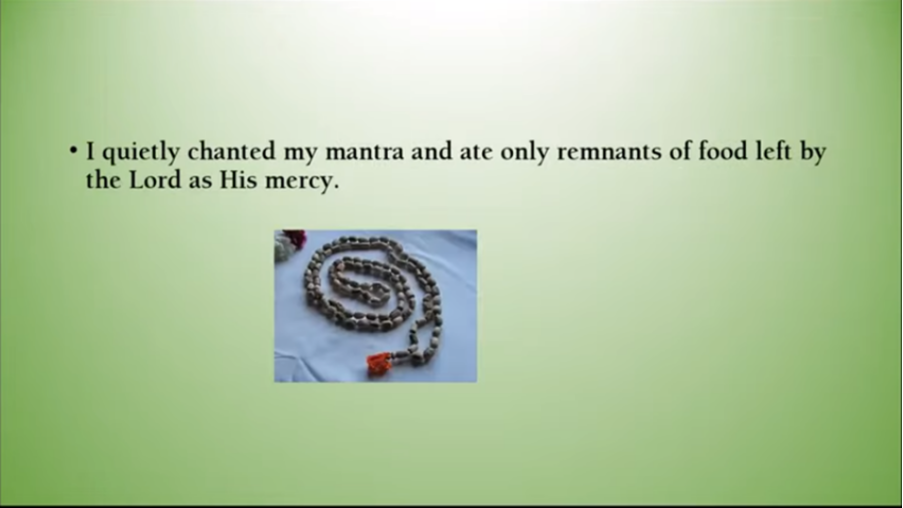
But, even though he was the king, he continued to chant his mantra very quietly and he would take only the prasadam of the deity.
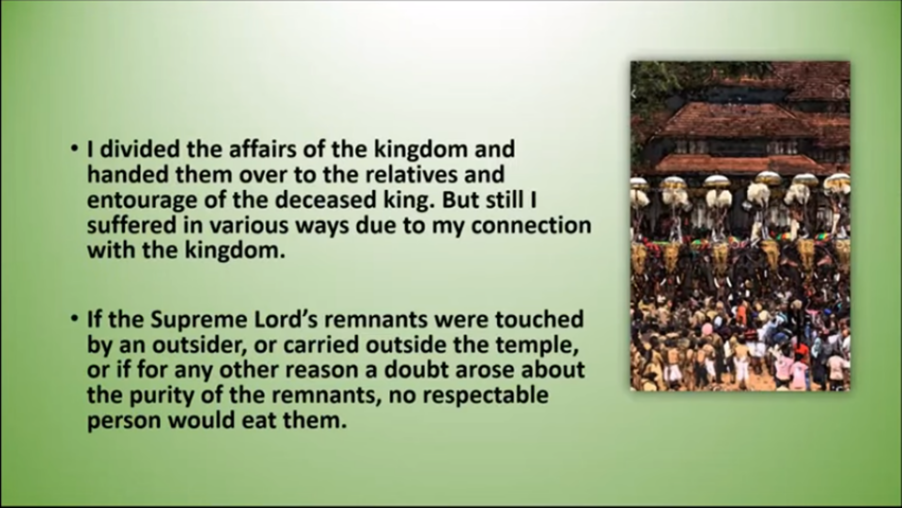
So, due to chanting that mantra, he became very dissatisfied in being the king, he wasn’t very interested in affairs so he gave all the management of the kingdom to the relatives of the king. But because he had been the king, people respected him a lot and this created an obstacle, he couldn’t chant properly because of lot of interruptions from people [Laughs]. And they had one custom and that is, the Lord’s prasadam, if it got touched by some outsider, they considered it contaminated, so they wouldn’t touch it anymore, they would throw it out [Laughs]. So, he was not very satisfied with that [Laughs].
So then, he met some devotees from Puri and they began describing Jagannatha [Laughs]. So, they described this form made out of wood and they described the prasadam, even if it’s touched by anybody, impure or whatever, there’s no problem with that, people still eat it [Laughs].
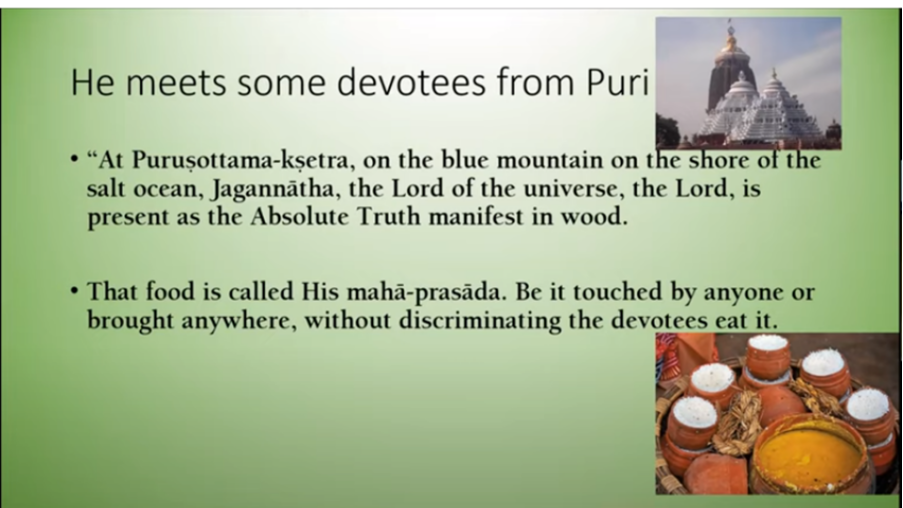
So, they glorified that place and said even the donkeys have four arms there [Laughs]. Anyone who goes there never takes birth again [Laughs].
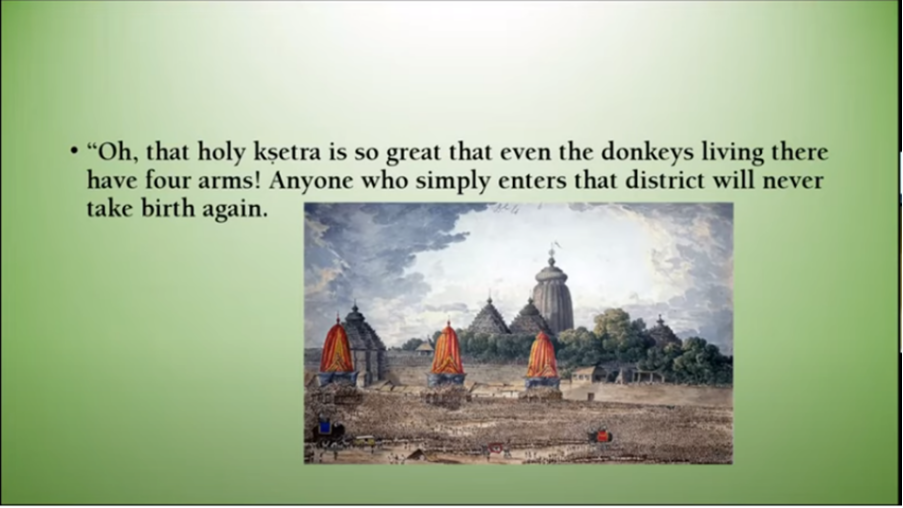
So then, this Gopakumar became very, very eager to go there, so he went there. So when he got to the temple, then from a distance he saw the big face of Jagannatha with His big eyes. He had a dark color like the rain clouds. And He had bright red lips.
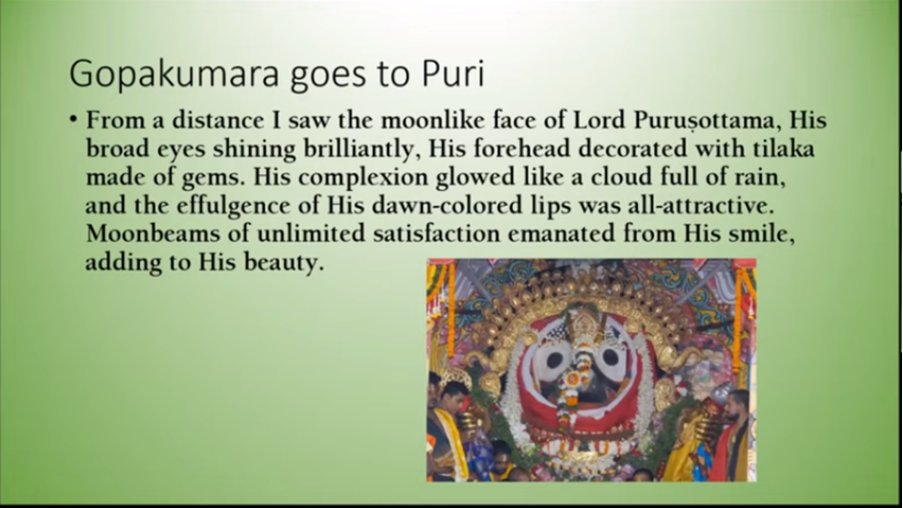
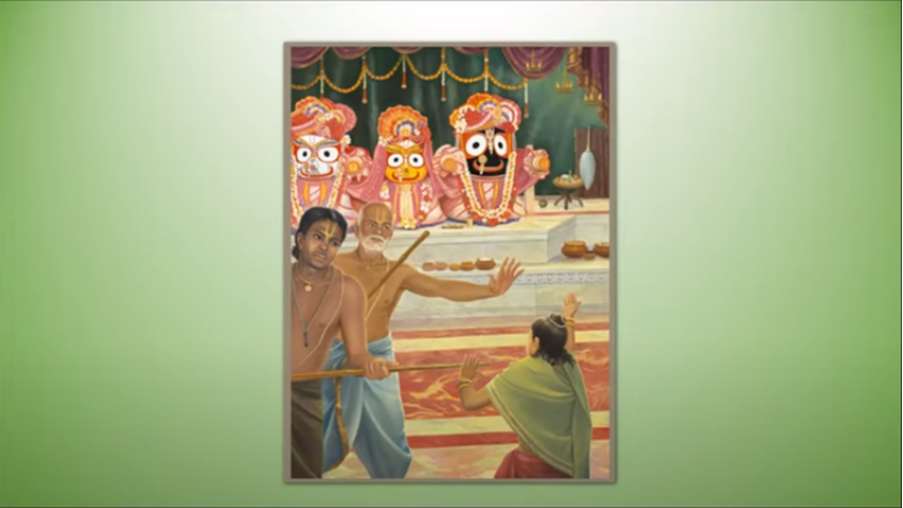
So, he was so excited, he began to run towards the deity and embrace it [Laughs]. And he didn’t actually know what he was doing but then the guards, the priests stopped him.
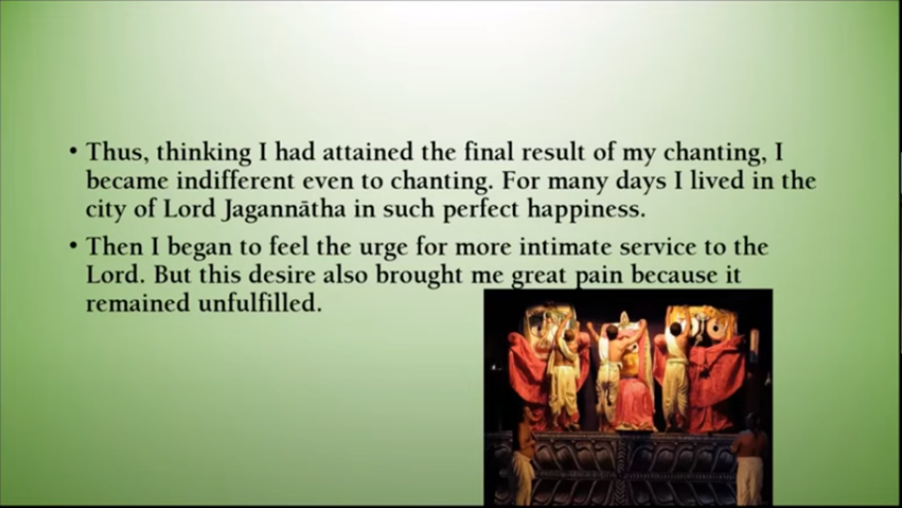
Anyway, he was very satisfied there in Puri and he thought, now I’ve got the final result of my chanting because I see the Supreme Lord. So, he even became less interested in chanting because he felt so happy there. But then he felt, I have to serve this deity, but he wasn’t allowed to serve the deity, so he felt dissatisfied.
And one day then he saw his Guru. So the Guru said, actually this mantra is service to Jagannatha. Chanting this mantra is service to Jagannatha. Don’t leave the chanting. So he said, by the power of this mantra you will live a long time and you will get the form of a cowherd boy. And you’ve developed the right mentality for tasting the final results of this mantra. Mentality, proper mentality to get the result of the mantra.
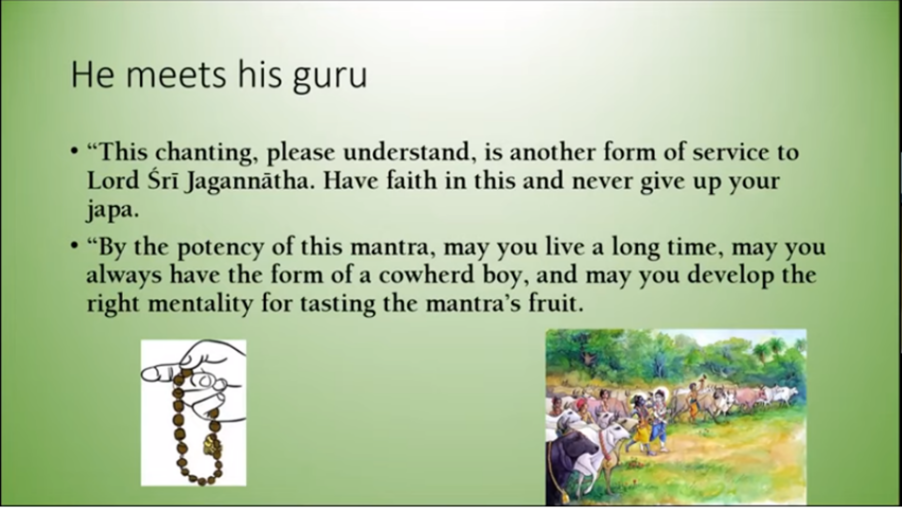
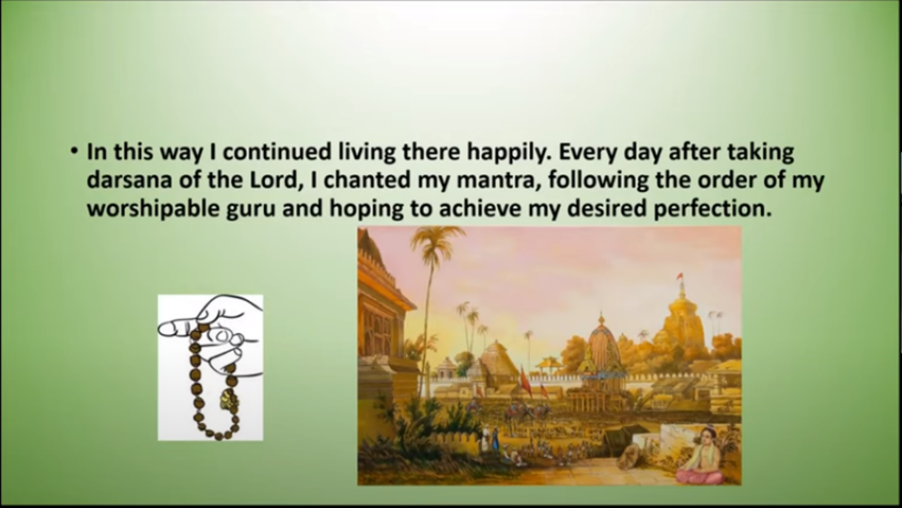
So, after that the Guru disappeared again [Laughs]. So he began chanting very enthusiastically and he was very happy. So, he would see the Lord and then he would chant his mantra and that was his service.
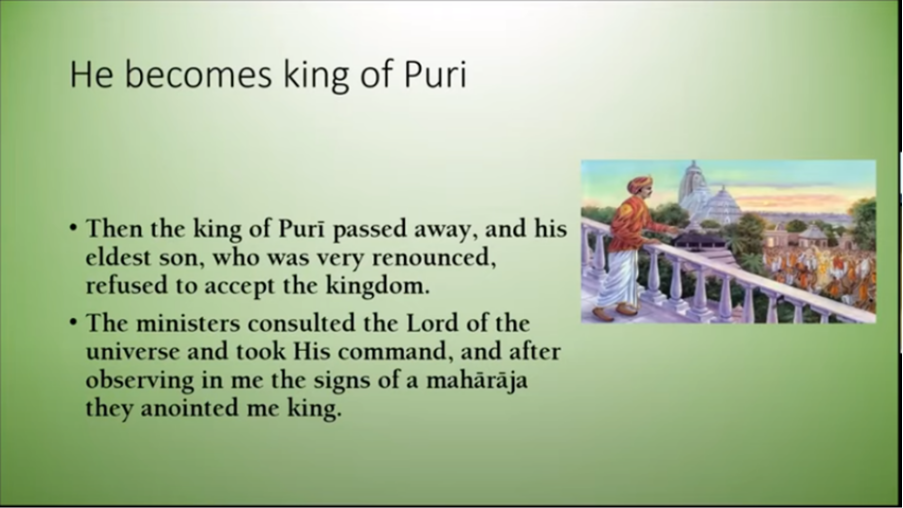
Then the king of Puri died [Laughs]. The king had a son, but the son also renounced everything and he refused to take the kingdom. So, the ministers, they went to Jagannatha and said, what are we going to do [Laughs]? So then Jagannatha said, you go to Gopakumar, he can be the king [Laughs]. So the ministers came to Gopakumar and they made him the new king [Laughs].
So, again he felt dissatisfied because he wanted to serve Jagannatha in a special way but he wasn’t allowed to [Laughs]. He also became distracted because he had to rule the kingdom.
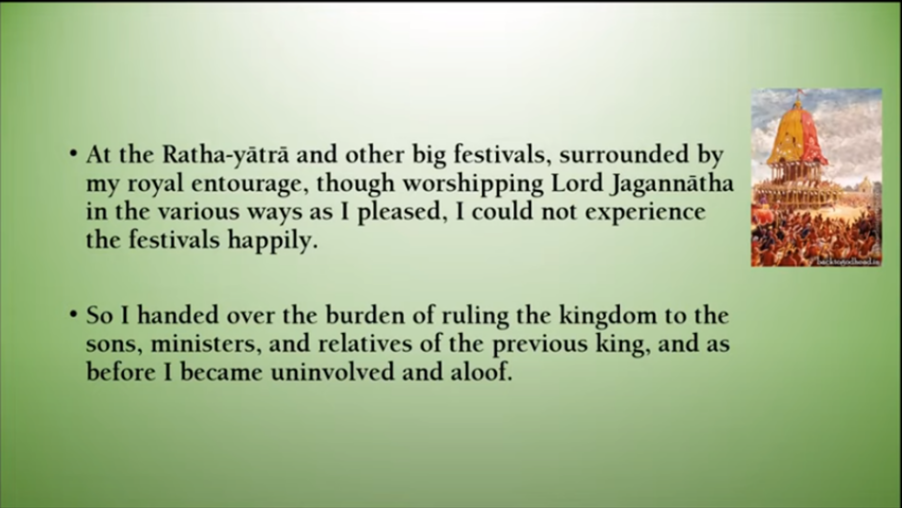
So, he celebrated all the festivals including the Ratha Yatra in a very grand way. But still he wasn’t feeling very happy. So, then he said, I’m going to give up the kingdom. He gave it to the ministers and the relatives [Laughs] and he resigned [Laughs]. But still the people were giving him great respect. So he didn’t feel very happy there and he wanted to leave.
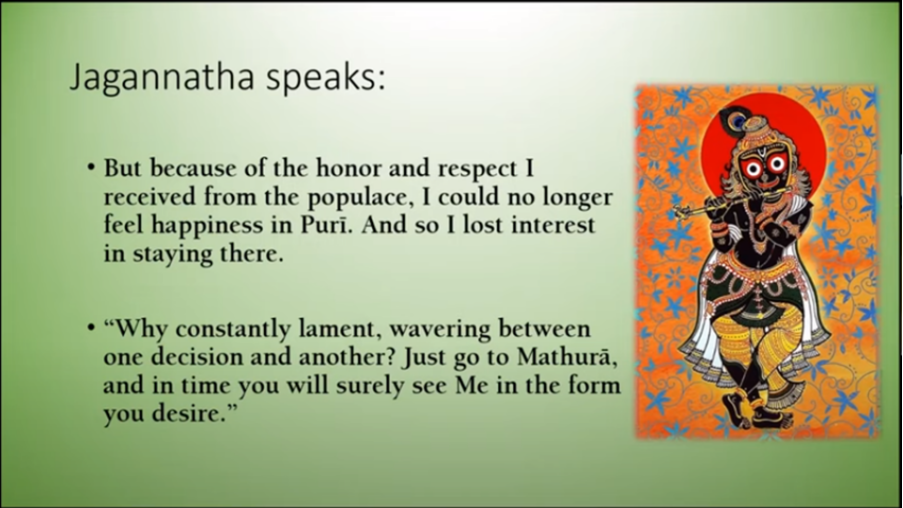
And then Jagannatha spoke to him [Laughs]. So then Jagannatha said, don’t lament. So Gopakumar was thinking, should I leave this place? But if I leave then I’m leaving Jagannatha. I don’t want to leave Jagannatha. So what should I do? So then Jagannatha said, you should leave. Go to Mathura. So, if you go there then, you will see me in the form that you really desire.
Okay, so that’s chapter 1. No, chapter 2 is next. Anyway, we can stop there.
Q & A:
1.) Maharaj, both Brahmana and Gopakumar when they start chanting the mantra they are in ignorance, without knowing the meaning of mantra. Then how they are like progressing?
Well, just like we chant Harinama, then we get some effect. But you don’t get full effect if you don’t chant. So, even with this mantra, because the name of the Lord is in there, they got some effect. Other mantras generally, even other mantras of Vishnu etc, don’t have such effect. You have to know everything about it and chant properly the mantra. Name, of course, is different, but the mantra is different. Krishna mantras are special. So that even those mantras, if not chanted properly, they give some effect.
Devotee: How he was able to understand ? He is recognizing this, he is distinguishing. How then, he was ignorant but still he recognized that this is not my name. [Not clear]
HH Bhanu Swami Maharaj: Well, the mantra, because it’s Krishna. So, he became more attracted to Krishna [Laughs].
2.) More importance is given to renunciation, to renounce everything?
Well, because he was king [Laughs]. And that was a distraction from chanting the mantra etc. So, it was interruption to his worship. So therefore, he gave up those services.
3.) So, is this also a special pastime? This Gopakumar [Not clear].
Well, this is the story to illustrate certain things. Of course, we can say the story itself becomes real. It’s not, he didn’t borrow the story from some Purana or anything.
4.) Gopakumar was first in Vrindavan and then he left?
Yes, he was a cowherd in Vrindavan.
Devotee: If he was in Vrindavan then how he left Vrindavan and went?
HH Bhanu Swami Maharaj: He chanted the mantra when he got initiation from the Guru, then he lost interest in family life and he wandered around and then he met the brahmanas or the brahmana doing the worship and then he went to the city and then he went to Puri and all this.
5.) Maharaj, now in kali yuga, yuga dharma is Nama Sankirtan .Nama, rupa, guna, lila [Not clear]
Nama, rupa, guna, lila. So, through the name we realize the form, then we realize the qualities then we realize the pastimes.
Devotee: How can we understand, can we think about nama very appropriate [Not clear]
HH Bhanu Swami Maharaj: Oh. By chanting one realizes the non difference of the name from Krishna, it’s non different. So in the name is the form, the qualities, and the pastimes that become realized in the chanting of the name itself. Okay. Hare Krishna.
Devotees: HH Bhanu Swami Maharaj ki jai!!! Srila Prabhupada ki jai!!!