
Bhakti lata – Part 1 | HH Bhanu Swami Maharaj | ISKCON Japan | 4th Nov 2025
nama oṁ viṣṇu-pādāya kṛṣṇa-preṣṭhāya bhū-tale
śrīmate bhaktivedānta-svāmin iti nāmine
namas te sārasvate deve gaura-vāṇī-pracāriṇe
nirviśeṣa-śūnyavādi-pāścātya-deśa-tāriṇe
jaya śrī-kṛṣṇa-caitanya prabhu-nityānanda
śrī-advaita gadādhara śrīvāsādi-gaura-bhakta-vṛnda
Hare Kṛṣṇa Hare Kṛṣṇa Kṛṣṇa Kṛṣṇa Hare Hare
Hare Rāma Hare Rāma Rāma Rāma Hare Hare
A creeper is a little plant. And a plant grows in a seed. If we don’t put the seed in fertile ground, it won’t sprout. And once it sprouts, we have to take care of it and water it nicely. So therefore, Bhakti is compared to a small plant, but it comes from a seed. If we don’t have a seed, we don’t get a plant. So, who supplies the seed? So that seed of Bhakti is planted by Krishna and devotee. By their mercy. So, we cannot just get Bhakti from anywhere, we have to get it through a devotee and the mercy of Krishna.
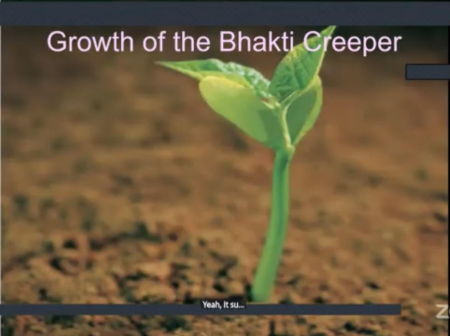
So the seed of course, means it’s the beginning of Bhakti. So, therefore, we begin Bhakti by the mercy of Krishna and devotees. So, we get the seed, and then we have to take care of the seed so that it will sprout. As I said, if we don’t have good ground or earth, it won’t sprout properly. Put it on the rock, it’s not going to sprout. So, what is the fertile field? So the fertile field is the heart of the devotee which has some faith. If there is no faith, the seed will not sprout. So, that devotee has to have a little bit of faith in the scriptures. And then Bhakti can begin to grow.
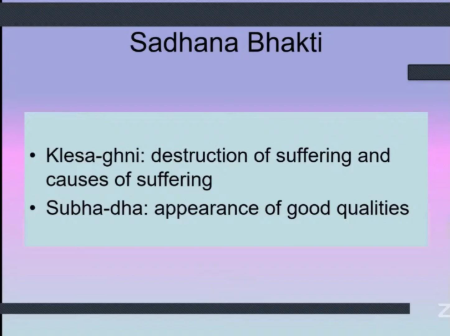
So, we see that the little plant here has two little leaves. So, when we begin Bhakti, two qualities manifest. One is called kleshaghni, destruction of suffering and destruction of the causes of suffering. And the second quality is called subhada, which means appearance of good qualities. So, when we begin practicing Bhakti, these are the first symptoms which will manifest.
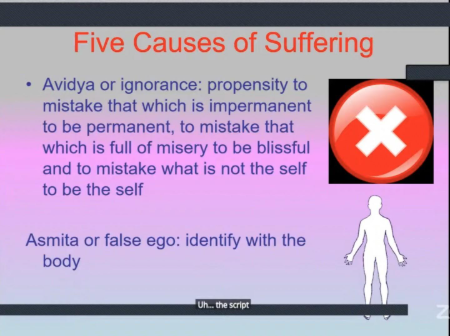
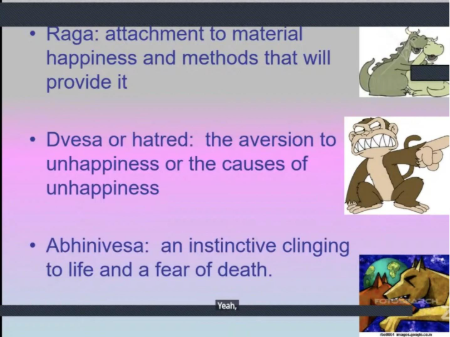
The scriptures describe five causes of suffering. So, the final cause, the most subtle cause is avidya or ignorance. Because of ignorance, everything looks opposite. We think that misery is happiness. We think the body as the self. So, the propensity to make mistakes then develops into false ego, identity with the material body. And in that body, then, we develop attachment to things which give us happiness and repulsion or hatred of those things which will cause us suffering. And then the final type of suffering is called abhinivesha, literally abhinivesha means complete absorption. So, we become completely attached to our body and we cling to life and we fear death.
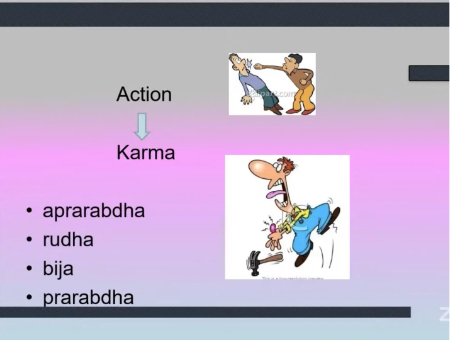
After this, of course, then we perform actions. The actions lead to karma. So, we commit violence, we will get some violence back on ourselves, that’s the karma. But the karma does not immediately manifest in the next life. So, it goes through stages. Here are four stages. Aprarabdha, rudha, bija and prarabdha. When it’s aprarabdha and rudha, we don’t even know that karma is there in this life. It won’t even manifest in this life and also maybe next or next life or next life. Bija means it will manifest in this life, but it hasn’t come yet. When the bija gets right, then it’s called prarabdha and we experience the suffering.
So, Bhakti destroys all of these things, this whole sequence, up to the prarabdha, all destroyed by the process of Bhakti. So, of course, in many cases, it will be gradual, you don’t get all the karmas destroyed immediately. As we go through Bhajana kriya up into Asakti and then Bhava, so then karmas get completely destroyed.
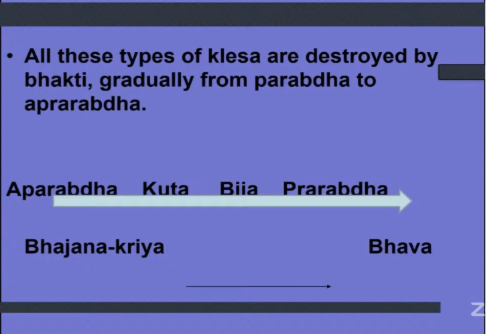

In some cases, the destruction of karmas may be very quick. In the case of Ajamila, he just chanted the name of Narayana with no Bhakti, and he destroyed all of his karmas in a second – past, present and future [Laughs]. So that happened quickly, because he had committed no offenses. So if he had committed offenses in previous lifetime or this lifetime, the process of kleshagni will go slower.
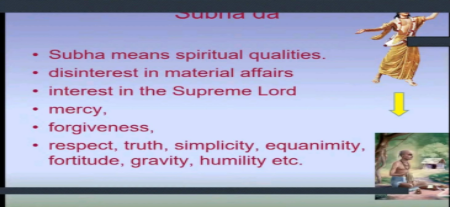
Simultaneously with the destruction of suffering, we get manifestation of good qualities. These are spiritual qualities, not sattvic qualities. So the Lord has 64 qualities, the jiva, by doing Bhakti can manifest 50 qualities. Qualities that arise from sattva guna will cause bondage. So Bhakti destroys all bondage, all karma, etc. So we’re not getting sattvic qualities, we’re getting spiritual qualities developed.
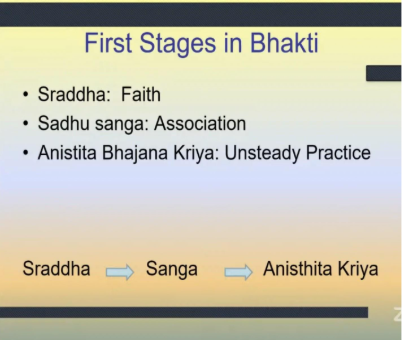
So as I mentioned, the qualification for Bhakti is faith. If the faith is not there, the bhakti seed won’t sprout. So it’s a qualification for Bhakti. So it’s actually not included in the Bhakti itself [Laughs]. So that faith is very, very necessary. And because we have that, of course that faith we shouldn’t think is sentimental, it’s actually faith developing in the jiva. And that may take many lifetimes to develop. With faith, then we approach devotees, and we inquire from them, and then we will get scriptural knowledge, and we learn how to do Bhakti, then we get the seed. But when we begin Bhakti, we will have a lot of anarthas. And thus, when we do the Bhakti, it is not very steady. Like a plant, and then you put the seed in, you water, and sprout comes up, and it’s very, very sensitive. So that’s how Bhakti is in the beginning, it is not very strong. But by caring for that Bhakti very nicely like a plant, it becomes stronger and stronger. So our bhakti will go from unsteady bhakti, anishtitha, to nistha, steady bhakti.
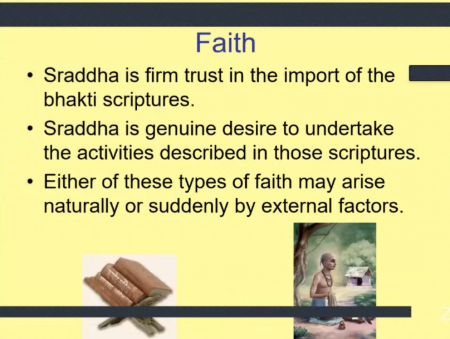
So I talked about faith, and faith means, of course, that we have trust in the Bhakti scriptures. Some people may have faith in Jnana scriptures or yoga scriptures, but if they don’t have faith in Bhakti scriptures, they cannot do Bhakti. So, when we take a scripture like Bhagavad Gita and read it, and Krishna says, I am the Supreme Lord, surrender to Me, the devotee will accept that. If he doesn’t have faith, he reads Bhagavad Gita and says, well, I don’t believe in God, I don’t even believe in atma [Laughs]. Or, next Krishna says, worship only Me, and then the person will say, well, no, I want to worship Shiva and Durga and Ganesh and Lakshmi and so many others. Why is Krishna saying this [Laughs]? So, therefore, if a person who doesn’t have faith in the Bhakti scriptures, very difficult to advance. Not only we have faith in the Bhakti scriptures, but we have to have great eagerness to follow the instructions given in those scriptures. Usually, that faith will take many lifetimes to develop. Sometimes, by extraordinary mercy of a devotee, it may develop suddenly also.
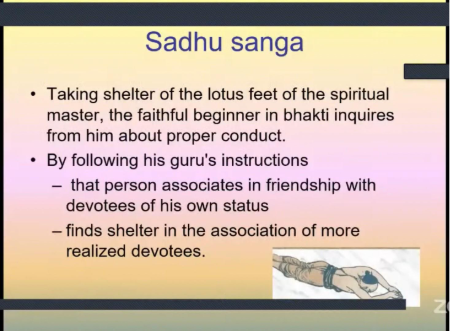
So, Sadhu sanga means to associate with devotees or Guru. So, the person inquires about how to do Bhakti, and then the Guru or the devotee will teach them. And, one of the important instructions is that, one should have friendship with devotees. And, for those devotees who are more advanced, the person will take shelter of them and take all of their instructions.
So, the initial goal will be to get from the unsteady, or anistitha state to the nisthita state. Of course, nistha is not the final stage, it’s only half the way through [Laughs].
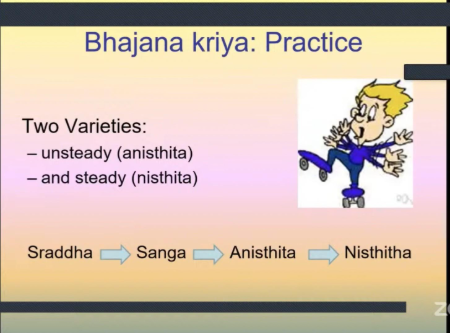
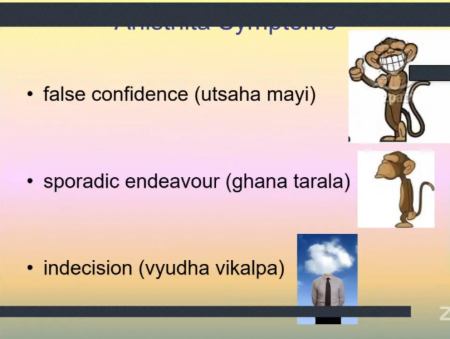
So, in the Madhurya Kadambini, Viswanath Chakravarthi points out six symptoms of unsteadiness. Just like a disease, you have a certain disease like diabetes, and there are certain symptoms that go with it. So, similarly, we’ve got symptoms by which we can detect that a person is at anistitha, unsteady state.
1.) The first symptom is called Utsaha-mayi. Utsaha means enthusiasm, in this case it means a type of false confidence. The example is given of a boy 5 or 6 years old, and he is very eager and finally he gets to go to first day of school. So, he comes home, and he’s very excited. And he looks at all the other children not going to school and he thinks, I’m so much better than everybody else. It’s only the first day of school, but somehow he thinks he knows everything [Laughs]. So, the person is very confident, nothing wrong with being confident. But it’s exaggerated. Yeah, and we should not replace the Bhakti with pride.
2.) The second symptom is called Ghana-tarala, which means sometimes very enthusiastic to do Bhakti, other times not enthusiastic.
3.) The third symptom is called Vyudha-vikalpa, which means very extensive imagination. It also means, the person likes to make all sorts of impractical plans. And the plans will keep changing. One day, the person may think, I’ll become a great sannyasi. All these material things are maya, so we have to renounce everything. And then another day, very soon after, then he thinks, no, the best process is to follow the example of devotees of Lord Caitanya and become a nice grihastha.
4.) The fourth is called Vishaya-sangara or, means struggle or war with maya, with material objects. In other words, this devotee has a lot of struggle with material enjoyment, sometimes they enjoy, sometimes they are able to control that.
5.) The fifth symptom is called Niyama-akshama, inability to uphold the rules or vows. So, the person will make a vow, I will chant so many rounds every day, and after one week they cannot follow anymore. I’ll read 4 verses of Bhagavad Gita everyday. So he will do this for one week and after second week, they cannot do anymore. So, it’s good to make vows, but again, we have to make vows which we can keep [Laughs]. And when we become steady at a little vow, we can make a greater vow.

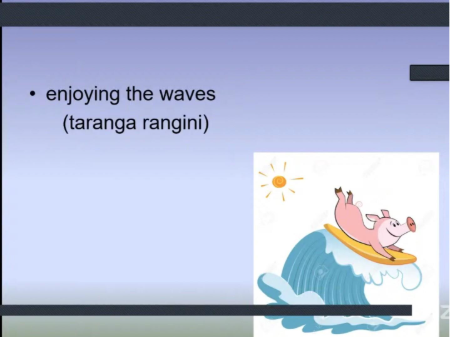
6.) Okay, and the last, the sixth unsteadiness is called Taranga-rangini, enjoying the waves. So, in performing Bhakti, then, we can get many material assets. We can get fame and position. We can get followers. So, if we start thinking of these things as our enjoyment, this is called Taranga-rangini. We cannot think that these results that we are getting are actually Bhakti. As I said, we are growing this little plant of Bhakti and we have to see how big that is getting, not what assets we get.
So, because the Bhakti is little weak and we do have all these anarthas, and then these six types of problems will arise. So, we have Sadhu sanga, we have Bhajana kriya starting the Bhakti, and then this is called anishtitha Bhakti, and then we go through anartha nivritti, where the anarthas get less and less. So, the process of increasing the Bhakti and decreasing the anarthas is to perform Bhakti itself, chanting, hearing, etc. So, even though the Bhakti is unsteady, we have to continue that Bhakti, and eventually we get to steadiness, Nishtha. Nishtha does not mean that all the anarthas are destroyed. They are still there, but they are much weaker. And the Bhakti has become stronger. So, when we reach that stage of Nishtha, then we can uphold vows very easily. We can maintain steady enthusiasm. We have much less difficulty with all material attractions. So, therefore, in growing this Bhakti plant, then we should try to come to the stage, where that bhakti plant is very strong. So, we saw that the first symptom of Bhakti was kleshaghni. So, when we perform Bhakti, the suffering is destroyed or decreased. This means the anarthas are decreased. So, we have to persevere in the Bhakti until that stage where we get steadiness.
Okay. Any questions there?
Q & A:
1.) So, you mentioned that the Bhakti qualification is to have even a slight faith, that’s where it starts. But you said it’s not included in the Bhakti process itself. Can you explain that a little bit more, please?
Yeah. So, Jiva Goswami explains in Bhakti Sandarbha that faith is a qualification for Bhakti. So, let’s say, to go to medical school, you need a certain qualification, may be a bachelor’s science [Laughs] degree or whatever, biology science or whatever [Laughs]. Yeah, so, if you get the qualification, then you begin to study medicine. So, those tests and whatever are different from the qualification. So, you could have faith, but you never start Bhakti also [Laughs].
Devotee: I’m sorry?
HH Bhanu Swami Maharaj: You could have faith, but if you don’t get the mercy of devotees, then you won’t start the Bhakti process [Laughs]. Of course, this faith also, like bhakti, comes from the spiritual world, it’s not material. Faith itself arises by mercy of devotees. But the mercy is a little different from the mercy when we start Bhakti. If we have faith, the devotee can teach us Bhagavad Gita and we accept it. So, it’s quite, let’s say, easy.
Whereas, if you don’t have faith, devotee can’t teach you Bhagavad Gita [Laughs]. So,[Laughs] how do we give mercy to the person [Laughs]? So, therefore, the mercy will only consist of, engaging a person in Bhakti without them knowing it’s Bhakti [Laughs]. So, they may take prasadam, they may hear kirtan, they may see Lord Jagannath in Ratha yatra. But each of these accidental contacts with Bhakti will begin to change the jiva a little bit until they develop faith. So, once we start Bhakti, the faith does not disappear, it continues and it grows. One of the ways that faith can grow is by getting more deeper knowledge of scripture.
Devotee: Thank you very much.
2.) Maharaj, there is unsteady bhakti, one is making the endeavour or plans. So, if we plan, okay, we want a big temple. It’s not possible, in current status it’s not in our reach. But if we don’t plan, then it will never happen. So, how we can decide which is a plan and which is not practical?
So, this type of unsteady bhakti, which was Vyudha-vikalpa, say extensive imaginary plans or whatever, means that, the person keeps changing his plans. And whatever plans he makes are not based upon qualification at all. We can say it’s like day dreaming [Laughs].
So, of course, in Bhakti itself, one of the angas of Bhakti is, don’t make big projects. Of course, that is explained as projects which will distract you from Bhakti. So, to try to involve in big material projects will be a distraction from Bhakti [Laughs]. And even if the project is like building a temple or devotion or whatever, we also have to be careful. We have to consider man power. We have to consider money [Laughs]. We have to consider our own abilities. So, we can always be ambitious, but we should not be impractical in all this.
3.) Is it possible for someone who, like they are going up the Bhakti stages and for a long time, they were may be at like Nishtha stage or even higher. But then, may be something happens, they, like, it’s possible to go from steady to unsteady?
Oh yeah, sure [Laughs]. It may be caused by bad association. Or the Bhakti may weaken because of aparadhas, particularly Vaishnava aparadha. So, there’s always some danger at any stage, but as we progress from Nishtha, Ruchi, Asakti and Bhava, the danger becomes less. But still, possibility is there. Bharat Maharaj was in Bhava stage. But then he became a deer. So, he fell from Bhava stage. But, after two lifetimes, he got Prema. So, it is said that he fell from Bhava because he had committed some aparadh in his previous life.
4.) Maharaj Ji, how can I personally track the whole process within myself? This process of Bhakti. Can I check within myself from stages to stages?
How to check? So, the intelligent devotee should be able to judge his advancement. Just like the gardener, he starts growing the plant and then he can understand the different stages. How long he has to cultivate it until he gets the flowers. How long to get the fruit, etc. So, at the beginning stages, it is more difficult. But if a person reaches the Nishtha stage, then it is quite easy for him to detect his stage.
So, Viswanath Chakravarthi has written Madhurya Kadambini and he identifies different stages with different symptoms, so that we can start identifying our stage. In one work, Bhaktivinod Thakur says that every Ekadasi, you should review your Bhakti and see if you have made advancement [Laughs]. What stage are you advancing [Laughs]?
Devotees: HH Bhanu Swami Maharaj ki jai!!! Srila Prabhupada ki jai!!!