Srimad Bhagavatam 11.10.12 | HH Bhanu Swami Maharaj | ISKCON Chennai | 1 April 2021
Oṁ namo bhagavate vāsudevāya
Oṁ namo bhagavate vāsudevāya
Oṁ namo bhagavate vāsudevāya
nama oṁ viṣṇu-pādāya kṛṣṇa-preṣṭhāya bhū-tale
śrīmate bhaktivedānta-svāmin iti nāmine
namas te sārasvate deve gaura-vāṇī-pracāriṇe
nirviśeṣa-śūnyavādi-pāścātya-deśa-tāriṇe
jaya śrī-kṛṣṇa-caitanya prabhu-nityānanda
śrī-advaita gadādhara śrīvāsādi-gaura-bhakta-vṛnda
Hare Kṛṣṇa Hare Kṛṣṇa Kṛṣṇa Kṛṣṇa Hare Hare
Hare Rāma Hare Rāma Rāma Rāma Hare Hare
Reading from Srimad Bhagavatam Canto 11 Chapter 10 Verse 12.
ŚB 11.10.12
ācāryo ’raṇir ādyaḥ syād
ante-vāsy uttarāraṇiḥ
tat-sandhānaṁ pravacanaṁ
vidyā-sandhiḥ sukhāvahaḥ
Synonyms
ācāryaḥ — the spiritual master; araṇiḥ — sacred kindling wood used in the sacrificial fire; ādyaḥ — held beneath; syāt — is to be considered; ante-vāsī — the disciple; uttara — at the top; araṇiḥ — kindling wood; tat-sandhānam — the stick in the middle, which connects the upper and lower wood; pravacanam — instructions; vidyā — transcendental knowledge; sandhiḥ — like the fire, arising from the friction, that spreads throughout the firewood; sukha — happiness; āvahaḥ — bringing.
Translation
The spiritual master can be compared to the lower kindling stick, the disciple to the upper kindling stick, and the instruction given by the guru to the third stick placed in between. The transcendental knowledge communicated from guru to disciple is compared to the fire arising from the contact of these, which burns the darkness of ignorance to ashes, bringing great happiness both to guru and disciple.
Purport
When the darkness of ignorance is burned to ashes, the dangerous life of ignorance is also eradicated, and one can work for his true self-interest in full knowledge. In this verse the word ādyaḥ means “original,” and it indicates the spiritual master, who is compared to the sacred kindling stick held below. From the spiritual master transcendental knowledge, like fire, is spread to the disciple. Just as friction between two sticks of firewood produces fire, similarly, bona fide contact between the spiritual master, who is the representative of Kṛṣṇa, and a sincere disciple produces the fire of knowledge. When the disciple takes shelter of the lotus feet of the spiritual master, he automatically acquires perfect knowledge of his original, spiritual form.
HH Bhanu Swami Maharaj:
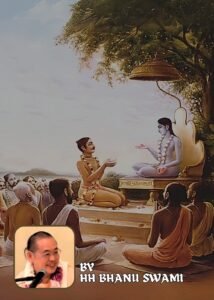
So, previously I was talking about knowledge. And that knowledge destroys the illusion of material existence. Now, an example is given to illustrate how this knowledge is produced. So, in the vedic sacrifices, they need fire. Now-a-days, we use matches. But in the vedic system, they make that fire by using three pieces of wood. So, there’s a stick on the bottom with a hole in it, a piece of wood on the bottom, a board with a little hole in it. And there’s another board and then there’s a stick, a rod in between. So, using the hands, just like a turning rod, you make the middle rod turn around and it generates heat at the bottom. And there’s a little bit of dry wood at the bottom and it catches fire because of the heat. So, the guru is considered to be the lower piece of wood and the student is the upper piece of wood. And the instruction is the rod in between. So, by following the instruction, then one gets knowledge like the fire. So, in this way, we have an illustration of the function of guru. So, here the function of guru is to teach, give some instructions. So, we can say this is a siksha guru. So, the siksha is important, but then there has to be a result from the siksha. So, the student has to use the instruction properly and then he will get knowledge revealed.
So, we may have a case where we get a guru and a disciple and no instructions. So, we have an upper stick and a lower stick, but no connecting stick, so nothing happens. Or we may have three sticks, we have the guru and the disciple and the instruction, but no fire. So, why no fire? The disciple may be incapable of understanding anything. He may not be interested at all. And thus, that instruction will give no result. So, to function properly, the guru has to be capable of giving good instructions. So, to function properly, the guru has to be capable of giving good instructions. And the disciple has to be qualified to use the instructions to get a good result. So, if the guru is qualified, the disciple is qualified and he gives the instruction, then we should get the result [Laughs].
So, one of the offenses to the holy name is guror avajñā. Which can mean not following the guru’s order or disrespecting the guru. So, real respect for guru is not just worshipping him with flowers, but to follow his instructions nicely, so we get the result. So, in Bhagavad Gita it says, pariprasnena sevaya, that we should be inquisitive and we should also render service. One can render service by washing the floor or gathering firewood as Krishna and Balarama did. But the real service is to follow the instruction, the spiritual instruction.
So, the instructions of course, have to be proper instructions. If the guru gives instructions which are not according to scripture, then they are also useless. So, therefore the guru has to have knowledge of scripture. How does he get the knowledge? He has to come in a proper sampradaya with acharyas. So, at least if the guru conveys the proper knowledge from the acharyas, then the student can take advantage of that. Of course, apart from giving the knowledge of the scriptures, behind that knowledge there is also the realization.
So, all devotees can act as gurus. And they can give some scriptural knowledge. But those who are on a higher level, give better knowledge. So, one may be at nistha or ruchi or asakti or bhava or prema. And the same knowledge even if it is, same knowledge is given by all of those different levels of persons, still, the knowledge given by the person in prema will be much more powerful. So, they will be able to elevate us to a higher level. Nevertheless, anyone who gives the knowledge is giving someone value. And therefore, we have gurus on different levels. And as Bhagavad Gita says, pranipat, we have to give respect. So the respect is given according to the amount of knowledge that the guru has and according to his realization. So, then the greatest respect will be given to the prema bhakta. And then to the person on bhava. And then next to the person at asakti stage. And then to the person at ruchi. And then to the person at nistha. So, they are all respected and one is given more respect than the other. So, if we follow this process, then of course, we get the result, we get the fire. Of course, if we get the knowledge from the prema bhakta, we will get big effect. So, Bhaktivinod Thakur mentions in one place that, the prema bhakta, if he gives mercy to a person, then that person can, if he has no background in bhakti or anything, he can elevate that person upto prema. And a person who has bhava can elevate a person upto bhava, if he already has a background in some way. And those who are lower, they can elevate a person to lower stages.
Of course, we also have to understand that generally people will take many lifetimes to advance. So in one lifetime, one takes gurus to get to nistha, another lifetime to get to ruchi, another lifetime to get to asakti, another lifetime to get to bhava, another lifetime to get to prema. That’s the normal process. So, one may have many gurus, siksha gurus and diksha gurus in many lifetimes. And by the mercy of Krishna, there is an arrangement. So, you will get the proper guru to help you advance.
So, this example is given here to illustrate how the guru gives instructions. So the whole topic here is getting proper knowledge. So we get the knowledge from the guru or we get the instruction from the guru and then we use that instruction to develop our knowledge. Previously I said that you have to take the knowledge and try to understand it. And then using that knowledge, one tries to get more and more realization of Krishna. So that is what knowledge is. We have these two stages, simulating those instructions and putting them into practice and then getting some realization. So the disciple, in order to properly get that knowledge, has to give that respect to the guru. And that is why we have in the scriptures so many verses telling how you have to worship guru. But most of these instructions are about siksha guru, giving instructions. As this verse also is.
And as I said, according to the level of the guru, then one gives different types of instructions. So, ideally one will have a guru in prema. And therefore one gives the utmost respect. But unfortunately most people will not get a guru in prema. So we have to settle for gurus on lesser level. But still we have to give respect. Why? Because they are giving the same knowledge. Knowledge is non-different from Krishna. Only by respecting that knowledge we can attain Krishna. At the same time, we understand that, that particular guru who is on the lower level is not on the same level as the person in prema. But we give proper respect because we understand that knowledge is absolute. So if we follow this process, then we get the result, like the fire.
Hare Krishna.
Q & A :
1.) Thank you, Maharaj. Maharaj, are there any possibilities for a disciple to have better or higher realizations in terms of rasa, etc, in relation to his own siksha guru or diksha guru? If so, are there any instances?
Well, anything is possible by the arrangement of Krishna. However, usually the progress is very gradual. And Krishna makes an arrangement at different times so that, you get the proper guidance from different persons.
2.) Maharaj, if I understood right, one who is at the level of prema as spiritual master can even give this prema to the lowest who is not so qualified or deserving. If that is the case, generally all the prema bhaktas are desiring to get all the souls back to the level of prema. How does it work Maharaj?
Prema bhaktas are very rare. And among them, most won’t preach. So, the one who preaches is exceptional [Laughs]. So, Jiva Goswami gives the example of Narada Muni [Laughs]. Who is pretty special because he is also a shaktyavesa avatar [Laughs]. So, certainly he gives mercy, but then that mercy may take different forms with different persons. So, by his mercy, Dhruva got a vision of Supreme Lord [Laughs]. Got a darshan of the Supreme Lord. That took him maybe six months. By his mercy, Mrgari the hunter got to bhava in three months. But Narada Muni may not give mercy at all to some people. So, he gave mercy to Mrgari, the hunter because Mrgari, the hunter gave him respect. And Mrgari, the hunter followed his instruction and he threw down his weapons and agreed not to kill anymore animals [Laughs].
3.) Maharaj, do we understand from Mrgari, from what you said that, respecting the spiritual master and following his instructions very much, does attract the mercy of the spiritual master as well as the guru parampara?
Well, following the instructions is actually the ultimate purpose of accepting a guru. So, that’s the best way we can please him and advance. So, then gurus also have to be very careful. They should be very careful what kind of instructions they give. So, if it is spiritual instruction, there is no problem. If it’s material instruction, then there maybe problem. Because most of us are not omniscient and we don’t know everything about everything in the material world. So, if one expects the disciple to follow materially imperfect instructions, then there may have a trouble.
Devotee: Maharaj, however, when the spiritual master unavoidably gives some instructions on the material aspects of a disciple, i mean, his motive is somehow or the other, encourage this disciple to the ultimate prema level. So in that sense, the spiritual master is never in trouble. Can we understand? Though the instructions could be different or it was followed properly, it was not followed properly. But the motive of the spiritual master is ultimately to get the disciple to the prema.
HH Bhanu Swami Maharaj: If the disciple understands that, understands that there may not be materially perfect instructions and therefore it is subject to fault and maybe disaster, and he accepts disaster also, then there is no problem. However, the disciple may not understand that. And then he will blame the guru [Laughs]. Guru made a bad marriage. Guru did this. Guru did that [Laughs].
4.) In the purport, it is mentioned that when the disciple takes shelter of the lotus feet of the spiritual master, he automatically acquires perfect knowledge of his original spiritual form.
So, of course, if one wants to get spiritual body, there’s also particular instructions for that. One can get general spiritual body or one can get particular spiritual body. So, for instance, in different sampradayas, they worship Vishnu. When they go to the spiritual world, they get four-handed form. However, with Krishna, there are also special forms. One can take a Cowherd boy form or a Gopi form or Manjari form or whatever. But then one has to worship in a certain way. One has to concentrate on those particular form.
5.) Maharaj does the disciple aspire for it and ask the spiritual master that he is aspiring for such a form? Does the disciple does it? At what stage does he do that?
That is the path of Raganuga. And at a certain stage, a disciple may approach the guru. And if the guru is qualified, then he may give particular form and particular sadhana.
6.) So, how to know we are in Raganuga?
Well, according to Rupa Goswami, one has developed a great greed for following after the inhabitants of Vraja. And therefore, it won’t be difficult for that person to become absorbed in always thinking of the pastimes of those devotees.
7.) Hare Krishna Maharaj. Dandavat pranam Maharaj. We give respect, we give love, affection and follow the instructions of our guru. But in our current situations, how do we realize the reciprocation back from him?
Well, if he’s not there in person, the only way is something like Krishna [Laughs], we worship Krishna and then, we have faith that He has responded.
8.) Maharaj, can you please inform the reference to the three sticks analogy one more time? And then the other question is, you mentioned about Narada’s example. How do we realize or what level did Nalakuvera and Manigriva attain?
HH Bhanu Swami Maharaj: What’s about the sticks?
Devotee: They want to have a repeat on that explanations Guru Maharaj.
HH Bhanu Swami Maharaj: Read the verse.
Devotee: [Laughs]. Maybe the second question about what kind of attainment about Nalakuvera and Manigriva attain?
HH Bhanu Swami Maharaj: They got out of their tree bodies and went back to their devata bodies [Laughs].
9.) What if the instruction of Srila Prabhupada and instruction of one’s guru differ? In such case, whose instruction to follow, one’s diksha, siksha guru or acharya, of Srila Prabhupada?
So, which instruction of Srila Prabhupada? He gave many instructions. So, one could say, well, Prabhupada’s instruction is different from my guru’s instruction, but then which instruction? Prabhupada’s [Not clear] [Laughs]. Well, the general instruction is to perform bhakti and chant Hare Krishna to attain Krishna. Details may change according to the circumstance and the different person.
10.) Do I need to awaken my svarupa which is already there, or develop it by desiring particular type of samantrishi? Which means svarupa is already there or I need to desire?
Well, if you practice jnana, you don’t develop anything. So, it depends on your practice.
11.) Maharaj, the question is, Brahma Sutra mentions a liberated person can take form or be with no form. In taking forms, it is mentioned one can take any forms and as many forms. On what pramana is it concluded that people in Vaikuntha have only four (handed) forms?
So, there are some sadhakas who don’t concentrate on any particular form of the Lord. Consequently, they can go to the spiritual world and they can choose one day one form, one day another form, etc [Laughs] without much, too much attachment to any of them. In the spiritual world, you can attain any form you want. So, in Brhad Bhagavatamrta, it is described that some of the inhabitants of Vaikuntha, they change into animals and birds and plants, whatever they want to, sometime. That is only for particular service. And then they have their basic form, they return to. The more one is attached to a particular mood and a particular service, the more likely is, one does not change one’s form.
12.) Sometimes when a devotee is chastised or cursed by a guru, it turns out to be blessings for the devotees. For example, Jaya, Vijaya, Nalakuvera, Manigriva. As they all got, after being cursed, the direct association of the Lord and they saw the Lord face to face.
HH Bhanu Swami Maharaj: What’s the question?
Devotee: The chastisement is a blessing for the devotees. Because most time, devotees don’t like to, people don’t like to get chastised. But Arjuna took the chastisement of Krishna very nicely, later surrendered.
HH Bhanu Swami Maharaj: Yeah. So, that is possible. But better we get blessings [Laughs].
13.) Can Vaikunta vasis get Goloka vasis moods and go to Goloka?
Anything is possible, but that would be very rare. Generally in Vaikuntha, they are satisfied with whatever role they have there. For instance, Hanuman never changes his role and becomes a Gopi [Laughs].
14.) Svarupa is fixed always or changes according to desire?
It depends on what do you mean by svarupa. In one sense svarupa never change because we are always atma and that’s our svarupa. The spiritual vigraha may change according to certain circumstances but that even is rare.
15.) How do we know that what svarupa or rasa a devotee is? Will the guru know or will the devotee himself know about his svarupa or rasa?
It will develop by his hearing from Bhagavatam.
Devotees: Grantharaj Srimad Bhagavatam ki jai!!! HH Bhanu Swami Maharaj ki jai!!! Srila Prabhupada ki jai!!!