Seminar on Gaura Tattva | HH Bhanu Swami Maharaj | ISKCON Japan | 16 November 2025 |
nama oṁ viṣṇu-pādāya kṛṣṇa-preṣṭhāya bhū-tale
śrīmate bhaktivedānta-svāmin iti nāmine
namas te sārasvate deve gaura-vāṇī-pracāriṇe
nirviśeṣa-śūnyavādi-pāścātya-deśa-tāriṇe
jaya śrī-kṛṣṇa-caitanya prabhu-nityānanda
śrī-advaita gadādhara śrīvāsādi-gaura-bhakta-vṛnda
Hare Kṛṣṇa Hare Kṛṣṇa Kṛṣṇa Kṛṣṇa Hare Hare
Hare Rāma Hare Rāma Rāma Rāma Hare Hare
HH Bhanu Swami Maharaj:
So when we come to a temple, we come to worship the Supreme Lord. And people will ask, so who is the Supreme Lord? And different religions will give you different answers. Many religions, of course, say there is only one God. Some religions say there are many Gods. However, if we talk about God, the usual definition is there’s no one superior to Him.
So in India, when people inquire about God, many people will say, well, we have many Gods. However, if we look at the scriptures of India, that is the Vedic literature—Vedas, Puranas, Bhagavad Gita, etc, we will see that these scriptures also say there is one God. And many of these forms that people worship in India actually are not supreme, they’re like servants of God.
Another problem when it comes to talk about God is that, many religions don’t even accept that God can have a form. However, if we look at Bhagavad Gita and other scriptures, we’ll see that yes, God does have a form. In fact, the Vedic religion is maybe the only religion in the world that does accept a form of one supreme God. However not only do the vedic literatures tell us God has a form, but they also say God can have many forms. So this is also something quite unique in this world [Laughs]. Not only God can have many forms, many extremely different forms. So God can have a human-like form, but he can have a form of a lion, he can have a form of a horse, a form of a snake, a form of a turtle, a form of a boar. And these, of course, are described in the Srimad Bhagavatam. So we have one God who could have many forms but all these forms are spiritual not material.
So as Caitanya Mahaprabhu, he takes the form with the mood of Radha. So he can appreciate the mood of Radha. So, Radha of course, appreciates Krishna with all the wonderful qualities. But Krishna himself wonders how, what does she really appreciate? So in order to understand what qualities in Krishna, Radha appreciates, then he takes the form of Caitanya Mahaprabhu and acts with the mood of Radha. And the third reason is that Krishna cannot understand the great joy that Radha feels for him. So he appears as Caitanya Mahaprabhu and with the mood of Radha to appreciate Radha’s joy. And thus, Krishna appears as Caitanya Mahaprabhu with the mood of Radha. This of course is a very internal reason for Lord Caitanya appearing. So, when we think of Supreme Lord, we think of one person. When we think of Caitanya Mahaprabhu, we should think of him as non-different from Krishna. But he takes on the mood of Radha, so actually it’s a combination of Radha and Krishna. So he’s actually Krishna but he has the mood of Radha. And because of that feeling of Radha, instead of being blue, he turns golden like Radha. So another name for Krishna is Gauranga. So, Gaura means golden, so he’s famous for being golden in complexion. So he’s Krishna with the mood of Radha and he becomes golden.
It is said in the scriptures that actually the Lord appears in three Yugas even though there are four yugas, so in Kali Yuga the Lord does not appear. Therefore, he is called tri yuga, he appears in three yugas. So then, what happens to Kali Yuga [Laughs]? So, usually it is said that the Lord does not directly appear, a Jiva with special powers appears, this is called a saktyavesa avatar. So this is actually a Jiva, a regular person like us, but with special powers. For instance, Narada Muni is also a Jiva with special powers, he’s called an avatar but a saktyavesa avatar. So Krishna himself appears in Kali Yuga, so he’s not a saktyavesa avatar when he comes as Caitanya Mahaprabhu, but he hides his nature as the Supreme Lord, so he doesn’t kill demons [Laughs]. So therefore, he is said to be channa in Kali Yuga, which means covered or hidden. So, channa avatar, which means he acts more like a human being. But we know that Krishna also acts very human like, but he also killed a lot of demons [Laughs]. He also shows universal form. So, many people are aware Krishna is Supreme Lord. But Caitanya Mahaprabhu hides powers, so he doesn’t show great powers. And he actually acts as a devotee of the Lord. And later on he took sannyasa, he acts like a sannyasi, as if he’s renouncing the world because he’s trying to give up material attachment. So he acts very human-like.
There are several references to Caitanya Mahaprabhu in Srimad Bhagavatam. So when Gargamuni comes to give names to Krishna and Balaram, at that time we have a particular verse. He says that in Dwapara Yuga, that was when Krishna appeared, the source of avatars appeared and it’s Krishna. And he appears with black colour, and in other Yugas he is white, red and yellow. So white means Satya Yuga avatar is white, Treta Yuga avatar is red. Kali Yuga avatar is pita, which means golden in colour, yellow, that’s Caitanya Mahaprabhu. So, later in the Bhagavatam, there is a description of the avatars. And finally there is a description of the Yuga avatar for Kali Yuga. And there it is said that this avatar appears as the same class as Krishna, Krishna like. But he’s not black [Laughs]. He is the opposite, he is pale in colour, which means golden in colour [Laughs]. So and instead of having weapons like chakra or sankha, club etc, he has his associates [Laughs]. So every Yuga avatar has a special type of dharma or a special way of worshipping the Lord. So, in Satya Yuga the white avatar teaches meditation. In Treta Yuga, the yuga avatar is red, he teaches homa, sacrifice, yajna. In Dwapara Yuga, we have black avatar Krishna, blue avatar Krishna, he teaches worship of the deity. And the avatar in Kali Yuga teaches Sankirtan. Sankirtan means chanting the Name of the Lord. So this is what Lord Caitanya does, he appears with this golden colour, but he’s same as Krishna and he teaches Nama Sankirtan.
So not only does Krishna want to experience Radha’s love, but he comes to teach the Yuga dharma, Sankirtan. So in the Caitanya Caritamrita, we find the description of Pancha Tattva. Of course Tattva means truth, it also means element. We have the five material elements; they are Tattvas. It also means principle. So, when we say Pancha Tattva, pancha means five, so, there are five principles represented by five persons.
Of course, it’s explained, ‘pañca-tattvātmakaṁ kṛṣṇaṁ bhakta-rūpa-svarūpakam bhaktāvatāraṁ bhaktākhyaṁ namāmi bhakta-śaktikam’ (CC Adi 7.6). So, this is offering respects to Krishna, who is non-different from the Supreme Personality as the devotee, Bhakta Rupa – Devotee Incarnation, Svarūpa – Devotee Manifestation, Bhakta Avatara – Pure Devotee, Bhakta and Bhakta Shakti – the energy of the Lord. So who are these? We have of course, Caitanya Mahaprabhu, he is Supreme Lord taking the form of a devotee. So then, the Lord of course can have many forms, he expands, so the first form of expansion is Nityananda Prabhu, first expansion. The Lord also expands to create the material world as these Purusha Avatars like Mahavishnu. Advaita Acharya is this Mahavishnu, and who is the devotee, the Jiva Tattva, that is Srivasa Pandit and who is the Shakti, that is Gadadhara. So in this way we have five persons including Caitanya Mahaprabhu representing Supreme Lord, his expansion, Purusha Avatar to create the material world, the Jiva Tattva. So, of course, Krishna in Goloka appears with Radha, and also with Balaram, and then Balaram expands into Mahavishnu to create the material world, and then within the material world we have some Jivas appearing as Saktyavesa avatar. So Radha and Krishna are Caitanya Mahaprabhu and Gadadhara. Balaram is Nityananda, Maha Vishnu is Advaita Acharya and Saktyavesa avatar, Narada Muni is Srivasa Thakur.
So just as Krishna and Balaram are brothers in Vrindavan, and they display friendly relations with Sakhya Rasa, so Nityananda and Caitanya Mahaprabhu display Sakhya Rasa—friendship. We see in the pastimes of Lord Caitanya mentioned in Caitanya Caritamrta that Nityananda and Caitanya Mahaprabhu were often joking with each other. That’s because they have very friendly relations. So Lord Caitanya appears in Kali Yuga and Krishna appears in Dwapara Yuga. But when Lord Caitanya appears, he also appears with associates who were also in Lord Krishna’s pastimes. An example of the friendly relationship between Nityananda and Lord Caitanya is the festival of Panihati. So, there, Nityananda is present and he says, I’m in the community of cowherd boys, so all the people around me are also cowherd. So we see in Krishna’s pastimes that Krishna and Balaram go up to the forest with all the cowherd boys and then they eat together, they eat their lunch on the bank of the Yamuna. So Nityananda came with all of his associates to Panihati on the bank of the Ganga and then he decided to have a similar type of meal with all of his associates. Lord Caitanya wasn’t there, he was in Puri. But Nityananda meditated on all that in his mind. Speaking to him, joking with him and eating. In this way that pastime is resembling pastime with cowherd boys.
So, there is a verse from the Padma Purana that says that Krishna sells himself to the devotee, he becomes subservient to his devotee. So, all the devotee has to do is offer a Tulasi leaf and some water. And if you offer this to the Lord, the Lord says, I am yours, I belong to you. Advaita Acharya, before the appearance of Caitanya Mahaprabhu, was lamenting for the condition of the people in Kali Yuga. In order to purify the people of Kali Yuga, the Lord himself will come as an avatar. So then he thought of this verse, ‘I can buy the Lord, I can control him, I’ll just offer Tulasi leaves and Ganga water’. So that’s what he did [Laughs]. He began worshipping his deity with Ganga water and Tulasi leaves. Lord you have to come, you have to appear in some form.
So Gadadhara Pandit is the Shakti of the Lord, which means Radha. But just as Krishna becomes covered as Caitanya Mahaprabhu, Radha also is covered, does not really act like Radha in the pastimes with Caitanya Mahaprabhu. So Gadadhara was so attached to Caitanya Mahaprabhu that he followed Caitanya Mahaprabhu to Puri. He had stayed there for the rest of his life with Caitanya Mahaprabhu. So, sometimes there are deities of Gauranga and Gadadhara, just as we have Radha Krishna, so that’s Gaura with Gadadhara.
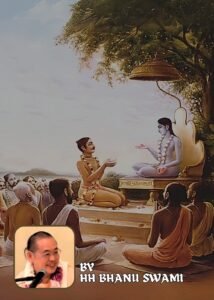
So, Srivasa Pandit is a Jiva, a special Jiva, so he is identified as Narada Muni. So Narada Muni is empowered to spread Bhakti. And similarly Srivasa Pandit is empowered to spread Nama Sankirtan. So, in the Caitanya Caritamrita it is described that how Lord Caitanya would have Kirtan in Srivasa Pandit’s house. So inspired by Srivasa Pandit, Lord Caitanya began Sankirtan there. And it was in Srivasa Pandit’s house that Lord Caitanya revealed himself as Supreme Lord to his devotees. So, we do have in the evening this arati song, where we offer lamp to the Lord and we are actually singing about the appearance of Lord Caitanya as the Supreme Lord in Srivasa Pandit’s house. So, that song describes, Caitanya Mahaprabhu sitting on a jewel throne and all the devatas are worshipping. And Nityananda is on the right hand side, on the left we have Gadadhara accompanied by Advaita and Srivasa Pandit is holding an umbrella.
So, Lord Caitanya does not appear alone, the Supreme Lord comes with his associates. So, Lord Caitanya had pastimes in Navadvip, so he had his associates there. He has his associates in Puri where he stayed for a long. And he has his associates in Vrindavan, he sent certain devotees to Vrindavan. So, the followers of Lord Caitanya have identified the people, the devotees in Lord Caitanya’s house with devotees in Krishna’s house. So, we know that Krishna was the son of Nanda and Yasoda. And grandfather and grandmother were Parjanya and Variyasi.
So, we find that in Lord Caitanya’s pastime, his father and mother were Jagannatha Misra and Saci. And grandparents were Upendra Misra. So Balaram was born to Vasudeva and Rohini. So, Nityananda is Balaram. So, Lord Krishna had a Guru and he was a householder, Sandipani Muni. In Lord Caitanya’s pastime, he got sannyasa mantra from Kesava Bharati. In Krishna’s pastime, Gargamuni gave name to Krishna and Balaram. So, Nilambara Chakravarthi, he gave the name to Caitanya Mahaprabhu.
So in Vaikuntha, Vishnu has two wives, Lakshmi and Bhudevi. In Lord Caitanya’s pastimes, he had two wives, Lakshmi Priya and Vishnu Priya. So Balaram married Revati and similarly Nityananda married Jahnava and Vasudha. So we have Narada Muni, he has a friend called Parvata Muni. So, he was Pandit’s brother, Sivarama Pandit like Parvata Muni.
So, we also have some different characters here, so one of Lord Caitanya’s associates was Murari Gupta, but he is considered to be Hanuman like Rama lila. And the reason is that Murari Gupta was very devoted to Ramachandra. Caitanya Mahaprabhu was always preaching, everyone should worship Krishna as Supreme Lord, Radha Krishna, Lalita are higher. And he told Murari Gupta, you have to worship Krishna. Murari Gupta when he heard that, became very disturbed. And all night he couldn’t sleep. How can I give up worshipping Ramachandra? The next morning, he came to Lord Caitanya and said, I cannot follow your order. And Caitanya Mahaprabhu smiled and said, very good [Laughs].
So, we also have Haridas Thakur. He was born in a Muslim family, but he became very great devotee of Caitanya Mahaprabhu. We consider it to be, Prahlad is also tortured just like Haridas Thakur. So in Lord Caitanya’s and Nityananda’s pastimes, we have these associates, they are identified as cowherd boys in Krishna’s pastimes. They were very devoted to Nityananda prabhu. We have Veda Vyasa appearing to spread the Vedas etc, and Vrindavan Dasa Thakur appeared to write Caitanya Bhagavatam.
Brihaspati, of course, he is the priest of the devatas, very, very intelligent. So, he appeared as Sarvabhauma Bhattacharya, who was very, very learned. Ramananda Raya was a very intimate associate of Caitanya Mahaprabhu in Puri. So, he is considered to be a combination of four people. Arjuna, who was the one of the Pandavas [Laughs]. In Vrindavan, there is a cowherd boy called Arjuna. He is also considered to be one of the chief gopis, that is Lalita. and also a gopi called Arjuni
So Radha and Krishna, of course, are represented by Caitanya Mahaprabhu and Gadadhara. And Radha, Krishna have their main associate Gopis like Lalita and Visakha, we have eight principal Gopis there. They are identified as great devotees, generally in the pastimes in Puri. We have, Lalita is Ramananda Raya, and Visakha is Swarupa Damodara, very bold, very eloquent for Caitanya Mahaprabhu. And in Vrindavan we have the Goswamis, so, they served Caitanya Mahaprabhu, but they served in a great way. So they identified as Manjaris, who are Gopis, but they serve Radha and Krishna in a little different way. So Rupa Goswami is identified as Rupa Manjari, and Sanatana Goswami as Rati Manjari. Gopala Bhatta as Guna Manjari. And Raghunatha Dasa as Rasa Manjari. So in this way, the associates of Lord Caitanya are all identified, generally with associates of Krishna.
So, as I mentioned, generally, the Supreme Lord is one. But he takes many forms. And though there are many forms, there is one Supreme Lord. However, in those different forms, the Lord will display different amounts of qualities. Of all the many forms, we’ll put Narasimha, Rama, and then finally Krishna at the very top. So, Krishna shows maximum amount of sweet qualities. So, this is the conclusion of Srimad Bhagavatam. But as I said, Caitanya Mahaprabhu is identified as Krishna, so he’s also at the very top.
So Krishna is on the top, but then Krishna has various relationships. So, Krishna has relationship with friends as well. He has friends, so this is called Sakhya. He has parents, Nanda and Yasoda, Vatsalya rasa. And then Krishna has relationship with Gopis, so this is called Madhurya-rasa. So Krishna is at the very top, but then in these relationships, we find that as we proceed upward, the relationship becomes more intense and more blissful. So, therefore, Krishna experiences greatest bliss with the Gopis. So, there are billions of Gopis. But then, at the very top, we have Chandravali and Radharani. So, of course, Madhurya-rasa is the most intense, most blissful, but then the relation of Radha and Krishna is the most blissful of them. So this is what Krishna displayed in Srimad Bhagavatam.
The topmost bliss takes place in his rasa-lila with the Gopis in Vrindavan. But because this is the highest, it’s also the most difficult to attain. It’s the most difficult to understand. So, therefore, Lord Caitanya appeared to make this love available to everybody in the world. How does he do that? Lord Caitanya is Krishna. He has the mood of Radha. He is combination of Radha and Krishna. So he appears in Kali Yuga to give it to all. So, the main way he does this is through Nama Sankirtan. So this is easy way to progress in spiritual life, as this is yuga dharma, but more than that, it’s the easy way to get prema.
Lord Caitanya Mahaprabhu is said to be the most merciful avatar. So, Lord Caitanya taught this particular combination of names. So, why Hare? Because this means Radha. We take the mercy of Radha, through the mercy of Radha, we get the mercy of Krishna. So, we call out to Radha, we call out to Krishna. So, then Krishna says, what do you want? So, what do we ask for? What do we want? We also call out to Rama, but we call out Krishna, who gives enjoyment to Radha. So we’re not asking for material benediction. We’re not asking for liberation; we’re asking simply for service. So, in this way, Caitanya Mahaprabhu appeared in Kali Yuga to give us the highest treasure of all, love of Radha Krishna.
Hare Krishna !
Q &A:
1.) Question [ Not audible]
So, a lot of the identities are with Krishna in Vrindavan. Particularly with the pastimes of Lord Caitanya and Vrindavan. When we have the pastimes of Puri, then we do see there are some associates more from Dwaraka lila or whatever, because we have the Pandavas. So, of course, the relationship of Vasudev and Devaki with Krishna is also Vatsalya, but it’s mixed with the awareness of Krishna being the Supreme Lord, so it’s much weaker than the Vatsalya of Nanda and Yasoda. So, in the pastimes of Navadvip, all the people also, all those devotees, they are also, not aware of Caitanya Mahaprabhu as the Supreme Lord.
2.) Maharaj ji, in this, what is real definition of detachment, because you told about Caitanya Mahaprabhu was a Sannyasi and you talked about the detachment. But He used to send Jagadananda Pandit to his mother Saci Devi to take care of her very quite often. But in Kali yuga it is considered attachment.
So Lord Caitanya was acting as a Sannyasi, so, therefore generally he chose detachment. At the same time, with bhakti in general and in Lord Caitanya’s movement, detachment is not the ultimate principle. And in Nectar of Devotion, Rupa Goswami says too much detachment also is not favourable for bhakti. The main principle is attachment to Krishna. The more we are attached to Krishna, the less we are attached to anything material. And at the same time, we should not artificially renounce everything. If we can engage things in devotional service, we use them. So, though we are detached from things materially, but we can see there’s a chance to engage people and things in devotional service, so we can do that.
3.) There are lot of people like, as we greet with Hare Krishna, as we greet everyone.There are some people who greet with Radhe Radhe. As you said that, if we call Radha then we are calling Krishna, so why we are not getting Radhe Radhe?
In one sense, any name of the Lord is wonderful to chant. But we also follow sampradaya. So, we follow after Lord Caitanya and their devotees. And generally they chant Hare Krishna.
4.) Question [Not clearly audible]
[Not clear] [Laughs] Radhe Shyam Radhe Shyam Shyam Shyam Radhe Radhe. They say it, so, they do that, but now Lord Caitanya introduced this. And he did this particularly because it’s found in Upanishad, which is vedic scripture. So it’s the name but also vedic mantra. So, it has vedic pramana to it.
Devotees: HH Bhanu Swami Maharaj ki jai!! Srila Prabhupada ki jai!!!