Seminar on Insights of holy name – Session 2 | HH Bhanu Swami Maharaj | ISKCON Chennai | Acharya Vani Mahotsava | 24 Jan 2026
Devotee:
Yesterday we had the inaugural address by a class on the holy name by His Holiness Bhanu Swami Maharaj. And fortunately, we have other speakers like Jagat Sakshi Prabhu, Madhav Gopinath Prabhu who are here to enlighten us on the first canto.
We all know Viswanatha Chakrawarthy Thakur played a very significant role for the establishment of International society for Krishna consciousness. How is it? Prabhupad, while he had the instruction from His Divine Grace Bhakti Siddhanta Saraswati Thakur to translate their books into English and spread it in the western world. He was very confident.
He was on the mercy and the order in executing the order of a spiritual master. But in the initial stage, he didn’t know how it’s going to happen.
Then in the process, as he was studying the commentaries of the previous Acharyas, particularly the verse 2.41 from the Bhagavad Gita, “vyavasāyātmikā buddhir;ekeha kuru-nandana; bahu-śākhā hy anantāś ca;buddhayo ’vyavasāyinām“ – Those who are resolute in purpose, their determination is one. And the intelligence of those who are resolute is many branched. Then in the commentary of Srila Viswanath Chakrawarthy Thakur, he understood then, what is that resolute. The resolution, the resolute purpose, those who are resolute means, resolute in executing the order of the spiritual master.
This particular verse was the inspiration for Srila Prabhupad to spread this Krishna conscious movement, translating, spreading all around and that’s why we are all here. So in that sense, the instruction from Bhakti Siddhanta Thakur, inspiration from Viswanath Chakrawarthy Thakur, the perspiration of Srila Prabhupad, we are all assembled here. So we are extremely grateful to Viswanath Chakrawarthy Thakur for this contribution. So let’s express our gratitude, I mean probably both the commentaries and the translations on the books authored by Viswanatha Chakrawarthy Thakur, 40 in numbers. And we have been fortunate to have the mercy of Srila Bhanu Maharaj to give it to us. So we are very, very thankful to Maharaj for being with us and we will continue the today’s session.
Hare Krsna !
HH Bhanu Swami Maharaj:
nama om vishnu-padaya krishna-preshthaya bhu-tale
srimate bhaktivedanta-svamin iti namine
namas te sarasvate deve gaura-vani-pracharine
nirvishesha-shunyavadi-pashchatya-desha-tarine
So Viswanath Chakrawarthy was discussing this verse, two verses, from the sixth canto concerning Ajamila chanting the name.
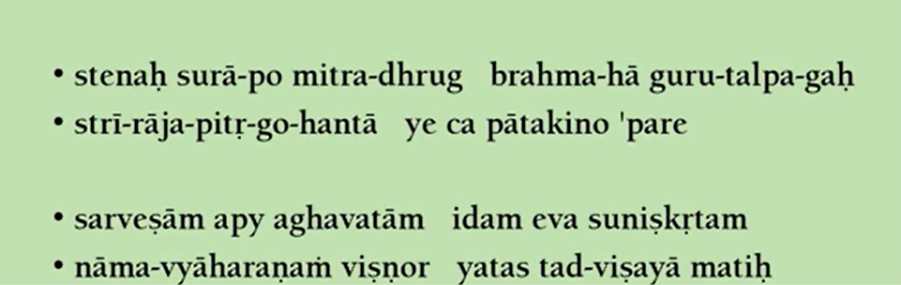
And the verse itself says that by chanting the name of Vishnu, one purifies oneself of all sins. It’s the best type of atonement or prayaschitta. And this is because, this attracts the Supreme Lord. And the other types of atonement in Karma kanda and Varnashram are not so effective.
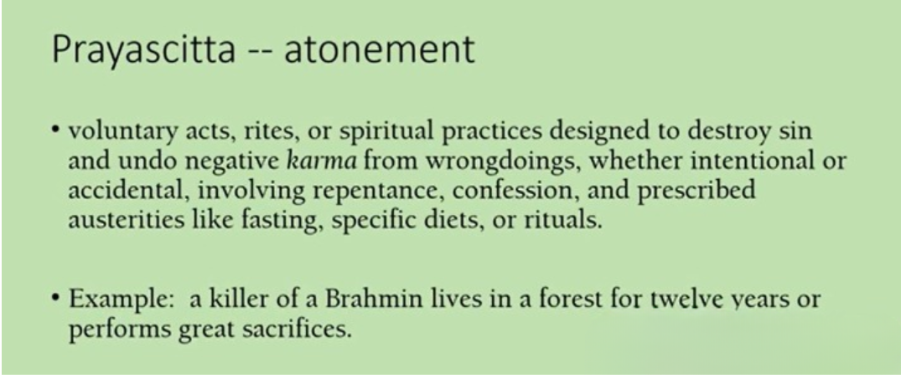
And in fact, not only are all karmas, not just some karmas, all karmas, past, present and future are destroyed. And not even that, the cause of the sinful activity, that is vashanas and ignorance are also destroyed. And not only that, they are instantaneously destroyed the first time you chant the name. And even if you only chant once. And even if you chant once and you have no devotion [Laughs]. So if that is the case, if you chant with devotion, how much greater effect you will have. So this is glorifying the effects of the name.

So this type of chanting accidentally and whatever is called namabhash. So we’re not intentionally chanting for any particular goal. We just like name your son or your name, your bakery, Krishna bakery [Laughs] or something [Laughs] or Krishna sweets [Laughs]. So that’s all namabhash.
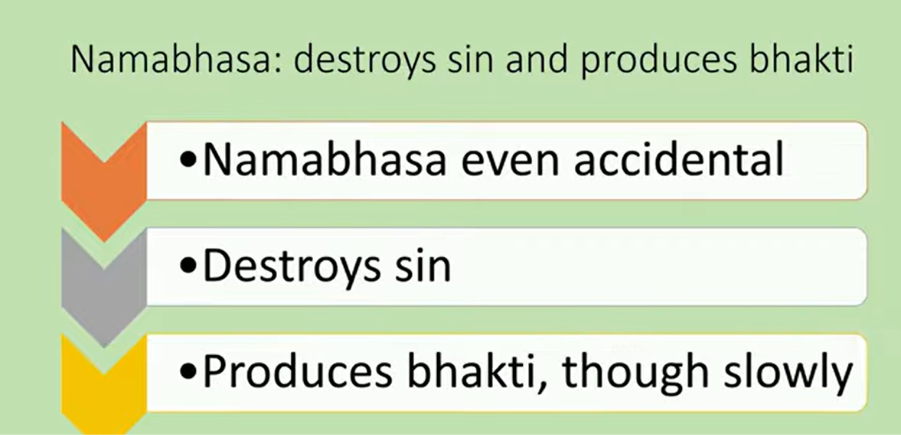
However, there’s another type of namabhash, where you intentionally chant. This however is a little different and let’s say we can say it becomes problematic. So you can intentionally chant and then you can chant with the wrong intentions. This makes it worse [Laughs]. And you can even have aparadh in the process.
So namabhash, of course, in any case, whether it’s accidental or intentional, it has effect. One effect is, it destroys sin. The more important effect for the devotees, of course is, it produces bhakti. But because it may be accidental, you’re not always chanting, it may be slow. So the destruction of all your karmas, etc. can be very quick. But producing bhakti may be a slow process. We even say the cause of faith is ajnana sukrti. So you may accidentally chant the name in previous life and that’s a namabhash [Laughs]. So if for generations your bakery is called Krishna bakery and you are generations keep chanting that and all your life you keep chanting that [Laughs], then eventually you may develop faith and then you practice bhakti. So in other words, through namabhash, you can get faith and then practice bhakti.
So someone asked yesterday, if namabhash is so powerful, why just do namabhash instead of doing sadhana bhakti [Laughs]? And one answer, of course, it is slow, because it’s not intentional. The other is, if it’s intentional but it’s namabhash, then it may be some impurities there. So again, it is slow.
So Ajamil chanted repeatedly but then he was always committing more sins. So if he committed more sins, then he has to chant more. That’s the proposal.
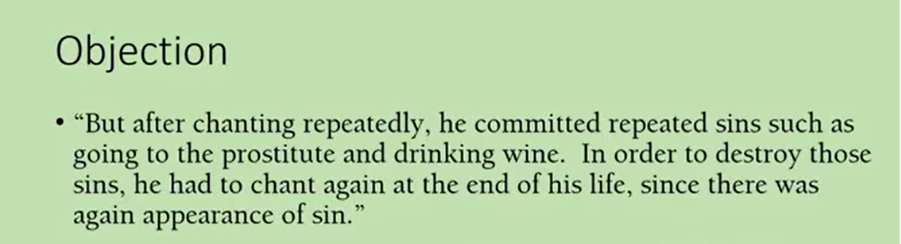
However, the answer is that ‘NO’. The name can destroy unlimited sins. So unlimited means – past, present, future. So if you accidentally chant the name, in the future you commit a sin, it has no effect. However, as I said, this type of effect is there, if one does not commit aparadh. So aparadh mean, if you are actually consciously chanting and think, I will do this and I will remove my sinful activity by chanting and we keep doing the sinful activities, then this is offense [Laughs].
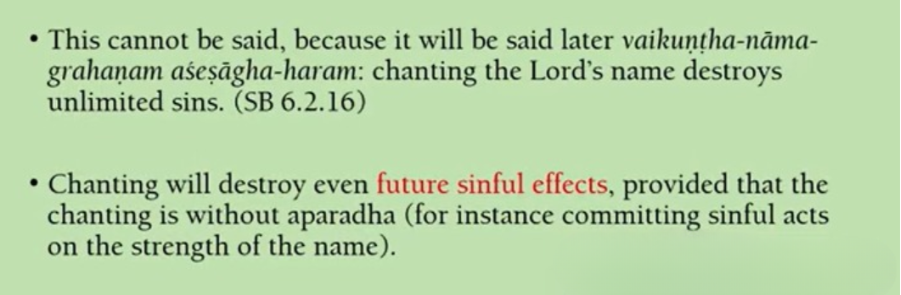
So we see that the simple act of chanting the name even once, has such power, it can destroy your future sins as well. And of course, in Karma-kanda, prayaschitta never does that. So we may wonder how is that possible? But this is the statement of scriptures.
And it’s not only the statement of Bhagavatam, we’ll find it in other places like here’s a quote from Haribhakti Vilas.
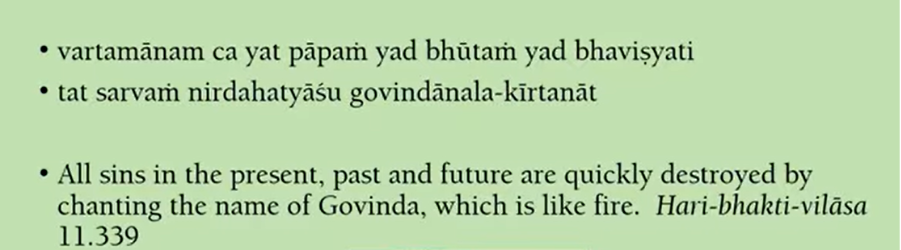
So it says particularly ‘vartamanam’ means present sins that you’re committing now, ‘bhuta’ means past sins, and ‘bhavishyati’ means future sins. So ‘sarva nirdahati’ means they’re all burned up, they’re all destroyed. In the fire of chanting Govinda’s name. So we see that chanting the name is much more powerful than any other atonement.
So here is from sixth canto itself, there’s a statement.
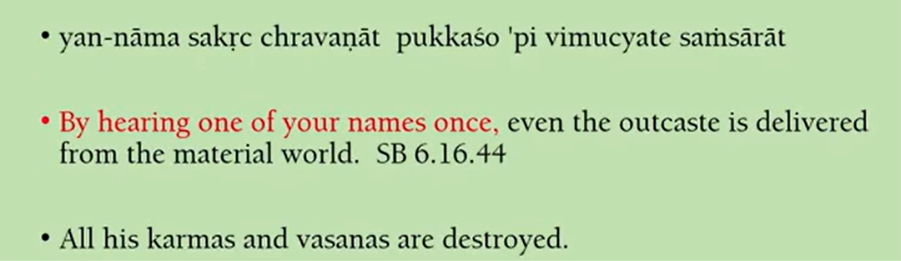
‘Pokasa’, which means an outcast, is freed from samsara. This means to be free from samsara, you have to destroy all your karmas. And how? By hearing once, not even just chanting, hearing the name once [Laughs]. So not only chanting the name once, even hearing the name once has this power to destroy past, present, future sins. So if you’re to become free from samsara, you have to destroy all your karmas. But you also have to destroy all the vasanas. And you have to destroy the ignorance. If any of these remain, you cannot get out of samsara. But chanting the name of Govinda once, you’re free from everything. And thus you are liberated [Laughs].
So of course this is actually what Haridas Thakur was glorifying with the assembly of Vaishnavas in Mayapur. So he says, even chanting in Namabhas gives you liberation. And one brahmana got up there in anger, and says, this is nonsense, you cannot say that. You have to practice jnana for thousands of years, then you get liberation. And then he angrily left things, if this is true, my nose should fall off [Laughs]. And a few days later, he got leprosy and then his nose fell off [Laughs]. But Haridas was only quoting scripture again, that’s it, it is like this. And it’s not just one place, many places in the Puranas, Bhagavatam, other places, it makes a statement.
Of course, people could say, well, that’s exaggeration. But then of course, we have one of the offenses of the Holy Name that to think that the glories of the Holy Name are exaggeration, it’s an offense [Laughs]. It is true that the scriptures sometimes exaggerate. So in the Karmakanda section of the Vedas, it is said that by doing yagyas, you get to Svargaloka and you stay there eternally. But we know that’s false. Krishna in Bhagavad Gita directly says, you go to Svargaloka, you fall down [Laughs]. But the statement is made to encourage people to do sacrifices, if they’re doing nothing, if they don’t have faith in the Lord, let them do sacrifices, go to Svargaloka and they think it’s eternal, so let them do that. So sometimes scripture does exaggerate the effects, the results. And thus we have to be careful when we quote scripture [Laughs].
If we like something, we’ll quote that and say, this is the best. And scripture will give plenty of opportunity because scripture praises everything. So for the people in Tamo-gun, Vedavyasa wrote Tamo-gun Puranas like Linga Purana, Skanda Purana, Shiva Purana, and there Shiva is glorified as the highest entity, everybody should worship him, he gives liberation, he gives the best results, etc. So that way, the Vedas are called the desire tree. You can get whatever you want from the Vedas [Laughs]. And you can even prove whatever you want from the Vedas.
But if we’re to truly understand the Vedas, we have to have a proper method of understanding. So some statements are stronger than others. And therefore, we have to be very intelligent in reading scriptures. And there are rules for interpretation given by Jaimini, who is in Karmakanda, but we still follow many of his rules. And even with all those rules, it may be complicated. Just as in law, so many laws are there, and if you follow all the laws, maybe you come up with the right result. But there’s always new cases, unpredictable circumstances. So then the judge has to hear everything, then he makes a decision. So to make things easier, at least our acharyas have solved a lot of this problem by getting rid of the contradictions and coming out with proper conclusions for us [Laughs].
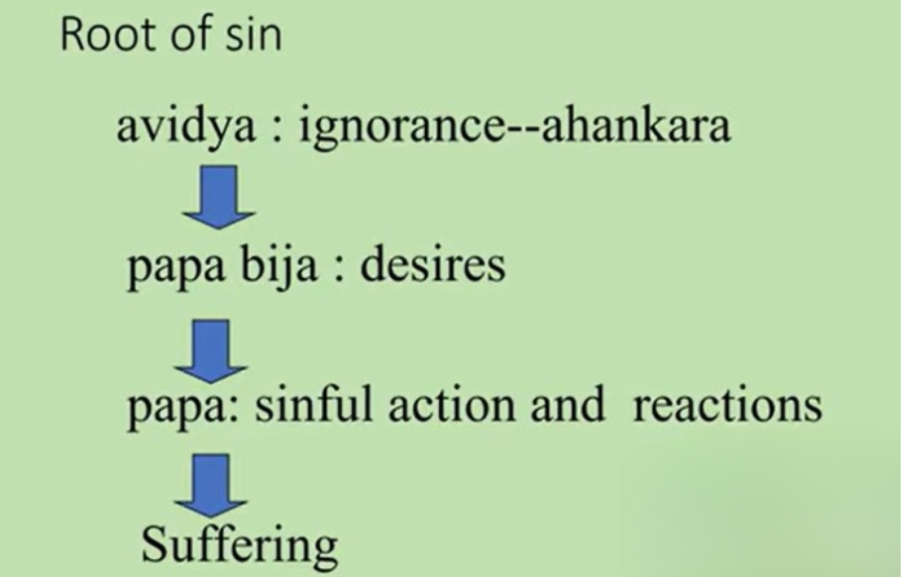
So in this case, we find that Ajamil chanted and past, present, future, everything, all the karmas were destroyed, and all the destruction took place with the first utterance of Vishnu’s name. But not only the sinful reactions, all the desires and the ignorance as well.
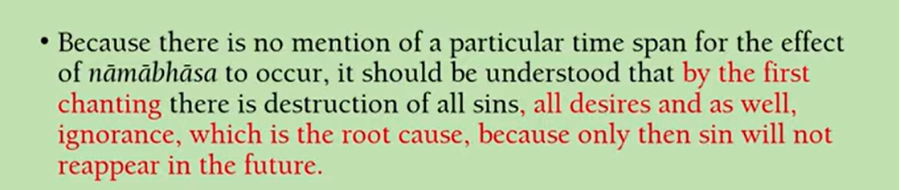
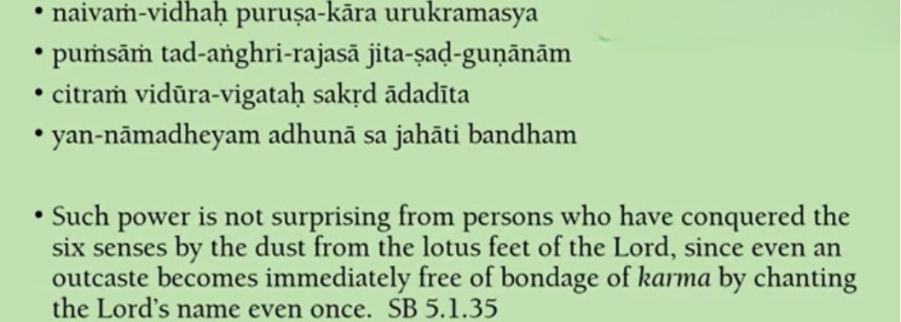
So if you destroy the root, there can be no sin in the future. So technically, the first time Ajamil named his son Narayana, he was liberated [Laughs]. So Vishwanath Chakravarthy quotes from the 5th canto, “Such power is not surprising from persons who have conquered the six senses by the dust from the lotus feet of the Lord, since even an outcast becomes immediately free of bondage of karma by chanting the Lord’s name even once.”
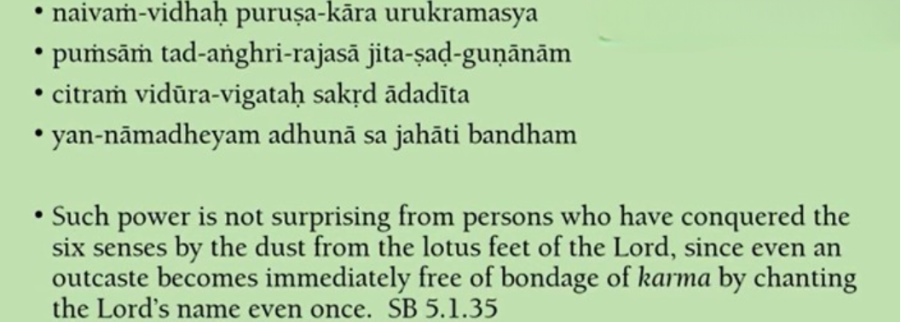
So here he particularly mentions, once – ‘sakrd’. He also says he gives up bondage, which means all karma is finished, you’re liberated. And the person who’s chanting is outcast. He has very bad karma. But immediately by chanting once, he’s free of all karma. He’s no longer outcast. So this is the very astonishing power of chanting the name. Even chanting once, the whole series of causes is destroyed. And this is not the only statement in Bhagavatam, so many other statements are there.
It’s on the basis of such statements that Bhaktisiddhanta Saraswati argued with the Smartas who were challenging the Gaudiya Vaishnavas. So the Smartas were criticizing the Gaudiyas, oh you’re so low class, because you admit all sorts of people into your movement [Laughs]. And of course, previously also there was such opposition with Narottam Das Thakur, etc. Because he was not a Brahmana and he was initiating, people were objecting. So there’s always been some, you know, this discontent in society with the Gaudiya Vaishnavas. And one of the arguments or challenges was that in order to worship the deity and the Shalagram, you should be a Brahmana. But of course, maybe that we say Vedas are very strict, but Pancharatra is not. It doesn’t have such consideration of Varna or Ashrama. However, more than even Pancharatra, Lord Caitanya’s movement is based upon Nama Sankirtana. So of course, Pancharatra is purifying, uplifting for all people of any caste or whatever, because of the Vaishnava mantra. And in Lord Caitanya’s movement, people are purified by name of the Lord [Laughs].
So we have such statements as this, many many statements like that. Just chant once and immediately, the outcast is no longer the outcast, the dog-eater is no longer the dog-eater [Laughs].
And in fact, there’s another statement that says that the person who’s a dog-eater, he chants once, he can perform the Yajnas, the Brahmana performance. This means that his prarabdha karma is destroyed. And his prarabdha karma was he was born as a dog-eater or a chandala or whatever. But prarabdha karma is destroyed, therefore he’s no longer a chandala. So therefore, the Vaishnava who’s chanting the holy name, can do whatever a Brahmin is doing. So that is the meaning of such statements. The person who chants the holy name has destroyed all of his karma, so you cannot talk about his birth anymore.
So just to graphically illustrate that, then Bhakti Siddhanta, after giving Vaishnava Diksha, according to Pancharatrik rules, then he gave Brahmin thread and Gayatri Mantra. It look, they’re better than Brahmans [Laughs]. So, all of our devotees here are like you, qualified, we got threads also [Laughs]. Of course, the goal is not to compete with Brahmanas, it’s only to show that the Vaishnava is super qualified, more than a Brahmana.
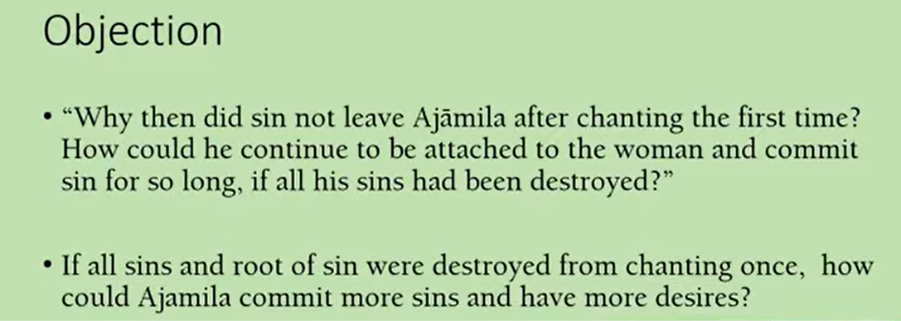
So, then we have this objection. Ajamil chanted the holy name, once all of his karmas were gone, no prarabdha karmas, no Vashanas, anything, but he still committed sin. He was still attached to his prostitute wife, he was attached to his sons and whatever like this. He committed crimes to support his family, so he was still sinful, so there is Vashanas. So, we have said that chanting once, his sinful reactions were destroyed and the causes, that is the Vashanas, the ignorance were also destroyed, so there should be no cause for sins after that point. But, we see he did commit sins after that point, so therefore, inference is, he must have still Vashanas, desires. And conclusion is, chanting the holy name did not destroy the Vashanas [Laughs]. So, the claim that you can destroy all the sinful reactions and the Vashanas, must not be true, because he still committed sins.
So, Vishwanath Chakravarthy gives this answer. So, there is people who are called Jivanmuktas, not necessarily devotees, they may be impersonalists. So, that means they realized Brahman, but they still have a body. But, if you are a Jivanmukta, all your karmas and Vashanas, ignorance are destroyed, how can you have a body, because this is a karma, all the karmas should be gone. And the body remains, and still you have to eat, still you have to walk, still you are doing activities, and still you are getting affected by material nature. So, it looks like you have got karmas [Laughs]. So, the answer is that some impressions, or what looks like impressions remain for that person of a Jivanmukta.
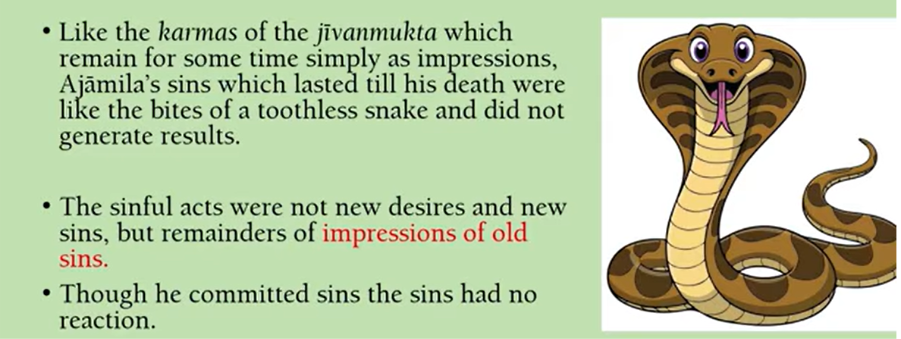
So, similar to that, Ajamil, he wasn’t impersonalist, he was just doing Namabhas, actually his karmas, his vasanas, everything was destroyed, but maintained a body, and it looks like he was going through sins, karmas or whatever. So, if he truly had Vashanas, and then committed sins, he should get results. But it’s difficult for us to figure out whether he is getting results or not, we cannot see.
The only way we know is when he was about to die, the Yama-dudas came, and the Vishnu-dudas came. And the Yama-dudas said, no, he has sin, we saw, even after he chanted the name, he was still doing sinful activities, he has karmas, we have to punish him. And the Vishnu-dudas said, no, there is no karma, even if he committed more sins afterwards, there is no karma. You cannot punish him. So, it looks like he was committing sinful activities, but there was no reaction, so Vishwanath compares this to a snake with no teeth, he bites you, but nothing happens [Laughs]. So, we do not have these old Vashanas – creating new desires, creating new sinful acts, producing karmas, no, it didn’t happen. So, impressions of the old sins remain, so it looks like he was sinful. But those actions produced no results.
So, why do we have these continued impressions? So, it’s not karma, it’s some arrangement of the Lord. So, Vishwanath Chakrawarthy gives one reason, that is that, it appears as if Ajamil did not change, he was still sinful. So, the reason for hiding the real result and looking like he was still sinful, whatever, is to maintain other philosophies. If people see that he is chanting the holy name, does this, they will give up all the other philosophies.
So, of course, we can say, maybe that’s good, at least they are doing namabhas [Laughs]. But the problem is that, in doing so, they may also commit so many aparadhs, because they don’t have real faith in bhakti. So, in other words, they can just use the name to destroy their sinful reactions and keep doing that, and this way they commit the seventh offense to the holy name [Laughs]. So, better than doing that, let them follow karma, yoga and all this and follow all the rules of punya and papa and avoid the sins and do prayachittas etc [Laughs]. So, as I said, these people, they don’t have faith in bhakti and if they see all this happening, they will take advantage of chanting the name in bhakti and then they will commit offense and then it doesn’t work.
So, that is why this accidental chanting has one benefit, if there is no offense, because you can have such immediate effects. But if we are intentionally chanting, we may end up with all these aparadhs, if we don’t have proper faith. So, in Padma Purana, the ten offenses are mentioned and among them we have ‘artha vada’, ‘harinamni kalpanam’. That is to interpret the name or thinking that, its powers are exaggeration.
So, as I said, this is the problem with consciously chanting, you could commit offenses. So, Ajamil chanted and it was not with any intention at all, there was no aparadh, so therefore the nama vows had great effect.
Others may consciously chant the holy name of the Lord, but in doing so, they have all these other offenses like thinking Vishnu is only equal to Shiva and Durga and Devatas etc. or thinking the name is exaggerated or only giving material results. So, they commit many offenses. So, Ajamil was most sinful, but by namabhas, he went to Vaikunta. And the smartas, they are following dharma and Varna-ashram, they are not very sinful, they are avoiding sin, but they stay in the material world [Laughs]. Even if they chant many times.
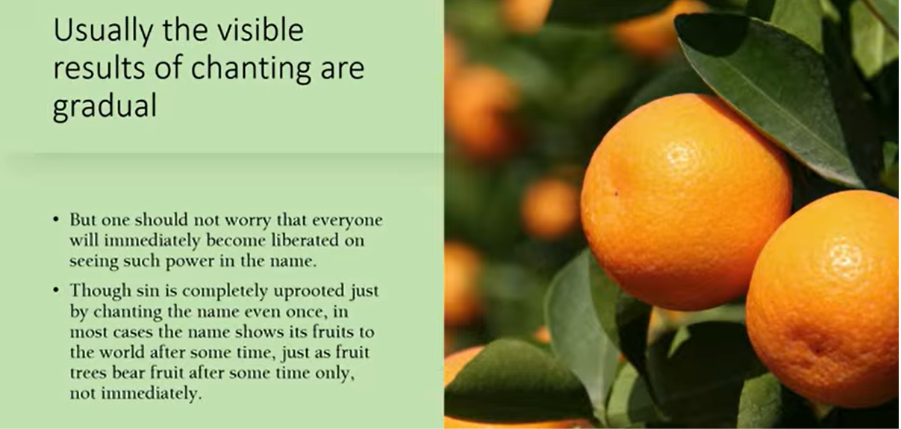
So there is another reason again for hiding the effects. And that is that, though Ajamil did uproot the sins and the Vashanas and the ignorance etc immediately, we don’t see the effect, so there is another reason. And that is to illustrate that things should be done gradually. So a fruit matures gradually, not suddenly. So though Ajamil’s sin and the causes are all uprooted, there is a show of gradual purification, to encourage people. So therefore even though the devotee is chanting and all his sins and vashanas are gone, the appearance is, he is progressing gradually.
In the Brahma Sutras, Baladeva Vidyabhushan also talks about the karmas and how they may have some residual traces. So, we are talking about Vidya, which means bhakti, and of course we can say the holy name. So, the holy name burns up all your karmas. So, though all the karmas are gone, by the will fo the Lord, the prarabhda karmas seem to remain. So, technically if all your prarabdha karmas are gone, aprarabdha, prarabdha, everything is gone, you disappear [Laughs]. So immediately devotees take prema, they disappear from the world.
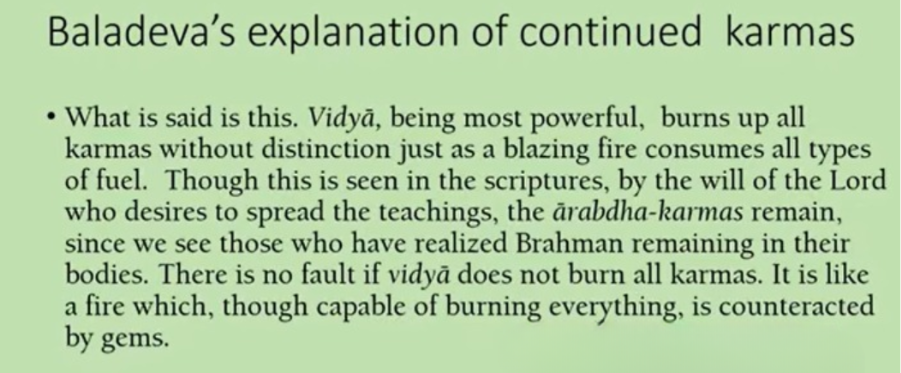
But the Lord desires that they remain in the world and they can spread the teachings of bhakti. So even though they realize Brahman, completely they are in prema, they remain in the body and they kept affected by material nature, they may be attacked by insects or you know, trip and fall, break their legs and there are so many things. Even though they are in prema, and it looks like karma [Laughs]. So, we should not attribute some fault to bhakti because of this, or the holy name, if it looks like the karmas remain for someone in prema.
So, it looks like the karmas remain and the karmas may also follow a pattern that looks like your karmas and you can predict it even with astrology. So, an astrologer can look at the chart of an advanced devotee and say, oh, I can predict all this is going to happen. Therefore, you still have karma [Laughs]. NO, it is not ! It is not under the law of karma at all, it is under the Lord only. However, the Lord makes that body follow a pattern and looks like karma [Laughs]. And he keeps a devotee there in the material world so he can preach bhakti.

So, sometimes chanting takes place, bhakti takes place, but it doesn’t look like there are any effects, the results aren’t coming. So, that’s not just for the prema bhakta, but for the normal devotees. So, again, that is so that other philosophies continue. So, the devotee may appear to be progressing slowly, but the Lord has the real understanding of the progress of the devotee. And the Lord can make arrangements for him to get to the spiritual world.
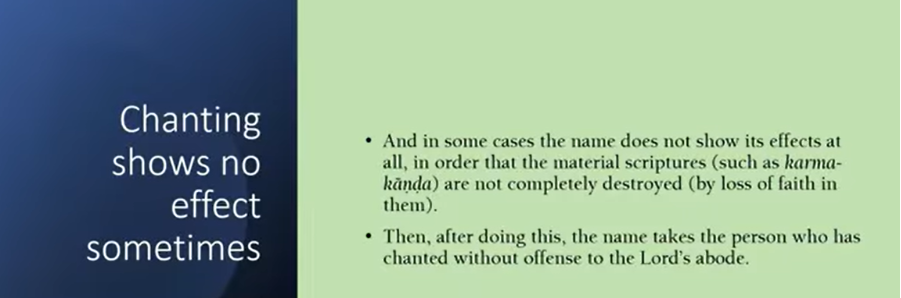
So, in many cases, people commit offenses and therefore the progress is slowed. So, Vishwanath Chakravarti gives the example of a merchant. And he gives protection to another person. And if that person surrenders nicely, he responds nicely. If that person offends the merchant, then the merchant becomes displeased and doesn’t give protection. But we shouldn’t think that the merchant is incapable of giving protection. So, those who commit offense against the name, then they lose the mercy of the name, the mercy of the Lord. So, the progress is slow.
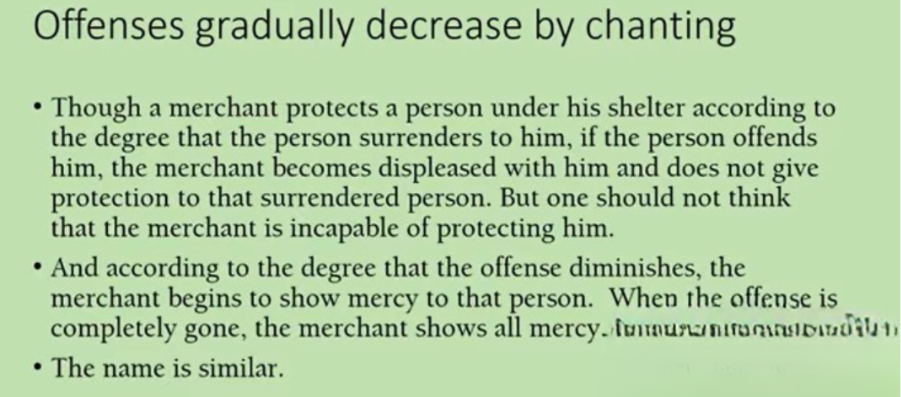
So, the merchant, he sees the offense, he doesn’t give his mercy, but gradually the offense lessens and then the merchant becomes favorable again. And when the merchant sees that the other person is completely unoffensive again, then he gives his full mercy. So, the name is like that. For the offense of people, then, we don’t see much response, but if by chanting continually the offense lessens and lessens, then we get more effect from the name.
So, some people who are practicing karma yoga or jnana or yoga, they have faith in that practice, may use bhakti as a secondary practice. And of course, without doing bhakti at all, karma yoga, jnana yoga and ashtanga yoga cannot bring about svarga loka or liberation. So, they employ bhakti, but because they are doing bhakti, we don’t say you are practicing bhakti [Laughs]. So, we name the person after their main practice.
So, you are doing karma yoga and you are worshiping the Lord a little bit, because you know that if you don’t worship the Lord, you are not going to get results of your karma [Laughs]. So, you are still called karma yogi. Whereas, a person may do mostly bhakti, but he may also have a little bit of attachment to karma yoga. That’s the second thing there [Laughs]. So, we say he is a devotee, but it’s mixed devotion here [Laughs]. So, that’s better than the karma yoga. However, it’s not pure bhakti. So, pure bhakti without the karma yoga mixture is the best. This is what is recommended in Bhagavatam and Bhagavad Gita, pure bhakti.
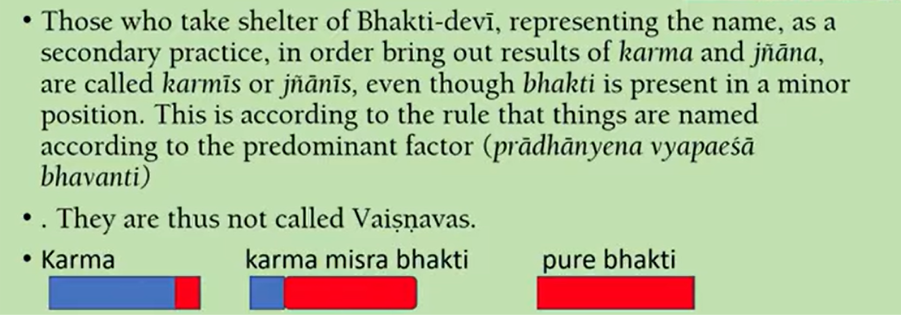
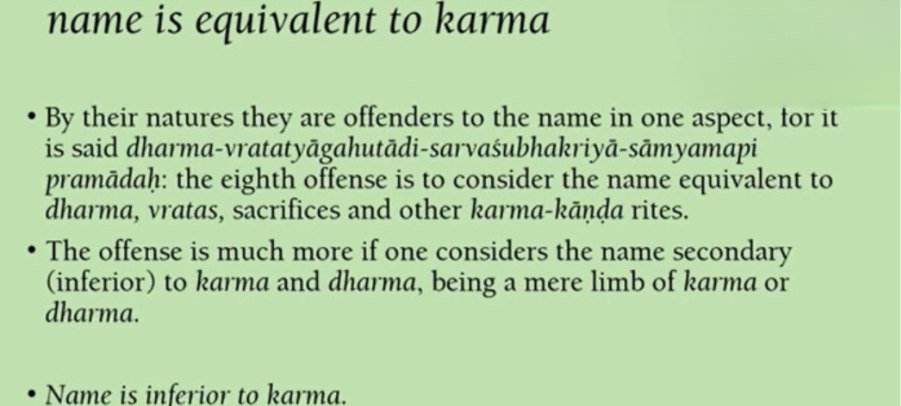
So, of course, Krishna also says they are all my devotees, Artha, Artha, Jigasa, etc. Jnani, they are all my devotees, but the one who is really practicing with all these other things, he is the best devotee. So, these people who are secondarily using the name and using bhakti, they equate it with karma. So, we see the eighth offense is to equate chanting the name with yajnas, sacrifices, vrathas, etc. So, though it kind of looks better than nothing at all, no bhakti at all, it’s also offensive. However, when the offense is more, if not only you consider it like karma, but you think it’s less than karma. Of course, simply because they are doing karma yoga mostly, that can be the result in general [Laughs]. They think karma yoga is better and they are doing a little bhakti, it’s just a side thing. So, therefore, though they do chant along with their karma yoga, whatever, there’s going to be some offense.
So, of course, this is better than no bhakti or all karma yoga, it’s better than nothing [Laughs]. So, what’s the result? You can get Svarga Loka. So, yes, it is offensive, a little bit of offenses there, but Bhakti Devi is very merciful. So, she says, I’ll give a little effect for the karma yoga and let them get Svarga Loka. So, and without that bhakti at all, no Svarga Loka. And even though it is offensive bhakti, still, they get Svarga Loka.
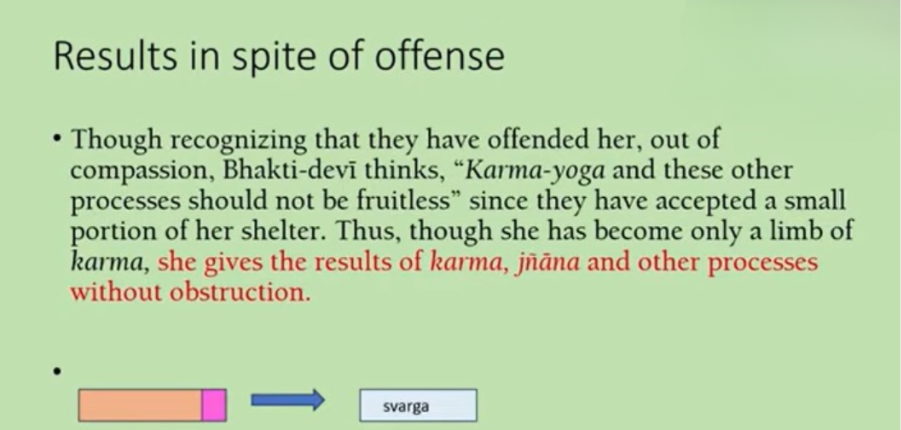
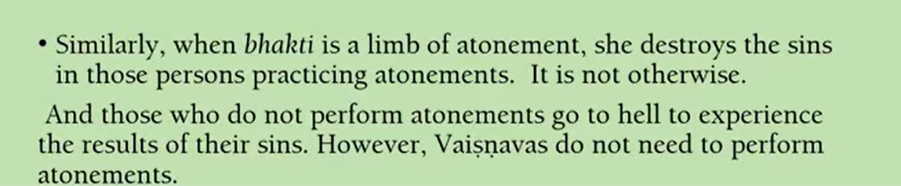
If you do karma yoga, no bhakti, no result. If you add a little bhakti, even if it’s offensive, you can get Svarga Loka. If you do jnana with no bhakti, again, no liberation. If you add a little bit of bhakti, even if it’s offensive, you can get liberation [Laughs]. So, again, you could use bhakti as part of your prayaschitta and whatever, as a minor aspect, and you can get some result. So, by doing the atonement with little bhakti, you can destroy your bad effects. So, if you don’t do any atonements of course, you just go to hell [Laughs]. If you are a true Vaishnava, you don’t have to do atonements at all.
Ok. Hare Krsna !
Q & A:
1.) Hare Krsna Maharaj, My question is, we just heard the power of the holy names, yet it has not been declared as a Chatur yuga dharma and only as Kali yuga dharma, why so ?
Actually, it’s eternal. It’s practiced at all times in the material world and in the spiritual world [Laughs]. However, in Kali yuga, it becomes the only process [Laughs]. Or if not the only process, the main process, and if you don’t do it, the other processes don’t work well. So, it’s selected as the only process because people are not qualified for anything else [Laughs].
Devotee: Maharaj, So, in other yugas, the other processes were giving same effect without
harinam ?
HH Bhanu Swami Maharaj: So, we see that in the other yugas, there is a main process like meditation or sacrifice or deity worship. And of course, even in meditation, there is mantra and in the mantra, there is name of the Lord [Laughs]. In doing homas, they offer mantras and there is name of the Lord, there also [Laughs]. And deity worship, you can’t even do deity worship unless you get the mantra and use that in your deity worship [Laughs]. So, automatically the name is somehow included in all the different processes.
However, in Kali yuga, the name is isolated. It’s not part of a mantra, another mantra, which requires initiation, etc. It is independent and doesn’t require initiation. So, this makes it easily available to everybody.
2.) Hare Krishna Maharaj, Shuddha Nam – chanting purely, means, we are not committing any offence, free from all offence. And again Maharaj, you have mentioned Nama apradh also without any offence. So, how to understand the difference between chanting the holy names purely and Nama abash? Because in both the cases, we have to chant without offence.
So, if we just talk about Namapradh, usually this refers to people like demons. So, with intention, they hate the devotees, they hate bhakti and they offend [Laughs] the bhakti and the deity, etc. Namabhas is largely no hatred and it could be accidental, so they are neutral. Or they can have Namabhas with slight offence, as if they are smartas, as they are chanting the holy name to get results from karma and I think, you know, holy name is equal to pious activities. So, slight offence, but there is no hatred involved there.
So, we have those two types of Nama-abhas, where they are accidental with neutral, we have intentional with maybe some smarta contamination. And the third type of Nama-abhas will be when devotees chant intentionally with some devotion, but they have ignorance. So, this may include the Nama aparadhs, if they are ignorant of the Nama aparadhs, but they are not intentionally hostile towards devotees and bhakti. And if they get knowledge, then immediately they can fix that aparadh, like thinking that the holy name is equivalent to pious activities.
3.) When we see devotees, I mean ourselves, we are engaged in duties, we are performing karma, we have office, we have all this. So, how do we understand Grahastha devotees, if they are in the pure devotion or karma mishra bhakti or karma bhakti? Because in our majority, 90% we are engaged in duties and office and everything. And then few hours we take out time in chanting, reading books. So, it looks like we are performing majority karma and then very few portion of bhakti. So, how to understand or my understanding is wrong?
So, when we use the word karma, I am doing my karma, we should not think this is karma yoga. So, karma yoga refers to following the rules of varna ashrama. Of course, you are probably following the ashrama rules [Laughs]. To some extent. In the modern world, not many people are following the varna rules. So, definitely you are doing activity in that sense karma, but not karma yoga mixture with bhakti.
So, bhakti itself, for the followers of Lord Caitanya, should be practicing pure bhakti. But Lord Caitanya also says you can be a sanyasi, grihasta, brahmachari, vanaprastha, brahmana, kshatriya, vaisya, sudra, mleccha, doesn’t matter [Laughs]. So you could follow karma yoga and varnashram, along with your bhakti, as long as it does not create obstruction. So, in that sense, you would be practicing karma mixture bhakti, literally.
But in our definition of pure bhakti, Rupa Goswami says, it should not be obstructed by karma or jnana. So, karma yoga creates obstruction if you follow all the rules and you start worshipping devatas and then you start developing material desires to get swarga loka or something. Or, if we continue the karma yoga and we think if I don’t follow it, I’m committing a sin [Laughs]. So, in pure bhakti, we understand bhakti is independent, doesn’t rely on anything else. So, if we think that we depend on karma yoga to get rid of our sin, this becomes aparadh. So, if you’re practicing pure bhakti and not mixing material desires in your bhakti and you’re working, it’s not a problem. It’s still pure bhakti.
4.) Hare Krsna Maharaj, Maharaj, while chanting our regular rounds, due to bodily discomfort, if I think that immediately after completing, I should go for rest like that, how it will be considered?
In Harinam Chintamani, Bhakti Vinod Thakur, he talks about the different offenses. One of the offenses is called pramada or inattention. Then he gives different types of inattention. One of the types of inattention is called laya. That means to sleep while chanting. So if you’re chanting and you fall asleep, that’s considered to be inattention. But if you’re tired and then you take rest, that is not a problem. But then you should fulfill your vow or whatever vow of chanting you’ve had sometime later.
So chanting the holy name is very flexible. And according to your ability, you can chant in different amounts at different times or whatever. And according to your constitution, according to your health, you can also adapt your chanting.
5.) Hare Krishna Maharaj, what is karma mishra bhakti?
Well, I just explained this. Literally, karma mishra bhakti will mean we mix karma yoga with the bhakti to a small degree. If it’s mostly karma yoga or a little bhakti, then it’s just called karma yoga.
So if we’re doing mainly bhakti yoga with a little karma yoga, there’s two types. So one is the good type. We do the karma yoga with no attachments. We don’t let it contaminate pure bhakti. We do it so we maintain our body or we teach others. That’s all.
The other is to do that little bit of karma yoga with attachment to its results, attachment to doing it. That is impure. So this is impure bhakti. So that is why I said in the definition of bhakti, Rupa Goswami says, the karma and jnana etc. should not obstruct the bhakti. We may have material desires in practicing our bhakti, but we’re not practicing karma yoga. So that’s not called karma mishra bhakti. It’s called Rajo-gun bhakti [Laughs].
6.) Maharaj, could you please explain how a karma mishra bhakta would think or act? Just to understand the difference from bhakta.
The karma mishra bhakti which is permissible, and this is what many people did in Lord Caitanya’s time. So in Lord Caitanya’s movement in Navadvip, we have Vaishyas, Kshatriyas, Brahmanas, Sudras, Melechas chanting the holy name. So they were following their varna activities or the ashram activities to support their material body, but it didn’t contaminate their bhakti. So in that sense, they were all practicing karma mishra bhakti, but it was permissible.
We can see pure bhakti with no varna and ashrama. But that may be difficult for most people. That’s the Babajis [Laughs]. They’re not even a grihasta. Nobody to support. They’re not a sanyasi [Laughs]. Other people that would have no karma mixture at all would be people who were the Mlechas or Haridas Thakur [Laughs].
7.) While preaching to chant the Hare Krsna Maha mantra, if we say, the benefit that is karma kanda benefits, is it offensive ?
Oh ok, If we encourage people chanting Hare Krishna, you’re going to get more money. Like that [Laughs] ? You’re going to get cured of all your sickness [laughs]. ?
Well, this makes it into impure bhakti. Of course, in the beginning of bhakti, many people are attracted, because they want to get rid of their misery [Laughs]. So certainly, bhakti will do that. It will get rid of your misery and we can also state that. Here in this story, it is said that by chanting just once, you get rid of all your karmas. Consequently, you get rid of all your miseries. So initially, yes, we can present that to people, but eventually we should also encourage them to practice pure bhakti. If we practice pure bhakti, automatically we get all these other results anyway. But we don’t ask the Lord for these things.
Devotees: HH Bhanu Swami Maharaj Ki.. Jai !! Srila Prabhupad Ki.. Jai !!