Srimad Bhagavatam – 1.18.27~28 | HH Bhanu Swami Maharaj | ISKCON Chennai | Dec 01, 2025
Om Namo Bhagavate Vāsudevāya
Om Namo Bhagavate Vāsudevāya
Om Namo Bhagavate Vāsudevāya
nama om vishnu-padaya krishna-preshthaya bhu-tale
srimate bhaktivedanta-svamin iti namine
namas te sarasvate deve gaura-vani-pracharine
nirvishesha-shunyavadi-pashchatya-desha-tarine
jaya sri-krishna-chaitanya
prabhu nityananda
sri-adwaita gadadhara
shrivasadi-gaura-bhakta-vrinda
Hare Krishna Hare Krishna Krishna Krishna Hare Hare
Hare Rama Hare Rama Rama Rama Hare Hare
Reading from Srimad Bhagavatam Canto 1 Chapter 18 Verse 27.
ŚB 1.18.27
विप्रकीर्णजटाच्छन्नं रौरवेणाजिनेन च ।
विशुष्यत्तालुरुदकं तथाभूतमयाचत ॥ २७ ॥
viprakīrṇa-jaṭācchannaṁ
rauraveṇājinena ca
viśuṣyat-tālur udakaṁ
tathā-bhūtam ayācata
Synonyms
viprakīrṇa — all scattered; jaṭa-ācchannam — covered with compressed, long hair; rauraveṇa — by the skin of a stag; ajinena — by the skin; ca — also; viśuṣyat — dried up; tāluḥ — palate; udakam — water; tathā-bhūtam — in that state; ayācata — asked for.
Translation
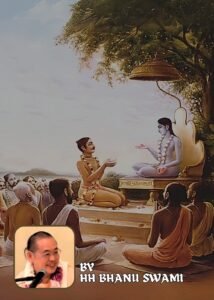
The sage, in meditation, was covered by the skin of a stag, and long, compressed hair was scattered all over him. The King, whose palate was dry from thirst, asked him for water.
Purport
The King, being thirsty, asked the sage for water. That such a great devotee and king asked for water from a sage absorbed in trance was certainly providential. Otherwise there was no chance of such a unique happening. Mahārāja Parīkṣit was thus placed in an awkward position so that gradually Śrīmad-Bhāgavatam could be revealed.
ŚB 1.18.28
अलब्धतृणभूम्यादिरसम्प्राप्तार्घ्यसूनृत: ।
अवज्ञातमिवात्मानं मन्यमानश्चुकोप ह ॥ २८ ॥
alabdha-tṛṇa-bhūmy-ādir
asamprāptārghya-sūnṛtaḥ
avajñātam ivātmānaṁ
manyamānaś cukopa ha
Synonyms
alabdha — having not received; tṛṇa — seat of straw; bhūmi — place; ādiḥ — and so on; asamprāpta — not properly received; arghya — water for reception; sūnṛtaḥ — sweet words; avajñātam — thus being neglected; iva — like that; ātmānam — personally; manyamānaḥ — thinking like that; cukopa — became angry; ha — in that way.
Translation
The King, not received by any formal welcome by means of being offered a seat, place, water and sweet addresses, considered himself neglected, and so thinking he became angry.
Purport
The law of reception in the codes of the Vedic principles states that even if an enemy is received at home, he must be received with all respects. He should not be given a chance to understand that he has come into the house of an enemy. When Lord Kṛṣṇa, accompanied by Arjuna and Bhīma, approached Jarāsandha in Magadha, the respectable enemies were given a royal reception by King Jarāsandha. The guest enemy, namely Bhīma, was to fight with Jarāsandha, and yet they were given a grand reception. At night they used to sit down together as friends and guests, and in the day they used to fight, risking life and death. That was the law of reception. The reception law enjoins that a poor man, who has nothing to offer his guest, should be good enough to offer a straw mat for sitting, a glass of water for drinking and some sweet words. Therefore, to receive a guest, either friend or foe, there is no expense. It is only a question of good manners.
When Mahārāja Parīkṣit entered the door of Śamīka Ṛṣi, he did not expect a royal reception by the ṛṣi because he knew that saints and ṛṣis are not materially rich men. But he never expected that a seat of straw, a glass of water and some sweet words would be denied to him. He was not an ordinary guest, nor was he an enemy of the ṛṣi, and therefore the cold reception by the ṛṣi astonished the King greatly. As a matter of fact, the King was right to get angry with the ṛṣi when he needed a glass of water very badly. To become angry in such a grave situation was not unnatural for the King, but because the King himself was not less than a great saint, his becoming angry and taking action were astonishing. So it must be accepted that it was so ordained by the supreme will of the Lord. The King was a great devotee of the Lord, and the saint was also as good as the King. But by the will of the Lord, the circumstances were so created that they became ways to the King’s becoming unattached to family connection and governmental activities and thus becoming a completely surrendered soul unto the lotus feet of Lord Kṛṣṇa. The merciful Lord sometimes creates such awkward positions for his pure devotees in order to drag them towards Himself from the mire of material existence. But outwardly the situations appear to be frustrating to the devotees. The devotees of the Lord are always under the protection of the Lord, and in any condition, frustration or success, the Lord is the supreme guide for the devotees. The pure devotees, therefore, accept all conditions of frustration as blessings from the Lord.
HH Bhanu Swami Maharaj:
So here we see the king reacting to not getting a proper reception. And we notice that reception is considered one of the important types of conduct in Vedic society. Of course, one of the principles is non-violence towards any living entity. So therefore, we treat all living entities kindly, but especially human beings. So in the rules of conduct for a householder or a Grahastha, welcoming a guest is a very important item. In fact, every day, in order to get rid of his daily sinful activities of stepping on bugs and burning insects in fire, etc., he has to welcome guests. And so, it’s an obligatory activity every day he should do. And if he doesn’t do that every day, then it’s a sin. So, therefore, welcoming a guest is an important item. If we fail to do so, then we commit sin.
Of course, there’s also a definition of who is a guest. So, if we have 20 beggars coming to your house, then that is not considered to be receiving a guest, if you feed everybody. But if a person who is traveling happens to come and he needs shelter and whatever, then you have to receive him. But as mentioned here in the verse, the reception does not have to be very elaborate. So you offer a seat so he can rest, you offer maybe a place to sleep if it’s night time, you offer some water, you offer some sweet words. And if you have food, then you give part of your food. So in this way, the grahastha is able to exhibit some compassion for others. And this extends through all the varnas.
So of course, if we have Brahmacharis, Vanaprasthas and Sannyasis, they don’t have a house. So they don’t have a place to offer, they don’t have any food to give you, because they also beg. So the rule applies particularly to the householder. And he may be in any varna, but nevertheless, if the guest comes, he has to receive him. Of course, and apart from that, there is respect due to varna, so the lower varna has to give respect to the upper varnas. But even if one is in upper varna, and then you have a guest, you have to receive him also. So in this case, we have the sage who is Brahminical, so he is in upper varna, and then we have the king who is Kshatriya, lower varna, but nevertheless, obligation of the sage is to receive the guest. So because he was a sage, we don’t expect lots of wealth etc., he is living in the forest or something, but he is married, he has a child etc., so at least he should offer a place and give some water and kind words etc.
When the king came, he did not respond. So then there is a fault on the part of the sage. The king also, because he is the king, he has a responsibility to see that even the brahmanas are acting properly. And therefore, if he shows some anger, we cannot really criticize him, because the sage is not acting properly. At the same time, we have previously seen that the sage was in samadhi, so how is he expected to respond? So the king, also being full of knowledge, and also being a devotee of the Lord, should have understood that. In other words, in one sense, though the sage was acting wrongly, in another sense, he cannot also be criticized for acting like that. Even it is said that a devotee who is not in samadhi, but very absorbed in his activities of bhakti, if he fails to follow all the rules of Varanashrama, it is not a fault. So, if the sage is actually in samadhi, it is not fake samadhi, it’s real samadhi, then he cannot be criticized and therefore, the king should not become angry. So, therefore, why should Pariksit become angry, it’s a little bit surprising.
So Prabhupada in the purport mentions, it is the will of the Lord. Yesterday we talked about Yogamaya. This is ignorance in one sense, but under the control of the Lord. So the Lord puts devotees, who are not covered by ignorance, normal ignorance of the material world, under some sort of ignorance. This does not apply to people in the material world, who are completely in ignorance 100% of the time, so there is no time when they are uncovered. So, devotees who are on the highest level, sometimes get covered by this Yogamaya, this type of ignorance. And then, they seem to act like people of the material world, who are covered by ignorance. So, of course, such ignorance is not expected for a devotee, especially a devotee who is on the highest level in the spiritual world, but somehow, he acts this way, and Pariksit becomes angry.
So, this is astonishing. How can a devotee show such materialistic quality? It’s completely contradictory to Pariksit’s nature. But we may expect anger in the case of Pariksit chastising Kali. But here, we have a sage, a Brahmana, who is in Samadhi, how can he become angry with him? So, of course, it is described how Pariksit was afflicted with fatigue, and with hunger, and with thirst. But even such affliction is also material.
So, therefore, this is not the activity of a highly advanced devotee. And thus, we cannot say that Pariksit got afflicted by material ignorance. So, then, we have to give an explanation, the explanation is Yogamaya. It was not the free will of Pariksit Maharaj, it was the will of the Lord. So therefore, no karma for such activity. Ultimately, Pariksit has no fault. But what this did, anger created his action, which was to put a dead snake on the sage. And then, the son of the sage, he cursed Pariksit. And then, Pariksit decided not to counteract the curse, and he decided to accept his death. And then, when he did that, he was fasting for seven days, and he asked the sages, what should I do now that I am dying? And various great sages and others gathered around, they gave various answers, but they were not satisfying answers.
And then, Sukadeva Goswami came. And then, when he was asked the question, Sukadeva Goswami says, you hear and chant about the Lord. Then he recited whole of Bhagavatam. So, of course, one of the questions of the sage is that, ‘now that Krishna is gone, and Dharma is gone, how will Dharma be represented in Kali Yuga?’ So the answer is, Srimad Bhagavatam has appeared in Kali Yuga to destroy all the darkness. So, how did it appear? It appeared through this means, the curse. And why was the curse there? Because Pariksit got angry. Why did he become angry? Will of the Lord.
So, in other words, this arrangement of Yogamaya was there in order that Srimad Bhagavatam would be revealed for the people of Kali Yuga. Now, of course, we can say from one point of view, Pariksit getting angry and getting cursed may be inconvenience for the devotee. But we see that Pariksit Maharaj responded in a very suitable way when he got cursed. He took this as a great opportunity to give up all of his responsibilities of managing etc. Of course, Pariksit already is pure, so he doesn’t have to give up material attachments. But like other devotees, he always craves the opportunity to hear the topics of the Lord. So, by giving up his kingdom, then he got the opportunity to hear Srimad Bhagavatam which was much greater pleasure. So, the devotee of the Lord takes the Lord’s arrangements, whatever they are, even if it creates some sort of inconvenience or disturbance, he is not concerned about that. He willingly becomes an instrument for the Lord’s plan. And so, there is no suffering on the part of Pariksit. And of course, this also becomes a sign of the wonderful qualities of Pariksit Maharaj. And so this particular pastime becomes very famous as an example of Pariksit Maharaj’s great tolerance.
So, the devotees, though they are pure and they don’t have any ignorance, their knowledge of the Lord sometimes gets limited for pastimes. And during the pastimes, even those devotees do not understand what is the plan of the Supreme Lord. And thus, Bhisma, when he was on the bed of arrows, he was saying, the plan of the Supreme Lord is difficult even for devotees to understand. Bhisma, a great devotee, but by the arrangement of the Lord, he is put on the wrong side of the army. He becomes the enemy of Krishna. And ultimately, Bhisma Dev is completely satisfied with Krishna’s arrangements. So this is the sign of a great devotee. The devotee accepts whatever arrangement the Lord makes in the material world for him. And that actually becomes the great qualification for getting the mercy of the Lord.
And in Bhagavatam it is said that the devotee thinks of all of the difficulties and everything that he experiences as mercy of the Lord. And he never wavers from serving the Lord. And that becomes his qualification for getting mercy of the Lord. So that is the conviction of the devotee.
Hare Krsna !
Q & A:
1.) Hare Krishna Maharaj. For someone like Bhishma Dev, do we understand that he was also something like this, where Krishna arranged and what was the purpose? For example, here we know what the purpose was. And one more related question. For example, in the pastime of Kardama muni, he had the Supreme Lord Himself appearing as his son Kapila. But when the Lord appears before him, he tells him that I shouldn’t be asking to get married. But it’s like a piece of [Not clear] it’s insignificant desire but I’m still shameless that I’m asking you for this. So in that you see that the child born is the Supreme Lord Himself. So these two instances, Bhishma, Kardama, are they all the arrangements of the Lord?
Well, of course, there’s always the arrangement of the Lord. Ultimately, everything is arrangement of the Lord in spiritual world because it’s all lila you know [Laughs]. However, the Lord also is responsive to the desires of a devotee. So, for instance, in the case of Jaya and Vijaya, they thought, well there’s nobody qualified to fight nicely with the Lord so we should take the role of a demon, so then the Lord fulfilled that desire and they were covered by ignorance and they became demons in the material world [Laughs].
So, in the case of Bhishma, we don’t really have a detailed explanation of the original cause of why he was like that, but we see that it’s something of the same nature, he wanted to fight with the Lord [Laughs]. And of course, even that desire is also in the spiritual world, we have virya rasa. So, the Lord and the devotees like to display virya. In the case of Jaya and Vijaya, of course they became demons. They were opposing the Lord, but in the spiritual world we have virya where there is, they are not demons, they are devotees like the cowherd boys wrestling with Krishna [Laughs].
But of course, because they are devotees, maybe the intensity is not so strong [Laughs] because we always [Laughs] know [Laughs] this is devotee, this is Krishna or whatever. So it’s not completely intense [Laughs]. So in the case of Bhishma, he’s actually on the opposite side and he has to fight with the opposite side with Krishna etc. So therefore, it becomes more intense [Laughs].
Devotee: Kardamu muni?
HH Bhanu Swami Maharaj: What about him? Well, he wanted the Lord as his son na?
Devotee: [Not audible]
HH Bhanu Swami Maharaj: Well, I guess we could say because obviously the Lord wanted to appear. So therefore, how does He want to appear? He has to appear through mother and father so He chose Kardama muni and then he has to get married or whatever. So, that desire, we cannot say that’s simply a material desire also. It’s the will of the Lord.
2.) This is regarding Maharaj yogamaya, that Pandavas losing in the dice, gambling match. Is it also because of yogamaya? Pandavas losing the gambling match. Is it also because of yogamaya? Can we say?
Well, yeah, all these events we can say, with the Pandavas, they lose, then they go to the forest, they get you know, banished to the forest for 12 years, and then they appear to suffer and whatever. We have to take that all as ultimately arrangement of the Lord. Because, if not, then we have to say, well, Yudhishthira is foolish [Laughs], and the Pandavas suffering in the forests is they got karma, whatever like that. So obviously, they are full of knowledge, and they don’t suffer, but they are put into this type of arrangement where they appear to suffer, and they appear to make mistakes. And all of these arrangements are there ultimately to produce the battle of Kurukshetra, where all the demons get killed.
3.) Maharaj, in the case of Parikshit, although he was cursed by the Sringi, but he took it very positive and constructive way, and it made him to detach from this kingdom and all managerial responsibilities. In the case of devotees, how can we apply this? Because sometimes, you know, devotees want something, but when they don’t get, they become very upset. But it is very difficult to accept that it’s also Lord’s arrangement.
So, accepting the curse shows how the devotee tolerates all situations in the material world. And if he loses a kingdom, what is the kingdom? It’s material, so he has no attachment. And if he gives up his body due to the curse, what’s wrong with that? Then he’s free from his material body, and he’s eternally with Krishna [Laughs]. So then the devotee takes, this is not a curse, it’s a blessing [Laughs].
So the nature of the devotee, of course, is, as Lord Caitanya says also, the devotee is tolerant as a tree. It’s also an aspect of surrender. So one of the aspects, the six qualities of surrender is, he feels very low and miserable, and whatever happens, he simply accepts that. But the other quality in surrender is that, he always feels he’s under the protection of the Lord. So when Parikshit accepts the curse and whatever and doesn’t mind, then this also shows his complete surrender.
4.) Hare Krishna Maharaj, regarding the Sringi curse, within seven days you will be bitten by a snake. Then how Parikshit Maharaj took that seven days? He got cursed and the same day he went to hear the Bhagavatam or in between some days are there, how we can understand Maharaj?
[Laughs] Not really explained, seven days from now, so I suppose from the curse, when he cursed [Laughs].
5.) How can devotees atone for past aparadhas that they may have forgotten?
So, if in previous lifetimes and even in this lifetime, if it is unconscious, we have no way of knowing. The only way we could know is hypothetical of course, is that bhakti is slow. So, if the advancement is slow, then we can infer, there must have been some aparadha. And the only solution is to continue very enthusiastically to perform devotional service.
6.) Maharaj, there is a saying, if someone does aparadha in previous lifetime, although if he tries to do bhakti enthusiastically, there are many obstacles comes in his path. So, how to handle this then? Although he is trying to…
Yeah, so the obstacle means that he performs devotional service, but the progress becomes slower because of certain anarthas. But the only way of clearing up the amarthas is bhakti, which is anartha-nivritti. So therefore, all we can do is continue devotional service and accept whatever anarthas are there, but keep performing our devotional service. In spite of the obstacles created, the Lord also still has great compassion to that devotee.
And the more advanced the devotee, the more obligated the Lord is to help that devotee. And thus we see in the case of Bharat, because of previous aparadha, he forgot the Lord and then he became a deer. But, because of his advanced devotion, when he was a deer, he did not forget his previous life, that was arrangement of the Lord. And thus in next life, he also did not forget and then he got prema. So this was arrangement of the Lord for him.
7.) Hare Krishna Maharaj, so you have mentioned like everything is the perfect arrangement by the Lord for the pure and advanced devotees. Does the same apply to the sadhakas as well?
That’s in the case of what? Aparadhas?
Devotee: Lord’s arrangement.
HH Bhanu Swami Maharaj: For what arrangement though?
Devotee: [Not audible]
HH Bhanu Swami Maharaj: Well, obviously everything is bhakti under the Lord. So in that sense, it’s arrangement of the Lord [Laughs]. In the case of aparadhas, the arrangement of the Lord is anartha-nivritti. Bhakti gradually destroys the anarthas. So though the aparadhas do create some obstacle, the Lord allows the devotee to continue bhakti and gradually those anarthas are dissipated, the aparadha is dissipated. So, that’s the Lord’s arrangement.
Devotees: Grantharaj Srimad Bhagavatam ki jai!!! HH Bhanu Swami Maharaj ki jai!!! Srila Prabhupada ki jai!!!