Srimad Bhagavatam – 1.19.29 | HH Bhanu Swami Maharaj | ISKCON Chennai | Feb 02, 2026
Om Namo Bhagavate Vāsudevāya
Om Namo Bhagavate Vāsudevāya
Om Namo Bhagavate Vāsudevāya
nama om vishnu-padaya krishna-preshthaya bhu-tale
srimate bhaktivedanta-svamin iti namine
namas te sarasvate deve gaura-vani-pracharine
nirvishesha-shunyavadi-pashchatya-desha-tarine
jaya sri-krishna-Caitanya
prabhu nityananda
sri-adwaita gadadhara
shrivasadi-gaura-bhakta-vrinda
Hare Krishna Hare Krishna Krishna Krishna Hare Hare
Hare Rama Hare Rama Rama Rama Hare Hare
Reading from Srimad Bhagavatam Canto 1 Chapter 19 Verse 29.
ŚB 1.19.29
स विष्णुरातोऽतिथय आगताय
तस्मै सपर्यां शिरसाजहार ।
ततो निवृत्ता ह्यबुधा: स्त्रियोऽर्भका
महासने सोपविवेश पूजित: ॥ २९ ॥
sa viṣṇu-rāto ’tithaya āgatāya
tasmai saparyāṁ śirasājahāra
tato nivṛttā hy abudhāḥ striyo ’rbhakā
mahāsane sopaviveśa pūjitaḥ
Synonyms
saḥ — he; viṣṇu-rātaḥ — Mahārāja Parīkṣit (who is always protected by Lord Viṣṇu); atithaye — to become a guest; āgatāya — one who arrived there; tasmai — unto him; saparyām — with the whole body; śirasā — with bowed head; ājahāra — offered obeisances; tataḥ — thereafter; nivṛttāḥ — ceased; hi — certainly; abudhāḥ — less intelligent; striyaḥ — women; arbhakāḥ — boys; mahā-āsane — exalted seat; sa — he; upaviveśa — sat down; pūjitaḥ — being respected.
Translation
Mahārāja Parīkṣit, who is also known as Viṣṇurāta [one who is always protected by Viṣṇu], bowed his head to receive the chief guest, Śukadeva Gosvāmī. At that time all the ignorant women and boys ceased following Śrīla Śukadeva. Receiving respect from all, Śukadeva Gosvāmī took his exalted seat.
Purport
On Śukadeva Gosvāmī’s arrival at the meeting, everyone, except Śrīla Vyāsadeva, Nārada and a few others, stood up, and Mahārāja Parīkṣit, who was glad to receive a great devotee of the Lord, bowed down before him with all the limbs of his body. Śukadeva Gosvāmī also exchanged the greetings and reception by embrace, shaking of hands, nodding and bowing down, especially before his father and Nārada Muni. Thus he was offered the presidential seat at the meeting. When he was so received by the king and sages, the street boys and less intelligent women who followed him were struck with wonder and fear. So they retired from their frivolous activities, and everything was full of gravity and calm.
HH Bhanu Swami Maharaj:
So this verse describes the reception by Pariksit Maharaj and others of Sukadeva Goswami. So here it is mentioned that the women and the boys stopped following him and making fun of Sukadeva Goswami when they saw how the great sages were respecting him. So the previous verse actually describes why or how he was recognized by the sages. Of course, he was disguised, so that many people could not understand his greatness. But the previous verses described the structure of his body. And in many cases, by looking at the body, we cannot see what the actual person inside and his mind are. However, in other cases, we have matching internal, that is mental state, and we can call the qualities internal, and also the external body, they go together.
So there are some books in Sanskrit that describe the external characteristics of a great person. He has certain proportions in his body. For instance, one of these qualities which is a little strange to us, is his arms reach down to his knees, that’s a great person, it may look strange to us, but this is a great person. So definitely, Sukadeva Goswami was covered and most people could not recognize him, but then a person who knew the scriptures and knew the auspicious characteristics of people could understand the auspicious characteristics on the physical body of Sukadeva Goswami. So, by seeing those external characteristics of his body, the great sages could also understand internally he was also great. We see in Bhagavatam and other scriptures how great personalities are often described. And we also have descriptions of Caitanya Mahaprabhu, and there are mentions of his bodily proportions, etc.
So, in this way, by seeing the external characteristics, the sages, even without hearing him, understood this is a person who is very great, we should give respect, we should hear from him. So, how do they honor him? So, in Vedic tradition, there are some things you should do. One is, if you’re sitting, you stand up. We see when Balarama entered the arena of sages, Romaharsana didn’t stand up, so he disrespected Balarama. Srila Prabhupad mentions in the Purport, well, Vyasadeva, Narada and a few others did not stand up. That was because they were father and Gurus of Sukadeva Goswami.
And we see in this particular verse, Pariksit Maharaj bows down, he lowers his head. We see, for instance, in Bhagavad Gita, there it says one should ‘pranipat’, one should fall down to respect the Guru. So, in this way, one offers traditional respect and one places the person comfortably. Of course, such treatment is due to a very exalted person, but actually, just to an ordinary person, the householder is supposed to give such respect. So the guest is called ‘Atithi’, which means a person who comes unexpectedly, you don’t invite him, he just comes and then you have to respect him. So one is bound to receive the guest, seat him and if he is tired, you give him a place to rest and you give him some food, if you don’t have food, at least you give water, if you don’t have water, at least you give kind words. So this is a duty, one of the prescribed duties of a Grahastha, he has to welcome the ‘Atithi’ and respect him nicely. And not to do so is considered to be a great sin and therefore one has to suffer for that.
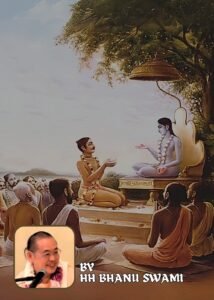
So, under ordinary circumstances, we must welcome guests, so what to speak of welcoming a great personality. This was not an ordinary house, this was an assembly and there is the king there and there was an assembly of great sages. And the sages recognized that this is not just a guest, he is a great personality. So they all stood up and they sat him down nicely on an asana, not just an asana, maha asana. And not only they sat him down, they sat him down in a very respectful manner. And then they worshipped him. So, in this way they showed the proper conduct, the proper etiquette. And in this case, this etiquette is for a certain purpose.
So, we know from Bhagavad Gita that you have to respect properly, that is you ‘pranipat’, and then what’s the next item? ‘Pariprasana’, ask questions and get answers. So they sat Sukadeva Goswami down nicely, they worshipped him and then they began to listen as Pariksit Maharaj’s questions were answered. And we see that here everybody was listening, but not only everybody, we have the Guru and the father of Sukadeva Goswami, Vyasadeva was there and his Guru, Narada Muni was there, they were also listening.
So, we see that Vyasadeva is famous because he compiled the Vedas. And he actually divided the Vedas and then he assigned a disciple to start a tradition or parampara for handing down those teachings of each Veda. But he also wrote Mahabharata with the Bhagavad Gita and the Puranas for people to get better explanation. And that also he assigned to one of his disciples. So, Vyasadeva himself was a great compiler and preserving tradition plus he was a great author of the Puranas and the Mahabharata. And he taught Sukadeva Goswami, Bhagavatam. But he was also sitting and listening as if he became the disciple. So, how was that possible? So at the beginning of Bhagavatam, it is said that when Bhagavatam came from the mouth of Suka, then it became sweeter. So Bhagavatam was not changed in any way, but it was somehow different.
So that indicates is that we have words, but who delivers the word is also important. So, we see that it is said in scripture that scripture is always pure but if it comes from a non-Vaishnava then it is like poison. So, if it comes from the mouth of a Vaishnava, it is not poison. Which means the sweetness and the value is preserved. But if the words come from the highest Vaishnava, then it will be the sweetest of all. Same words but somehow effect is different. So, therefore scripture is always scripture but nevertheless we do want to hear from proper speakers. So Bhagavatam is praised not because it was written by Vyasadeva but because it was spoken by Sukadeva Goswami and it became very sweet.
So what made Sukadeva Goswami’s delivery of Bhagavatam superior? So ultimately if we examine we will see that particularly the descriptions of Krishna’s pastimes in the 10th Canto and ultimately the description of Krishna with the Gopis and the description of the Rasalila, these are the items which Sukadeva Goswami relished. So, because of his realization of these pastimes, then when he delivered the words, they became very very sweet. So that is why though we have scriptures which we have to respect and hear, nevertheless we also relate that to the speakers.
So when we speak of Sampradaya and Parampara, we are not only speaking of handing down the scriptures. Of course, some of the members of the line, the Parampara have written commentaries. But when we trace our Parampara, we are tracing the scriptures and the commentaries and who delivered them. So we trace a Parampara by naming the different devotees who passed on the teachings of the scriptures. So in this way we have a Siksha Parampara. So, this means the scriptures are important, but again we need the proper persons to deliver them. So, we have our scriptures like Bhagavatam and its commentaries and we have a person to teach it. Then we have a qualified listener. A person qualified with devotion. And then he hears and he absorbs the meaning. Then he is able also to pass on the same scripture. So, we have the scripture passed on with realization of the proper meaning. And of course, the meaning does not just mean to take the dictionary meaning of the words and the sentences. But rather to convey the actual experience of Krishna and His pastimes. So in this way, the meaning and experience of scriptures get passed on from, not the scriptures but person to person using the scriptures.
So, scriptures are definitely important. And the ultimate scripture for us is Bhagavatam. And then the person to deliver those scriptures, Bhagavatam and its commentaries is very important. And in this way a person can get the proper meaning and proper experience from Bhagavatam.
So, the process that Lord Caitanya has introduced is simple. It is chanting Krishna’s name.
This is much simpler than other processes. And thus we have no dependence on other systems. Definitely all these systems are mentioned in the scriptures. So we have Vedic system, with all of its various rules. Related to that, then we have the Smriti Sastras with all Varnashramic rules. And through those Varnas, particularly the Brahmanas, the Vedas are carried on.
So, that is we have the Vedas and we have the Smriti Sastras, we have additionally the Pancharatra scriptures. These are a little more specialized because they are all about Vaishnavas. Vedas and Smriti Sastras, everybody there, Shiv Shaivites, Shaktas, everybody included in that. So, Pancharatra deals with Vaishnava, Vaishnava conduct, Vaishnava mantras, Vaishnava worship. And exclusively the worship of forms of Vishnu and the avatars and Krishna. So, this system actually overrides many of the Vedic rules. So, in the Pancharatrika system, if the Guru chooses to give you the Krishna or Vishnu mantra, you become qualified, regardless of whether you have Upanayanam and Vedic samskaras, etc.
So, though both scriptures are there, we give more prominence to Pancharatra over Vedas or Smriti. Of course, strict followers of Vedas and Pancharatra will always criticize, Oh, you Vaishnavas, you are breaking all the rules of the Vedas. Of course, some of the Vaishnavas also, compromise to some degree, so they follow the Vedas, plus they follow Pancharatra at the same time.
But we see if we go to the Pancharatra Sastra, there are places where it overrides the Vedic rules completely. However, then we come to Bhagavatam, Bhagavatam also overrides even Pancharatra. Of course, very emphatically it also overrides Vedas and Smritis. So there in Bhagavatam, it is allowed that you can give up all your ‘Sva Dharma’ and your Varanashrama and whatever in Vedas and whatever if you have firm faith in worship of the Lord. And of course, in Bhagavatam, we also have prominence of chanting the name of the Lord. So, it is this prominence of the name which Lord Caitanya stresses. And Lord Caitanya proclaims that Nama Sankirtan is the Yuga Dharma. So chanting the name surpasses Vedas and Smritis and even Pancharatra.
So we can say well how can you do that? How can we just ignore all the literature because we also say that we should follow Sruti, Smriti, Pancharatra, etc., we should follow. So, of course, we do not give up those rules, but at the same time, we give great prominence to Nama Sankirtan. And thus in Caitanya Caritamrta, Lord Caitanya says, chanting the name surpasses Diksha, which is Pancharatrika. According to Pancharatra, you’re not a Vaishnava unless you take Diksha and get your Diksha Mantra. And you cannot participate in the activities of Vaishnava that is prominently worship of the deity unless you’ve got Diksha. And without that worship, you can’t get perfection, you can’t go to Vaikuntha. But Lord Caitanya says, no chanting the holy name does not depend on Diksha and you can get the highest perfection. So in other words it goes beyond even the rules of Pancharatra. What to speak of the rules of Smritis and the rules of Vedas.
So for many conservatives in society, this also was pretty revolutionary. But all based upon Bhagavatam. Of course we can say Bhagavatam is a summary of all the Vedic knowledge. So definitely if we go to Smritis and Pancharatra and we go to the Vedas, we will find definitely there is provision for doing what Bhagavatam says, ‘rejecting everything, just worshipping the Lord and chanting the name’, but it is not so prominent and therefore it’s hidden among all these other rules. And thus Bhagavatam says, ‘anyone who chants the name of the Lord immediately if he chants purely then immediately even if he is born as a dog eater which is not even in the Varanashrama system, lower than Varanashrama, he gets higher than the Varanashrama, he can do whatever a brahmana can do but he can do more.’ So that of course is a little bit of a very astonishing claim. And to say that then it becomes Nama aparadha because that means we’re thinking holy name glories are exaggeration.
But this is also justified because Rupa Goswami quotes these verses in Nectar of Devotion to show that bhakti destroys not just karmas, but even the prarabdha karmas which means your birth etc. So, therefore, we find that there is a scriptural support in Bhagavatam for such claims. Still of course people oppose this. Which means they oppose Bhagavatam statements. Why? They will put more stress upon Smritis and all those things and Vedas. But the basis of Lord Caitanya’s movement is not those at all, it is Bhagavatam. So, therefore if we take Bhagavatam as the main scripture and if we take such verses, we will understand that bhakti and particularly holy name goes beyond every other process. And that is illustrated in the case of Ajamila.
So there we say, Ajamila chanted name of Narayana, not even as a devotion but accidentally by naming his son Narayana and in one second, all of his karmas and his prarabdha karmas and not only his prarabdha karmas, the vasanas, the desires behind it and the ahankara, everything was destroyed. And then people will say, ‘ah that’s ridiculous’. If all his prarabdha karmas are gone, why does he still have a body, why does he look like Ajamila, why does he continue his sinful activities even if everything, all the vasanas are gone, all the karmas are gone.
But we see Viswanatha Cakravarti in his commentary gives very nice explanation for all of this. Of course, we cannot expect everybody to chant like Ajamila because he chanted with no offense. So those who chant with offense then process will be slower. So of course those who are chanting with offense and are also devotees of course then yes the process will be slow but not so slow as someone who is chanting Nama-abhas like Ajamila just naming their son Narayana with offense or whatever like that because they’re devotees with devotion, so the process will be quicker even though it will be slower than like say Ajamila’s case, instantaneous destruction of all karmas and all desires. So we can never underestimate the powers of Nama Sankirtan.
Hare Krsna!
Q & A:
1.) Maharaj, regarding Hare Krishna mahamantra, we hear from devotees that, why it is known as mahamantra because different mantras give different goals, aspirations. Chanting Hare Krishna mahamantra can give karma, jnana, bhautika labha also and can go to prema also. This is one understanding devotees give. Another devotee told that, why it is known as mahamantra because other mantras at least have Om Namo, this mahamantra has all the names only, there is nothing else. And some said that, this is mahamantra because it doesn’t require any qualification anyone and everyone can chant it without. So, Maharaj is this understanding correct or there is some more understanding about why this is known as mahamantra?
Any form of bhakti can give all results. So, any form of bhakti, smaranam or kirtan or sravanam etc or offering obeisances etc, so, they can all give results of karma, jnana, yoga and bhakti. So, the Vaishnava mantras, the diksha mantras, they are also part of bhakti. They also do the same thing. They can give results of karma, jnana, yoga or bhakti. But requirement for the mantra is, you have to get it through diksha. Most mantras have rules for chanting those mantras. Just as there’s rules for chanting vedic mantras and the brahma gayatri etc. So, there are rules for chanting the Vaishnava mantras and even they have you know Vaishnava gayatris and then there is a Vaishnava sandhya even like sandhya vandana for the vedas you have a whole ritual for your Vaishnava Krishna gayatri or whatever, Kama gayatri or whatever. There are also particular rules for chanting these mantras. Of course, it is said that, and you have to purify the mantra and do so many things. And these ceremonies are mentioned in Hari Bhakti Vilasa. Of course, there it also says, well Krishna mantras, you don’t have to do all these rituals [Laughs]. So, in that sense even the mantras, the Krishna mantras are a little more liberal than the other mantras for Vishnu etc. But still there’s restriction because to get the mantra you have to have diksha, then you have to be qualified according to the Guru and when you get the mantra, you can’t give it to anybody else, unless you give them diksha [Laughs]. So, the name of the Lord is free of all of these restrictions in terms of rules and rituals and who get, who gives it to you and who you give it to, it’s all free [Laughs]. And you can get all the effects that you get from mantras and other types of bhakti. But we can say easier because it is not so restricted by time, place, purity, impurity all these rules. And even if you chant accidentally, even if you chant half the mantra, still has effect [Laughs]. You cannot accidentally chant diksha mantras because they’re also the whole series of things which just can never be accidental. The name you could have chant accidentally as in the case of Ajamila. So, the name is more easily accessible, easier to perform and more powerful. So, one interesting fact is mentioned by Sanatana Goswami in Brhad Bhagavatamrta. So, Gopakumar who was in Vaikuntha, not so satisfied with worship of Vishnu because he wanted to see Krishna. He was told by Narada Muni that actually if you want to go to Goloka, you have to, not use your mantra, which was his diksha mantra, but Nama Sankirtan. Then you get to go Goloka and see Krishna [Laughs]. There is no reason given for that, obviously except for the power of the name is more than the power of the mantra. But we can also say that the mantras are part of vaidhi, whereas the name could be raga, so [Laughs] it’s more powerful [Laughs].
2.) Thank you Maharaj. Maharaj, can we say concluding that, because of the karunya feelings of mahamantra, it is mahamantra? Because of karunya, because of most merciful and most compassionately available for anyone and everyone, it is mahamantra. We can conclude like this Maharaj?
The Sri Vaishnavas call Om Namo Narayanaya the mahamantra [Laughs]. So, in a sense that we say it is a relative term. But of course, if we take Bhagavatam conclusion, Kṛṣṇas tu bhagavān svayam [ŚB 1.3.28]. Worship of Krishna is higher than worship of Narayana and therefore, the name of Krishna higher than the name of Narayana in that sense [Laughs]. So, when we use the word mantra in this sense, it’s a little bit different. Because the normal sense when they talk about nama and mantra, mantra is the diksha mantras. And nama is not that type of mantra that requires diksha but when we say mahamantra, we’re just saying mantra anything sacred, sacred sound in general, not any particular mantra from you know, Vaishnava pancharatra or whatever. If we take the general definition of mantra to mean, that, the sound which delivers the mind from material world, then we can say that mahamantra means the most powerful sound to deliver you from material world and give you prema [Laughs] of Krishna [Laughs].
3.) Thank you Maharaj for the elaborate explanation. Maharaj, one more question. In Brhad Bhagavatamrta, in the third part we see that, this Gopakumar goes to the spiritual world and there he gets the name Swarupa. Then later on, his another friend who was not even a worshipper of Krishna, he was a worshipper of Durga and by his mercy, I want to say, he gets to spiritual world and he also get the name, some, the name Jana Sharma. So, there I could see that almost 25 pages are there for one shloka explaining his various examples as to the power of mercy of a devotee. So because Gopakumar followed so whole process, chanting, so many things he did for many many yugas and here witthout any effort, he got it. So, can we say this is an exclusive example of kripa siddhi Maharaj? The Jana Sharma got?
So that, the brahmana who was worshipping Durga devi was, by the mercy of Durga devi, who was the presider over the mantra [Laughs], he got the Krishna mantra also [Laughs]. So, he began to chant the Krishna mantra. So therefore, he became a Vaishnava in a sense [Laughs]. And due to that influence of the mantra, then he became disinterested in all other processes and eventually ended up coming to Vrindavan and that’s where he met Swarupa [Laughs]. So, yes, by the mercy of Swarupa, then he became, you know perfected. But of course, it’s also there, it’s actually the mercy of Radha, because Radha had instructed him to go there to it. So, we can say Radha’s mercy was involved also.
4.) Hare Krishna Maharaj. The description of Bhagavata vidhi and vaidika vidhi and in general, the brahmana communities those who strictly follow the vaidika vidhi, they say the Bhagavata vidhi is too liberal.
[Laughs]. So, the people who have different faiths, even if the faith is in, you know, scripture and vedas and whatever, then, they will see that their, think their process is always superior. And they will choose scriptures to support their ideas. But as I said Lord Caitanya and our Goswamis have chosen Bhagavatam as our authority. So therefore based on that, then we do all these things. And in Bhagavatam, it says yuga dharma is Nama Sankirtan, not following vedas [Laughs].
5.) Hare Krishna Maharaj. Maharaj, what exactly is the difference between namabhasa and suddha nama?
Well, namabhasa takes two forms, one is the unintentional chanting as in the case of Ajamila or there’s so many different ways, you could accidentally chant with no faith. So, in that chanting there’s no faith. There may or may not be offense behind it. So, in that sense we can say, it is, it’s not pure chanting. The other type of namabhasa is to chant with intention. So, you’re chanting everyday, you’re doing kirtan or chanting japa or whatever, it’s not accidental but still, it’s not pure. So, one may be chanting for material goals, so we have a mixed type of bhakti. Or we may have mistaken philosophical conceptions. Such as the ultimate limit of nama is to get you to svargaloka or that Krishna is a devata, name is material, all these sort of things. So, these are also aparadha [Laughs]. So, pure name means that, we chant with devotion, but also according to the definition of pure bhakti. And we’re free of philosophical misconceptions and thus free of aparadhas.
6.) Hare Krishna Maharaj. Maharaj, we see in Kali santarana upanishad it’s said like iti ṣoḍaśakaṁ nāmnāṁ kali-kalmaṣa-nāśanam. Only Hare Krishna maha mantra can deliver in this kali age. At the same time, we see other sampradaya, they have their own mantras. For example, Nimbarka sampradaya, they have similar mantra like us. Radhe Krishna Radhe Krishna like that. And Sri Vaishnavas, they have Om Namo Narayanaya. So, my question is, if our maha mantra is the only deliverer of this kali, how, we see there, they are chanting their mantras and also there is, they are getting delivered. So, isn’t it, how to reconcile this?
So, in the Sri sampradaya, their mantra is actually not nama. It is diksha mantra. So, their process is, their sampradaya is more based upon archana. So, of course, the Nimbarka sampradaya also has nama. As well as mantras. They also worship Radha Krishna [Laughs]. So, it’s quite similar. So, there’s a slight difference in the philosophy we have acintya bheda abheda philosophy. And they have dvaita advaita philosophy [Laughs]. There’s a slight difference. But this is all according to sampradaya, there’s going to be some difference.
7.) That’s my next question is like, for a pure devotee like Parikshit Maharaj, like we can understand that he got thirst and he got angry, he garlanded sage, everything, it is because the, that episode is because of the will of the providence. So, as a, at the same time as a struggling sadhaka we, whatever problems comes to our life, we turn our face to the scriptures. Whenever we have some problem in our life, we cannot come to the conclusion that, this is the will of providence. So, from that episode like, like whatever happened in our life, we cannot say that, that is, this is the will of the providence. So, should we take it as this is due to my karma or how do we take it as?
So, this is mentioned in Bhagavatam, the devotee who is suffering, then he takes it as not Krishna’s direct mercy, but mercy in the form of karma. And of course, karma itself is self produced. We do activities that cause our karma [Laughs]. So, the devotee takes responsibility for his present situation in terms of his karmas. Of course, it may not all be karma, may be some arrangement of the Lord also. But the devotee takes responsibility and in spite of all of the inconvenience, he continues with strong faith to worship the Lord. And this qualifies him for the mercy of the Lord.
Devotee: Maharaj, if he thinks, if a devotee thinks it is because of his karma, so even if one if he chants one time the Krishna nama, every karmas are gone. Even if we chant one time of Krishna is every karmas are gone, including prarabdha.
HH Bhanu Swami Maharaj: If he has no offense [Laughs].
Devotees: Grantharaj Srimad Bhagavatam ki jai!!! HH Bhanu Swami Maharaj ki jai!!! Srila Prabhupada ki jai!!!