Seminar on Insights of holy name – Session 3 | HH Bhanu Swami Maharaj | ISKCON Chennai | Acharya Vani Mahotsava | 25 Jan 2026
HH Bhanu Swami Maharaj:
nama om vishnu-padaya krishna-preshthaya bhu-tale
srimate bhaktivedanta-svamin iti namine
namas te sarasvate deve gaura-vani-pracharine
nirvishesha-shunyavadi-pashchatya-desha-tarine
jaya sri-krishna-chaitanya
prabhu nityananda
sri-adwaita gadadhara
shrivasadi-gaura-bhakta-vrinda
Hare Krishna Hare Krishna Krishna Krishna Hare Hare
Hare Rama Hare Rama Rama Rama Hare Hare
So we have seen that chanting of the name of Narayana and other names of the Lord has very astonishing effects. More astonishing effects than karma yoga with its atonement or prayaschita. It’s more powerful than even jnana and yoga. And quicker in its results than other forms of bhakti. However, the effects lessen if we mix the bhakti or we have offenses.
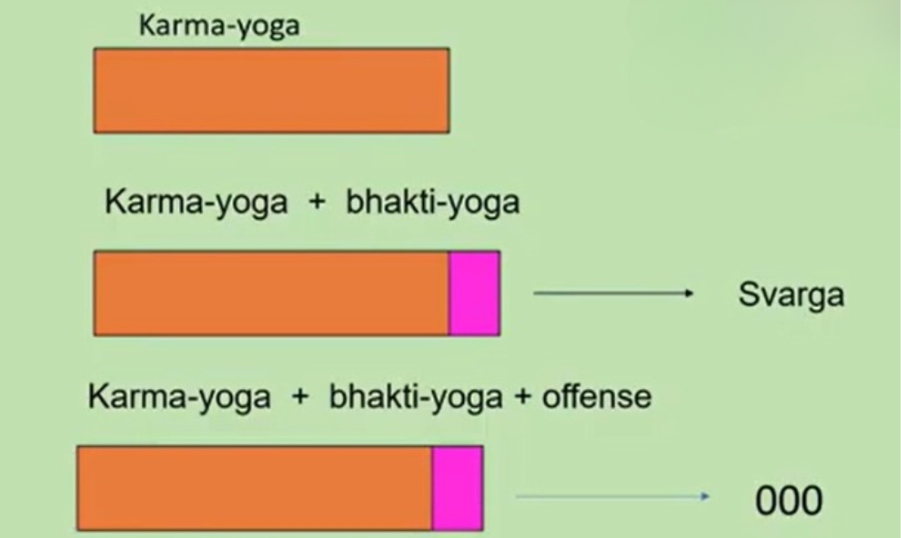
So if you have a little bhakti which has a little offense into karma yoga, you can get svarga yoga. If there is no bhakti at all in your karma yoga, you get nothing [Laughs]. And similarly with jnana yoga, there is a little bhakti there, even if it’s aiming at liberation, you can get liberation. And if there is no bhakti at all, no liberation. So this of course is not pure bhakti that they are doing. This is minor bhakti, secondary bhakti.
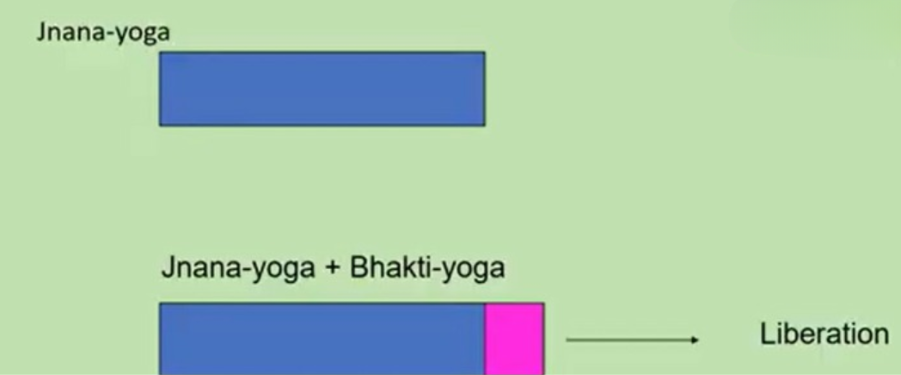
So, Vishwanath Chakravarti explained, when they are doing this bhakti as a secondary process, generally there is some aparadhas involved because they are equating it with yajnas and charities and what not.
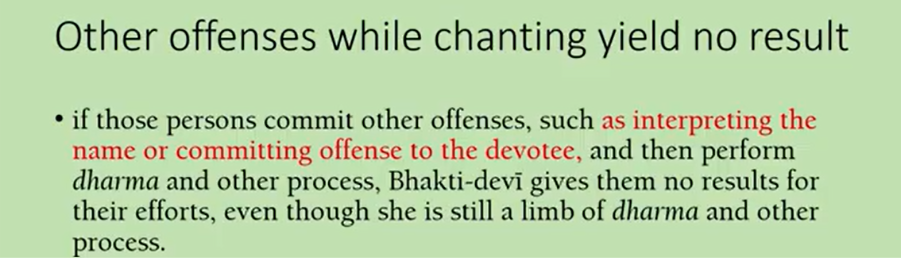
Still, bhakti yoga tolerates and gives them some result. But if you have worse offenses, more serious offense such as offending the devotees, then you get no effect [Laughs]. So even though you are doing the little bit of bhakti yoga with karma yoga, little bit of offenses there, if you have greater offense like offending devotees, then it’s zero again, back to zero [Laughs].
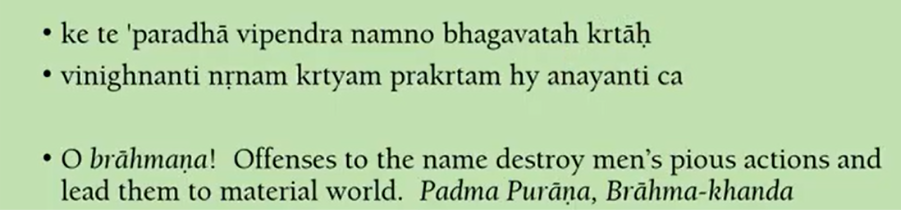
So we see that therefore offense, even with name, and name is very tolerant, if we have offenses, then there is an obstruction. And thus, we often stress in namaparadas or offenses against the name, those offenses which will obstruct the name and thus obstruct results. So the offenses are of course listed in Padma Purana, but it is not just Padma Purana that is mentioning this, all the Puranas are saying this. So this verse says that, the aparadhas will, of course doesn’t give you real spiritual results, but it destroys pious actions [Laughs]. So that means you can’t even get pious results if you start offending.
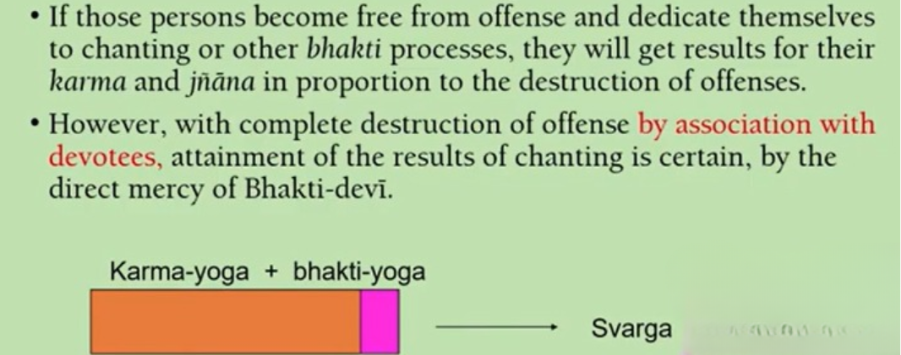
However, process of bhakti is very tolerant, name is very tolerant, so if they get freed of their offense, when they chant seriously with purity, then they can get the results of karma, or jnana, in proportion to how much they’ve destroyed their offenses. If they get association with devotees practicing pure bhakti, then they can destroy the offenses completely. So therefore, association of devotees who practice pure bhakti is also very important.
So the Yamadutas describe the history of Ajamil and in there, he was a brahmana who was practicing karmas. So he was not a devotee, he was doing karmas, but we assume that within that karma yoga, he was also worshipping Vishnu as a secondary element. And of course, this means that generally, with these people doing bhakti as a secondary element, they consider bhakti like a punya. So there is some slight offense there. And we said that he was chanting purely when he named his son Narayana. How can he be pure? Because he had actually been doing nama-aparada in his bhakti. So how is it possible?
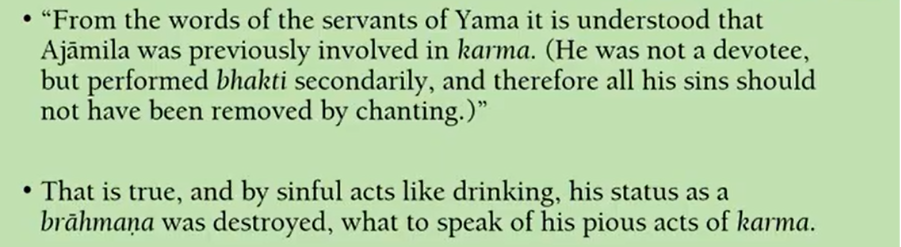
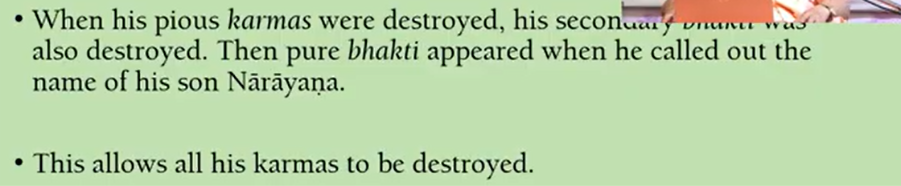
So Vishwanath Chakrawarthy explains that, yes he was practicing his karmas with a little bit of contaminated bhakti [Laughs], but he began to do sinful activities like drinking, etc. And this way, he destroyed all of his punyas. So not only his pious karmas or activity, even his secondary bhakti got destroyed [Laughs]. So in this way, he was left with nothing [Laughs]. No secondary bhakti, even if it was offensive, and no pious results of his karmas. And thus, when he chanted the name Narayana, there was no offense, there was no punya, and all of his karmas got destroyed.
So, in the scriptures, when you’re practicing karma or jnana, it says you should also perform some bhakti. It’s scriptural. So if scripture is recommending bhakti as a secondary element of karma or jnana, how can it be offensive? But as I mentioned previously, we can see many statements of scripture, we have to examine them very carefully. Some statements are stronger than others. How do we determine that? We have to look at the actual conclusion. For instance, the whole karma-kanda section of the Vedas is scripture, but it’s saying karma is supreme [Laughs]. Similarly, in chapter 3 of Bhagavad Gita, Krishna tells Arjuna, you practice karma yoga and worship Devatas [Laughs]. And he says, this is best for you. You’re not qualified for anything else [Laughs]. So we cannot isolate statements of scripture, even whole scriptures. we have to see it as a total.
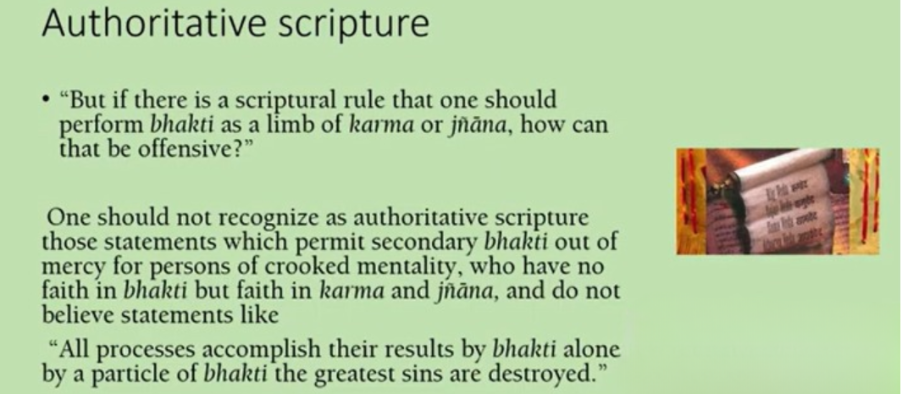
Now of course, these statements glorifying karma yoga, jnana yoga, ashtanga yoga, are there to encourage people who are not qualified for bhakti. So if they have a little faith in karma or jnana, these statements encourage them to practice that. And of course, Krishna in Bhagavad Gita also says, I give these people the faith by which they can worship Devatas, practice karma yoga, etc. So we have to take statements from other Puranas in the same way. So the Tamo-gun Puranas, they glorify Shiva. And they have many stories to show that Shiva is superior to Vishnu. So we have to not just see one scripture, we have to see all the scriptures [Laughs]. And with one scripture like Bhagavad Gita, we have to look at the conclusion, not look at the initial statements. So as I said, these statements are there, they have a function, they give people faith in a particular process when they’re not qualified for bhakti.
So we may state, oh this is not the conclusion, the conclusion is bhakti is the best, bhakti is the most effective, everything else depends on bhakti. But they won’t believe it. So if they’re so fixed in those methods, karma yoga or jnana yoga, even if you present contradictory statements and they won’t accept them, let them practice that. So people practice secondary bhakti along with karma and jnana and there is some offense there. And it’s recommended in scripture for those people, not for devotees!
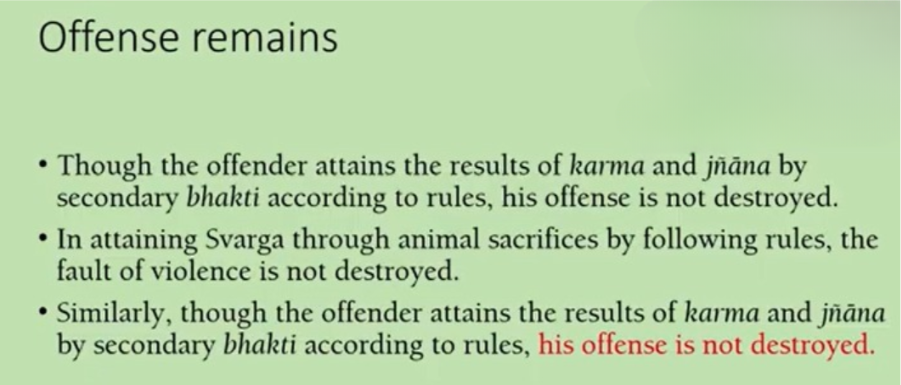
It’s better than no bhakti, but still there is some offense there. And even if he gets results of karma and jnana, his offense is not destroyed. So even if you attain svarga loka by doing karma yoga with a little bhakti, you may do animal sacrifices, still, you’re still subject to the effects of the animal sacrifice. So similarly, you do karma and jnana and you offend the holy name and the process, your offense remains after you get your results.
So how do we get rid of those offenses? You can take a Vaishnava Guru, take initiation. And if you do so, this means you’re taking shelter of pure bhakti. And you’re not using bhakti as a secondary means, it’s the primary means. So though bhakti and the name are the primary means, you could do karma yoga as a secondary process as long as there are no obstructions there. So it is karma mishra bhakti, but it is still pure bhakti.
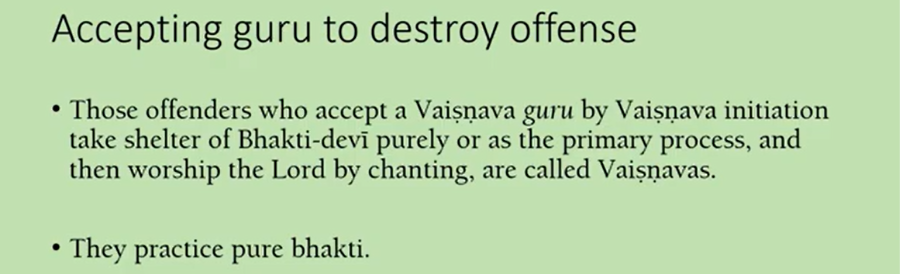
However, you can also do karma mishra bhakti, which is not pure bhakti [Laughs]. And that is when you start depending on that karma yoga, which is secondary, and you’re ascribing separate results to it that bhakti cannot give. In any case, if one gets the association of devotees practicing pure bhakti, one can begin the pure bhakti process and then we get destruction of the aparadhs. So we chant the aparadhs every day. So this is to show that if you came from a background of karma yoga, etc., you’re getting rid of these aparadhs of thinking that chanting the holy name was a pious activity or that Krishna is equal to a Devatas, all these bad conceptions. So as the bhakti increases, the offences decrease. The more we do the bhakti, we destroy the offences, the more we get the mercy, and this way we can progress to prema.
So in the first canto of Bhagavatam, we have this famous verse. Krishna purifies the person through hearing and chanting. So he becomes situated in the heart of the devotee and he destroys ‘abhadra’, all the sins. So this is actually a description of anartha nivrtti stage. And of course this is one stage.
After anartha nivrtti, we have nishta, ruchi, asakti. So gradually the anarthas and the aparadhs are dissipated. So in other words, if one has aparadhs and one begins the practice of pure bhakti, the process becomes gradual. So these stages of bhajana kriya, anartha nivrtti, nishta, ruchi, asakti, etc. So there is a gradual progress. And this is described as stages for people who have aparadhs.
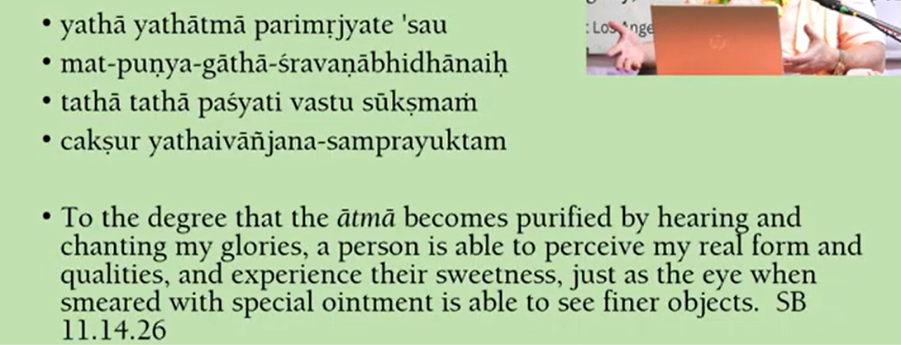
So if you have no aparadhs, the progress will be very quick and you cannot distinguish all these separate stages. So this is the verse from 11th canto showing this gradual development of bhakti. “To the degree that the atma becomes purified by hearing and chanting my glories, the person is able to perceive my real form and qualities and experience the sweetness just as the eye, which is mirrored with special ointment, is able to see finer objects.” So if you have serious eye disease and you start putting the ointment on, you don’t get full vision immediately [Laughs]. So every day you put on the medicine, gradually your sight becomes better. Therefore, we get this gradual progress in bhakti because of offenses. And gradually the offenses get destroyed.
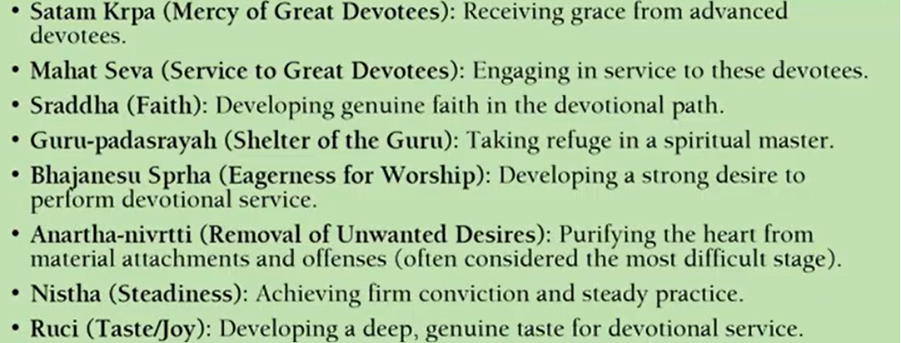
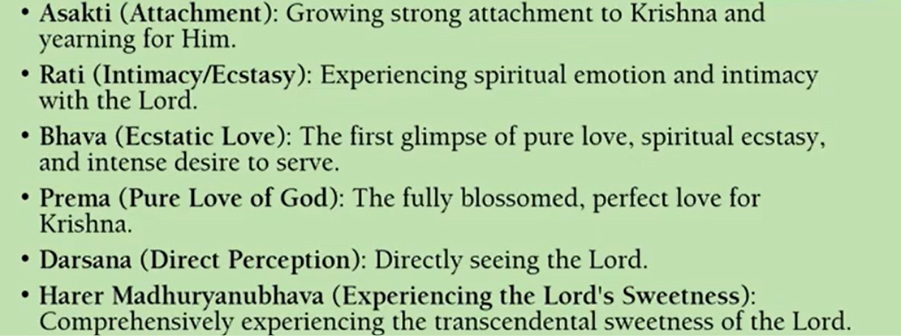
So Vishwanath Chakravarthy mentions that from these statements we can understand that those who have offended and start practicing pure bhakti, they have gradual progression through 14 stages. After all the offenses are destroyed, then they can attain prema. So he mentions 14 stages. Usually we have less stages. So he has expanded the basic stages into a few more preliminary stages and final stages. So first stage is mercy. After mercy then we do service to the devotees. Then we develop faith. Then we take shelter of a Guru. Then we develop eagerness for worship. Then gradually the anarthas are destroyed. So this means offenses and material attachments are destroyed. After this you get to steadiness. Steady practice, firm conviction. So in this process the anarthas and offenses are getting destroyed and the bhakti is increasing. So at nishta there are still anarthas there, but the bhakti is a little stronger so therefore you can steadily practice. At ruchi stage the bhakti is very strong and the anarthas are much less so therefore the bhakti manifests with taste.
Then the anarthas get less and less, almost gone and the bhakti is very strong so this is called attachment or asakti in which the attachment is so strong you can almost see Krishna. And at this stage the practice of bhakti becomes so spontaneous that there is no effort at all in doing bhakti. And then we come to rati (bhava) which means we actually experience the Lord. This becomes deeper. We say it is bhava. It becomes deeper. It is called prema. So at prema no anarthas at all. So only bhakti fully manifested. And in that state you can have continuous perception of the Lord. So at bhava you get some temporary appearance of the Lord and prema permanent and that darshan is very wonderful. And then in prema you see the Lord and experience the Lord and all your senses become saturated with the sweetness of the Lord. So these are the stages one goes through if one has all these aparadhas or whatever gradual purification.
So if you have no offense then everything is quicker. You don’t go through all these fourteen stages [Laughs]. You can chant the Lord’s name and go to Vaikuntha. And then actually is the case of Ajamil. He didn’t even have a Guru [Laughs]. He just named a son Narayana and then he went to Vaikuntha. So this is the power of the name.
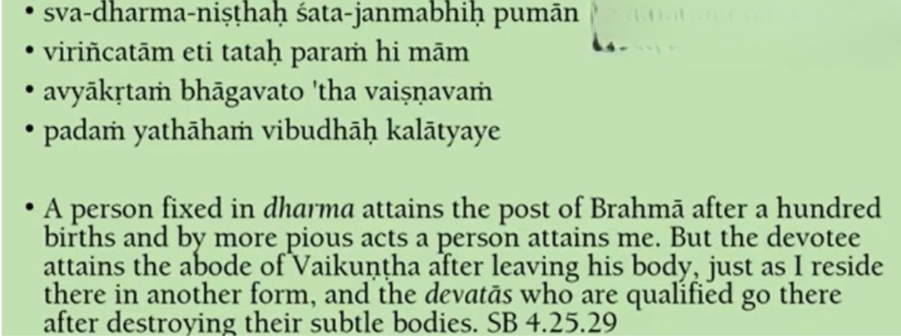
So here is a nice quotation. “A person fixed in dharma attains the post of Brahma after a hundred births and by more pious acts a person attains me. But the devotee attains the abode of Vaikuntha after leaving his body, just as I reside there in another form, and the devatas who are qualified go there destroying their subtle bodies.”
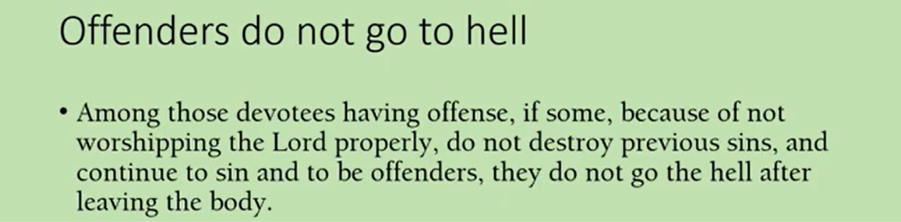
So the devotee who is practicing pure bhakti is in a special position. So he goes after many births but the devotee goes after leaving his body. So very quick process. So this is referring to a person who has no offenses. So even if the devotees have offenses, because they didn’t worship the Lord properly, they don’t destroy all of their sins and whatever. They still have some sin. They are still offenders. They don’t go to hell at least. That’s their blessing [Laughs].
So bhakti we know is indestructible. Nevertheless if we have people doing offenses or whatever, they have to take birth again and whatever bhakti is there, it continues. So therefore, we understand that bhakti with offense still has some effect and the bhakti can continue in their life after life. By their continuation of bhakti life after life, gradually the offenses are decreased and decreased. And then they can practice pure bhakti and then go to the spiritual world.
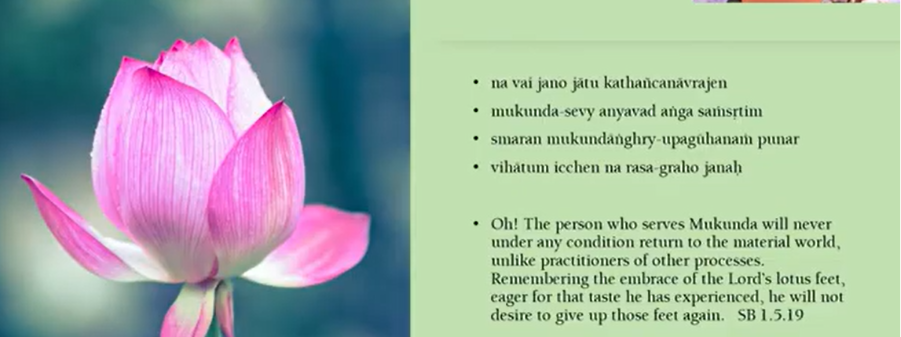
So this is one verse here again to illustrate that. “The person who serves Mukunda will never under any condition return to the material world unlike the practitioners of other processes. Remembering the embrace of the Lord’s lotus feet, eager for that taste he experienced, he will not desire to give up those feet again.”
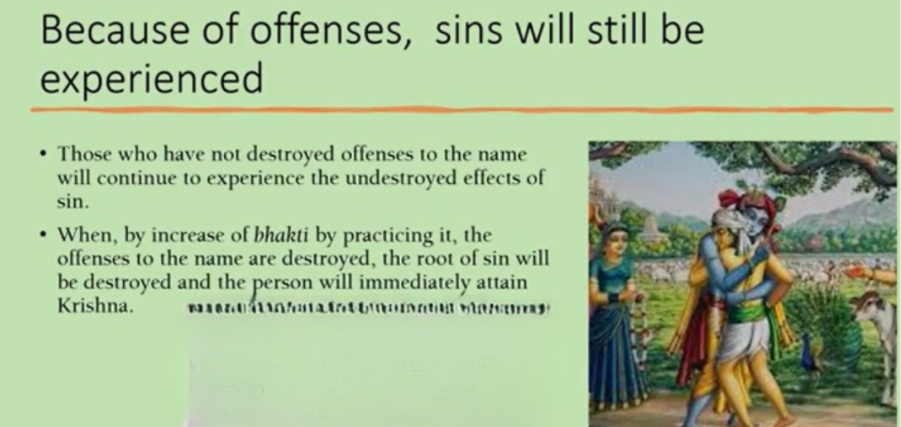
So this shows how the bhakti is imperishable. So though a person does commit offenses and performs bhakti, bhakti is still very merciful and he allows the bhakti to continue life after life. But we see that if they do have offenses in the chanting, then all the sins are not immediately destroyed. However by continuing bhakti, gradually the offenses are destroyed. The root of sin is destroyed and then the person can attain Krishna. So those devotees may take some time, here he says 1, 2 or 3 lifetimes to attain the Lord.
So the process is delayed in order that bhakti can properly increase or mature. And as we progress, there are some auspicious side effects. But we should not attribute those auspicious side effects to material karma. Bhakti itself can give all effects of karma yoga or whatever. So the devotee also experiences suffering. So the suffering is actually arranged by the Supreme Lord. So this is like a doctor who sees the sick person, he makes them fast and gives them bitter medicine. So the cure may involve some suffering [Laughs]. So the cure for the devotee to practice pure bhakti from offensive bhakti to pure bhakti may require some suffering in this world.

And thus we see this verse in the 10th canto. “If I especially favor someone, I gradually deprive him of his wealth. Then the relatives and friends of such a poverty-stricken man abandon him. In this way he suffers one distress after another.”
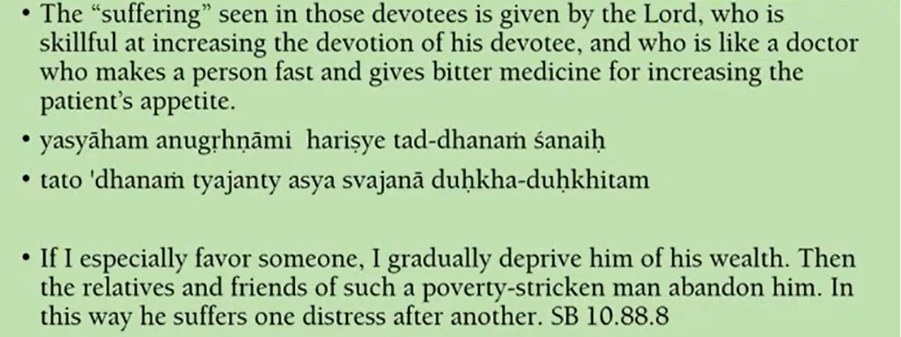
So here it states that he loses his wealth and he takes it as mercy of the Lord. And Prabhupad quoted this verse when he was doing his business and then suddenly somebody stole all his goods [Laughs]. By experiencing such sufferings, the devotee realizes the futility of material life and he surrenders to the Lord more.
So, what are the offenses? So, interpreting the name, thinking its glories are exaggeration, equating with pious acts, these are offensive. So, these offenses will be very common among people who are doing impure bhakti or mixed bhakti. But then, as I said this before, the very strong offense ultimately is offending the devotees and then committing sin on the strength of the holy name. So, these last two actually give worse effect than the other ones.
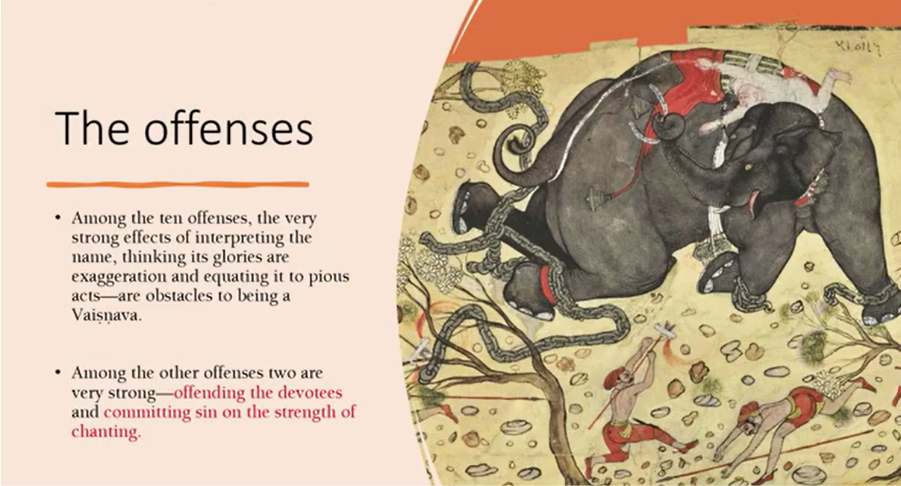
So, again the Padma Purana emphasizes the effect of these aparadhs. How can the name tolerate criticism of those who spread the name? So, this is sadhu ninda, criticizing the devotees who are spreading the glories of the holy name. So, this is the mad elephant offense. And this is the offense that can begin to destroy bhakti. And why? The devotees, as I said here, are the people who are spreading the holy name. So, not only they are spreading the holy name, they are spreading pure chanting of the name. They are spreading pure bhakti. And in this material world, there is no other source of pure bhakti or the pure name. And the supreme Lord, he empowers these people to distribute bhakti and the name. So, if we offend the devotees who are spreading the name and bhakti, then we are actually cutting off any hope of mercy. We may argue that okay, I will offend one devotee, but then I can go to another devotee and get his mercy [Laughs]. But this doesn’t work. Once you offend one devotee, Krishna withdraws mercy from all devotees [Laughs]. So, Krishna is empowering these devotees, you offend the devotees, then Krishna won’t give you any mercy. So, not only we can’t advance, actually we lose a taste for bhakti. And once we lose the taste for bhakti, then we don’t want to practice bhakti. But the only cure for the offense is to do bhakti and chant the name, and if you don’t want to do it, then you’re lost. So, that’s why it’s called the mad elephant offense.

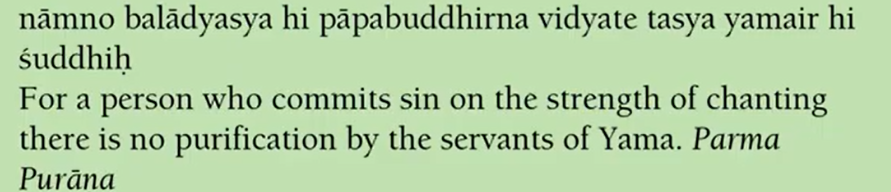
So, the second serious offense is committing sin on the strength of chanting. So, the name of course is all powerful and it destroys sin. But to utilize the name for that purpose and commit more sin, this becomes an exploitation of the mercy of the name. And instead of destroying your sins by doing that, you get worse effect [Laughs]. So, here it says you don’t get purification by the service of Yama, which means actually you’re going to get punished by Yama Raj. So, instead of getting purified of sin, you create more sin. But apart from not getting purified of sin and getting more sin, it also destroys your bhakti. So, these sins are very serious.
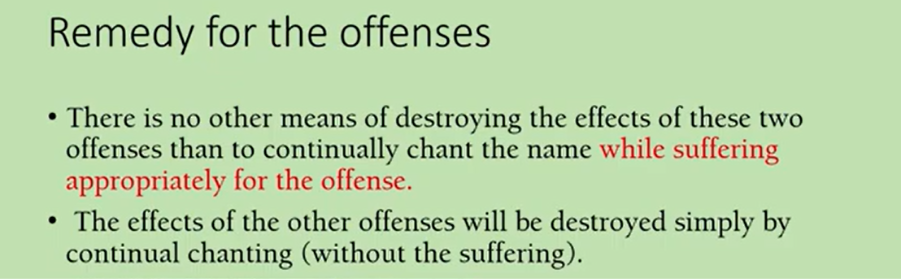
So, the cure for these sins is chanting the name [Laughs]. Of course, it may be difficult because you lose your taste. But if a person is very intelligent and very determined, then he will do that. Just as a cure for some disease may be a very painful cure. But if one is intelligent and is aiming to get cured, then he will go through that suffering in order to get the cure. So, the intelligent devotee, in spite of the fact that he has no taste, he will understand that chanting is only a cure. So, even though he has no taste, he will chant and chant and chant. Of course, with these serious offenses, he will have to get the suffering also. If the offenses are not serious, like interpreting the name, etc., then the offense is destroyed by simply chanting, without having to get any suffering.
Okay, Hare Krsna !
Q & A :
1.) Hare Krsna Maharaj, What constitutes offending a Vaishnava?
So, the offense can be physical, mental, or verbal. And there are many ways we can offend. Of course, one offense is to consider him in terms of material standards. So, we can judge him according to varna. If he is a low varna, he is not a very good devotee. If he is a brahmana, he is a very nice devotee. This is offensive. Similarly, if ashram, oh, he is a Grahasta, not so good. If he is a sanyasi, he is very nice [Laughs]. This is all material considerations. We can judge the advancement of a devotee on other material standards, such as health. He is healthy, he is nice, he is sickly, he is not a good devotee [Laughs]. Or, even dress. He dresses nicely, he is a nice devotee. We can judge him in terms of money. He is a wealthy devotee, he is better, he is a poor devotee, he is no good. We can judge the number of followers. This Guru has many disciples, he is a very elevated Guru. This one has two devotees, he is not a good Guru. We can even use age and say, oh, he is an older devotee, he is senior, therefore he is better, and he is a younger devotee, he is less. This is offensive. Another offence, of course, is to consider past, his past history. So, because he was in jail, he was in prison f[Laughs] or two years or something, he is not as good devotee as this devotee who did not go to prison. And, of course, all of this is because of karma.
People are in certain material positions because of karma. So, we are judging them according to past karma, but we know the way to become a devotee, we are free of karma.
Another offence is that the person may have some vasanas that are still there, that look like this, and he has some bad habits or whatever. So, to constantly criticize him for that is also an offence.
And then the last one is, he commits a sinful activity, then he remains a devotee, so to criticize him for that also is an offence. So, we may say, well, how is that [Laughs]? We are permitting everyone to be sinful. But we see in Bhagavad Gita, Krishna says, even if you commit the most sinful activity and you continue your bhakti, you are My devotee. So, therefore, we have to be very careful when we talk about devotees or treat devotees. And we have to judge them according to the seriousness of their bhakti.
2.) Hare Krsna Maharaj, in the case of Bharat Maharaj, it is said that, he was in a very advanced stage, bhava stage, how is that at that stage, he got attached to a deer ?
Jiva Goswami explains that, because of an aparadh in a previous life. The effect of that aparadh was not completely destroyed even in bhava stage. And this caused him to get attracted to a deer. So, in other words, the effects of previous aparadhs are very difficult to destroy.
Viswanath Chakrawarthy says, this actually is an arrangement of the Lord. So, he arranged for him to take three births to get prema. So, he says, this is the mercy of the Lord [Laughs].
3.) Are there any examples of offence, committing sinful activities on the strength of chanting the holy name?
Well, we can give a theoretical example. A person, he hears a lecture and the devotees are speaking and they say that, ok chanting the holy name destroys all your karmas and all your sins, like in the case of Ajamil. It’s an effect and no bad results. So, then he’ll think, okay, very good, I’ll go and do some sinful activity and I’ll chant the holy name and I’ll get no effect [Laughs]. But we should not use the name in order to commit offences [Laughs]. If we’ve done some sinful activity, of course we could chant the name to get rid of the effect. But we should not use it to do more sinful activities.
4.) Maharaj, does continual chanting mean only chanting the name or can it also be Guna kirtan or Leela kirtan?
So, chanting the name is the yuga dharma. But we can do other types of kirtan also. So you can have rupa kirtan, guna kirtan or leela kirtan. So these are other types of bhakti [Laughs]. We don’t discard any type of bhakti like smaranam or padasevanam or archana. But we put emphasis upon chanting the name.
5.) Hare Krishna Maharaj, I don’t want to commit offence but still my mind forcing me to commit mind level offence, how can I avoid this?
Which offence [Laughs] ? Of course the verbal and the physical are more serious. But the mental offence, if it is not controlled, will eventually become verbal or physical. So what is the cause of this? One cause is bad association. We associate with people, even devotees who may like to criticize devotees [Laughs]. So we have to avoid such association. And of course the main thing is, if we are aware of the aparadh, we try our best to avoid and meanwhile we do the opposite. We chant the holy name and we praise devotees [Laughs].
6.) Ajamila is a brahmana, did sacrifices for result, that itself is a mild offence against the holy name. How we can say that he is offenceless?
Yes. So as I explained, he did many sinful activities. And that destroyed all of his pious effects. It also destroyed all of the mixed bhakti, offensive bhakti that he had done. And thus he was left with zero. Then he was able to chant without offence [Laughs].
7.) Hare Krishna Maharaj, what is the consciousness of a person who is inoffensive? When we say being freed from karma and jnana tendency, what does it entail?
Well as I said, you could practice karma yoga or jnana yoga as a secondary element and it doesn’t have to be offensive. You could practice karma yoga merely for supporting your material body or to set an example for other people, that’s all. So contamination comes when we, in the process of doing such a thing, we think that bhakti is also less powerful.
8.) Hare Krishna Maharaj, how we can practice bhakti and increase bhakti without offences?
So one of course is knowledge. If we are aware of the offences and what they mean, then we can try to avoid them. We are given scripture and books and Prabhupad purports, so that we can practice bhakti properly and avoid the aparadhs. So to help us, then we have sadhu sanga. So if we associate with devotees who are practicing without aparadhs, then this encourages us also to do similar type of bhakti. And Srila Prabhupada made ISKCON so that devotees could associate together. So if you are trying to do by yourself alone, it may be difficult. If you can do it in association with devotees, it becomes easier.
9.) Maharaj, it sounds better to stay away from Vaishnavas, and protect oneself from aparadh, rather than serving with them and unintentionally hurting them and offending them.
So though chanting the holy name is independent, still it is always advised we chant the holy name and we associate with devotees and we hear the scripture. So association with devotees is recommended in order that we can practice pure bhakti and maintain that pure practice. Of course, because you associate with devotees, there is a danger you could commit Vaishnava aparadh. But then we have knowledge, so we can prevent that.
And if you choose good association, that can also prevent that. If on the other hand you choose no association, then it is more likely your bhakti is not going to be practiced purely anyway. And even without association with devotees, you commit more offense against devotees. Because then mentally or verbally, you may still criticize them [Laughs]. So generally, you can say, okay, I want to associate with devotees, but if you are not associating with devotees, you can associate with materialists [Laughs]. And then they are more likely to criticize and you are more likely to criticize also.
10.) Dear Maharaj, as you said, Ajamila didn’t do any offenses while chanting, so he went to Vaikuntha. So he didn’t accept Guru also. Can we find any people now in Kali Yuga who will not find or commit any offense? Please enlighten, dear Maharaj.
So we don’t know. It is very difficult for us to judge who has offense and who doesn’t have offense. Particularly if there is offense from previous lifetime, who is going to know? So all we can do is see how people progress in bhakti, and if it is slower, that means there must have been some offense. That’s all we can conclude.
11.) Are Vaishnavas offenses proportionate to advancement of the devotee offended ?
As for the offense yes, If you offend a very advanced devotee, then the effect is more serious. If it is a half devotee or Kanistha, it may not be so serious. And of course the problem there is, you may not be able to see, who is the advanced devotee and who is a less devotee [Laughs]. The person may look like a beggar and then you want to say, okay, we can criticize that person, but actually he is the most advanced devotee, so we have to respect everybody.
Devotee: Are neophytes are not considered as devotees. ?
HH Bhanu Swami Maharaj: Kanishtas don’t associate with devotees. That’s the definition given in the 11th canto of Bhagavatam. They worship the Lord, but they don’t associate with devotees. They don’t respect devotees. Because of that, they don’t have proper knowledge, so their bhakti is definitely not pure bhakti. And it is possible they can start offending devotees also. So they are not classified as devotees proper. They are called Vaishnava praya, almost a devotee. So they are considered devotees because at least they are worshipping Krishna. If they get mercy of a madhyama devotee, then they can become madhyama and become real devotees.
12.) So for curing a disease in the medicinal field, there are various ways, like that, are there any other process like Hare Krsna chanting to get the same effect ?
Well, we see that prayaschitta is one way of removing karma, but it is a slower process. If you do jnana or yoga, it is a very slow process, but you can actually get liberation that way. But in order to practice jnana and yoga, you have to be qualified by sattva guna. So there are other processes to get rid of your karmas and to get liberation. There is no other process to get prema.
13.) A hunter hunt a bird and the bird died painfully. Is this bird in her previous life did hunting and gave sustaining to birds? Because we know normally the birds does not have any karmic reaction.
So animals including birds cannot produce karma and they cannot commit sinful activities. Like a tiger kills an animal, he does not get any karma. A hawk kills a mouse, he does not get any karma. But they are in that body as a result of their previous sinful activities. M
14.) Many people will arrive or visit the temple to fulfill those desires and wishes through there by paying in order. So all those wishes fulfilled by the Lord means that does not visit the temple again. For example, patients visits the doctors to cure their diseases. If the diseases is cured means they say doctor is good, otherwise they won’t say it. So in the primary stage, all the devotees visit the temple to fulfill their wishes. Their wishes are fulfilled so they visit the temple again and again. And eventually it becomes a devotional service. When the devotional services arises, then Krishna gives obstacles or is the primary stage to give obstacles. So this is the process for all people who become devotees ? Is this right or wrong?
So different people come for different reasons. Some come and pray for money. Some come to get relief from distress. Some come because they are inquisitive. Some come because they are actually in knowledge of Krishna. So the motive for coming to temple is various. But we can say a majority will come to get rid of distress and to get material gain [Laughs]. And certainly the Lord responds. An example of a distressed devotee is Gajendra and the Lord responded. An example of a devotee who wanted wealth is Dhruva. So Lord responded to them. Of course, that’s not the highest goal, just to get relief from distress or to get material benefits. And hopefully by association with devotees practicing pure bhakti, they will begin to change their goal. So that is the special advantage of ISKCON temples.
If you go to Balaji or Guruvayur or Ananta padmanaban temple, people are going there to pray and nobody says anything else [Laughs]. And they are praying for money or relief from distress. Nobody is preaching to them [Laughs]. But if you go to ISKCON temple, then we tell you, okay, you can get those things, but higher than that is you shouldn’t pray for them. Krishna will give anyway. But you should strive for pure bhakti and prema.
Devotees: HH Bhanu Swami Maharaj Ki.. Jai !! Srila Prabhupad Ki.. Jai !!