Seminar on Insights of holy name – Session 1 | HH Bhanu Swami Maharaj | ISKCON Chennai | Acharya Vani Mahotsava | 23 Jan 2026
Devotee :
So every morning we remember Vishwanath Chakravarti Thakur and particularly ‘yasya prasādād bhagavat-prasādo yasyāprasādān na gatiḥ kuto ’pi’. So that is the glory and Vishwanath Chakravarti Thakur has unlimited glories like, you know, One of the first instruction that his spiritual master Sri Radharaman Chakravarti gave him is to write the.. those days because there is no Xerox, there is no what is scanning or anything, everyone has to write Srimad Bhagavatam. His spiritual master told him his instruction is to write all the 18,000 verses and Vishwanath Chakravarti Thakur write those verses. The significance is whenever, wherever he was, he was in an open area.. If it is a hot climate, it will be a cool shelter for him And whenever there is a very, very freezing cold, there will be a sun rays upon him and if there is so much of floods all around, none of his place or none of his scriptures will be touched by the water. That is the glory I mean, there’s unlimited glories.
So let us all be fortunate to hear from His Holiness Bhanu Swami Maharaj. One or two requests is please switch off your mobile phone or, put it on a silent mode. Those who are in management or some service can take their phone out and speak. Second thing is those who have not registered, in order to do the festival nicely, in order to serve you better, only when you register, we’ll be able to serve you better. There is a registration counter near the elephant or cow and calf. Please do register. We are welcoming His Holiness Bhanu Swami Maharaj and all the devotees for this wonderful festival.
HH Bhanu Swami Maharaj :
nama om vishnu-padaya krishna-preshthaya bhu-tale
srimate bhaktivedanta-svamin iti namine
namas te sarasvate deve gaura-vani-pracharine
nirvishesha-shunyavadi-pashchatya-desha-tarine
jaya sri-krishna-chaitanya
prabhu nityananda
sri-adwaita gadadhara
shrivasadi-gaura-bhakta-vrinda
Hare Krishna Hare Krishna Krishna Krishna Hare Hare
Hare Rama Hare Rama Rama Rama Hare Hare
In the Nectar of Devotion, Rupa Goswami defines sadhana bhakti as engagement of the senses to attain bhava for Krishna. So, in the same work, he describes all the different activities that we do to engage the senses and they are given a number, sixty-four items. And then, among those sixty-four, he takes five as most important. And He says, quickly by practicing these five, you can attain prema. So, among these five is chanting the name of the Lord, Nama Sankirtan. Of course, we also know from Bhagavatam that Nama Sankirtan is the Yuga Dharma. And we also know that in Bhagavatam, Nama Sankirtan is pointed out as to be the most powerful method within bhakti. This may not be apparent in all cases because the devotees often get involved in hearing the various pastimes of the different avatars, including Krishna. However, if we look closely, then we will see at the beginning and at the end, Nama Sankirtan is most prominent.
Of course, because Srimad Bhagavatam is a Purana and a Mahapurana, it deals with ten topics that are typical of a Mahapurana. Just as you have a textbook on medicine, then it would have to cover operations, anaesthesia, all the different subjects and all the different anatomy, all these different subjects. So, in the second canto and again at the end of the Bhagavatam, a list of the ten topics are given. Of course, among these topics, asraya is considered to be the ultimate topic. And Of course, asraya literally means shelter or ultimate cause. Various Puranas will select Vishnu or someone else, but Bhagavatam makes Krishna the asraya. Even though we have many different avatars described in Bhagavatam, ultimately Krishna is said to be the cause of all causes. So, we can argue therefore then the Bhagavatam should just be about Krishna, why anything else? But because it is a Purana, it should deal with the ten topics. However, if we examine closely, we will see these ten topics all ultimately point to the asraya.
So, we have sarga, visarga, sthana, etc. as mentioned here as topics. So, the first topic is sarga, which means creation. And the second topic, visarga, secondary creation. So, sarga refers to the first aspect of material creation, that is, Maha Vishnu glancing over Prakriti. And after all the elements are manifested in Prakriti, then Brahma takes the elements and makes them into bodies, material bodies and material planets. This is visarga.
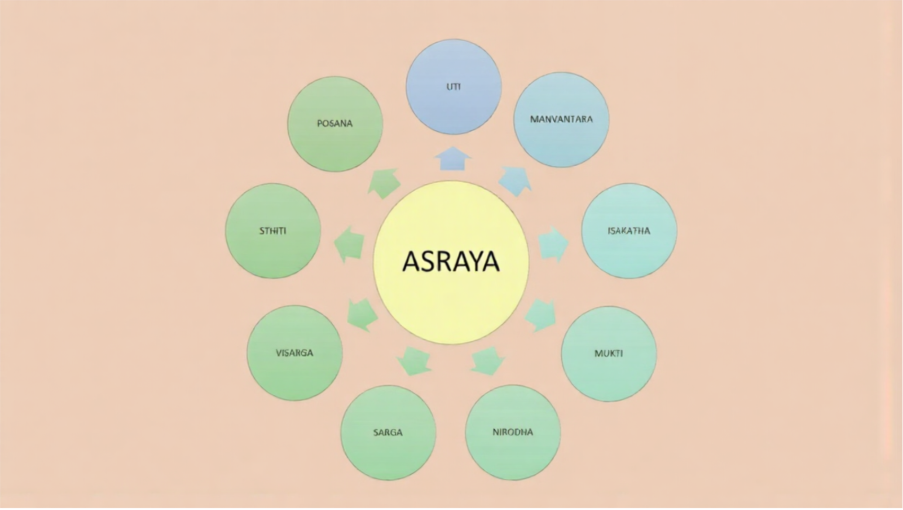
So, we find in the third canto, we have a description of Maha Vishnu glancing. In the fourth canto, we see the creations of Brahma. So, when Brahma creates the living entities, the bodies at least, the living entities have to live some place. And therefore, Brahma creates the lokas. So, that is described in the fifth canto of Bhagavatam. So, in the fifth canto, we have a description of all the planetary systems for hellish planets, all the way up to Brahmaloka. And then in the middle, on Bhumandala, we have a description of all the different varsas and the dvipas. And these places are useful because they become the residences of different Jivas with their material bodies, according to their karma.
So, how does all of this relate to Krishna? It relates to Krishna because Brahma comes from Vishnu, Garbhodakshayi Vishnu comes from Maha Vishnu. Where does Maha Vishnu come from? Krishna [Laughs]. So, though primary creations, secondary creations are through other entities, ultimately coming from Krishna. So, whatever power we see manifested in Maha Vishnu, Garbhodakshayi Vishnu or Brahma is ultimately in Krishna also. So, it is very skillful of Krishna, that he could create the material world and be completely separate from it. So, we see Krishna involved in his eternal pastimes in the spiritual world with the cowherd boys, the gopis. But who is going to manifest the material world? So, Krishna does not do that directly, he does not interrupt his pastimes, but through his expansions, he carries out all of this. Thus, prakriti, and the whole material world and all the planets and the material bodies are unimportant for the Supreme Lord.
However, Supreme Lord should never be indifferent to anything he creates. So, we see Vishnu expands as Ksirodakasayi Vishnu. He expands as the Antaryami in all the Jivas in the material world. In this way, he monitors all Jivas. So, he is not completely indifferent. At the same time, he doesn’t interfere with the Jivas. So then, what is to happen? The Jivas stay in the material world eternally. But the Lord is not so indifferent or neutral. He also manifests himself in the material world in various ways. So, one way is by avatars. And therefore, from the third canto all the way to the tenth canto, we have lists of the avatars who come. And the purpose of the avatars is to take the Jivas in the material world to the spiritual world. So, throughout each day of Brahma, we have avatars appearing. In fact, the avatar appears in every yuga, the yuga avatar. These avatars do not stay there forever. They stay for some years or some days and some years or hundred years or whatever, thousand. They disappear.
So, what happens in the meantime? Jivas are back to zero [Laughs]. So, therefore, there are other means by which Krishna helps the Jivas. So, therefore, we have one of the topics after sthana, which is the planets and all that, we have in fifth canto. Then we have poshana, how the Lord protects the Jivas. Of course, the avatars are doing this service also. But the Lord should do something when the avatars are not present. So, of course, one means is devotees. Another is Manus and their descendants. So, these are various ways in which the Lord penetrates the material world and is very merciful.
So, the sixth canto of Srimad Bhagavatam deals with this topic of poshana, how the Lord protects the Jivas, other than avatar. So, in the sixth canto, we have the story of Ajamila and this demonstrates the power of the Lord’s name. So, though the Lord is not personally present as avatar, His name is present. And becomes just as powerful. So, this is one way in which the Lord also distributes His mercy to the material world through His name.
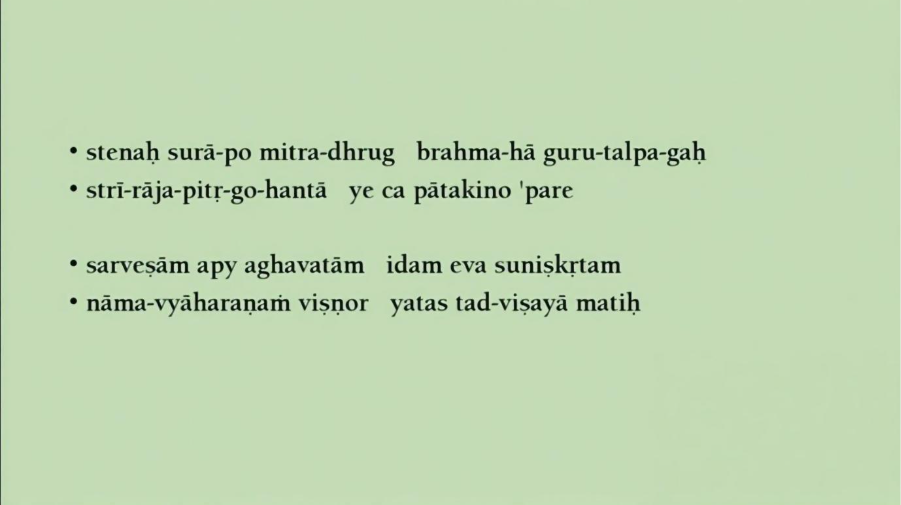
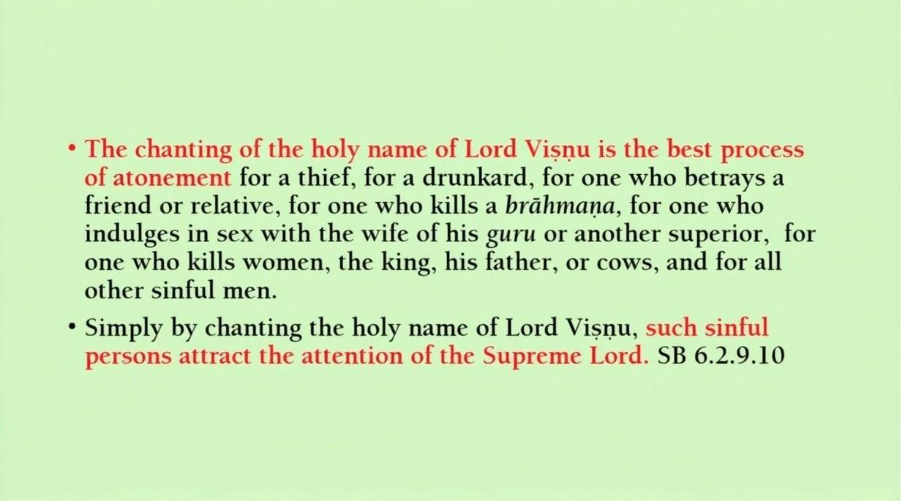
So, this story begins in the sixth canto and Vishwanath Chakravarti gives one very elaborate commentary on the name. These are the actual verses that he writes commentary on. Of course, he has commentary on the other verses as well, but this is the very elaborate commentary. So, in the first two lines, we have all sorts of sinful people [Laughs]. ‘Stena’ means thief [Laughs]. ‘Surapa’ means drinking liquor [Laughs]. ‘Mitradrug’ means one who is violent with a friend [Laughs]. ‘Bramaha’ means killer of a Brahmin [Laughs]. ‘Guru Tapa-gah’ means a person who steals the wife of his guru [Laughs]. So, in this way, we get a whole list of sinful people. So, for the thief, for the drunkard, for one who betrays a friend or relative, for one who kills a Brahmana, for one who indulges in sex with the wife of his guru, or the superior, for one who kills women, king, father, or cows, and for all other sinful men, chanting of the holy name of Vishnu is the best process of atonement. So, in the third line here, we have Aga. Agavatam, Aga means sins. ‘Agavatam’ means those who are sinful. So, for all of those who are sinful, this chanting is ‘su-diskritam’. This is the best atonement. And what is that atonement? ‘Nama Vyavaharanam’ of Vishnu, chanting the name of Vishnu. So, why is it the best atonement? That is ‘yathas-tad-vishayamati’. This chanting the name attracts the Supreme Lord [Laughs]. So, of course, any type of bhakti attracts the Lord. But here it says this chanting of the name is the most attractive to the Supreme Lord.
So, we can ask the following question. The name of the Lord may destroy sins, but how can nama-abhas, that is accidental chanting, not devotional, be the atonement for thousands of grave sins which cannot be destroyed by thousands of twelve year vows, etc. So, if you kill a brahmana, you have to do vows for twelve years, etc. So, how can inattentive chanting of the holy name be atonement when you have to do so many other atonements for the one sin? So, serious sins require serious atonements [Laughs]. And the serious sin requires great effort to get rid of the sin.
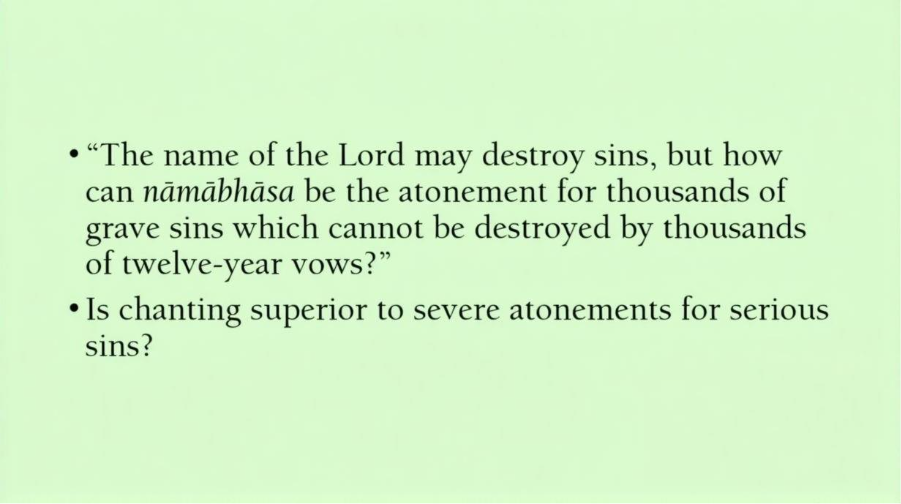
So, chanting the holy name without attention means no effort and suddenly all the sins are gone. How is it possible? So, the concern is that if we do sinful activities, we have to suffer. And the more sinful they act, the more suffering we have to get. And nobody likes suffering. So, though we commit a sinful act, we don’t want to get the bad results. So, what to do [Laughs]? So, scriptures give a solution. You do these prayaschittas or atonements to cancel out the suffering. So, we cannot really remove the sin, we can remove the resulting bad karma [Laughs]. And if people have faith in scriptures that say if you commit sinful activity, you get bad results, therefore you do this, then they will practice these atonements if they’ve done a sinful activity. So, this is the system within Karma Yoga or Varnashram, that you do sinful activity, you have to counter that with a very serious atonement.
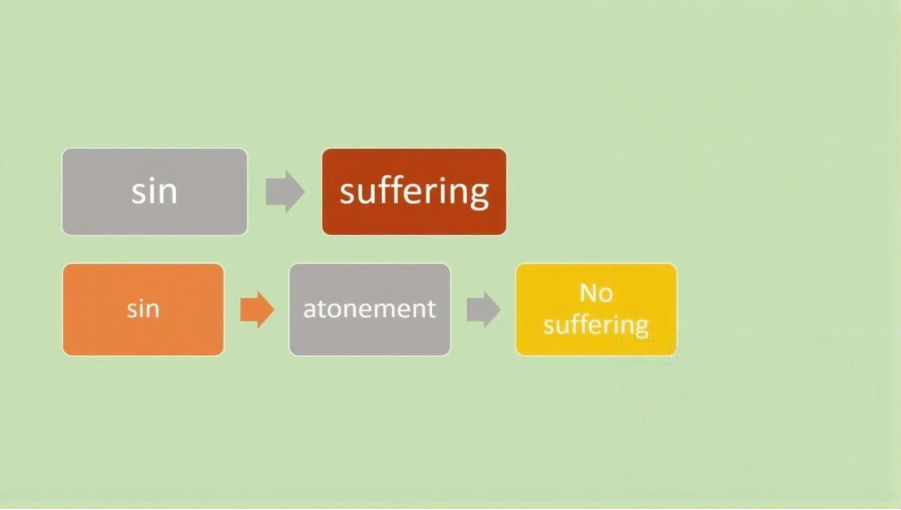
So, in the Smritis and in the Puranas and even in the Vedas, we’ll see all sorts of lists of sinful activities. Then they’ll give a list of all the bad punishments you have to get. And even in Bhagavatam, there’s a whole list of all the different hellish punishments you get for certain sinful activities. So, of course, this all requires some faith. Certain sin gets a certain bad result. How do we know? We have to accept scripture. So, those people who accept scripture, then they will also read how to avoid the suffering. So, they will practice atonements.
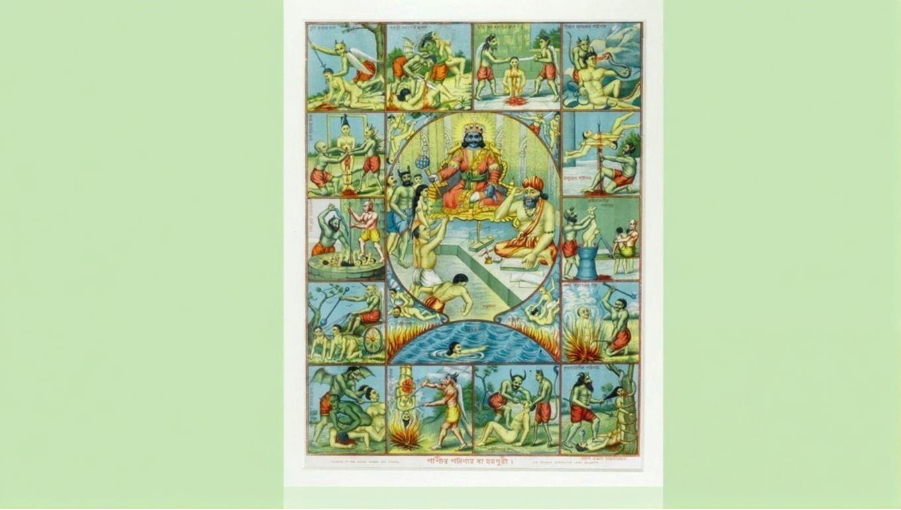
So, the scriptures give us many types of atonements. And, of course, in some Puranas like Garuda Purana, you’ll get all sorts of atonements mentioned. So, these are voluntary acts or ceremonies or practices to destroy the result of your sin, that is your bad karma. The act may be intentional or unintentional, still you’ll get some bad result. So, ultimately, we cannot avoid violence in this world. Thus, we cannot avoid sin. Thus, we cannot avoid suffering [Laughs]. So, in order to live, in order to walk, in order to eat, in order to breathe, you’re always afflicting other living entities. It all creates bad karma and, consequently, suffering. So, the scriptures also have remedies for all of these accidental things. But, more serious are the intentional sinful acts. And, consequently, the prayaschitta is much more serious. So, it involves these various remedies for the sin, the prayaschittas. It could be various. It may be fasting, it may be renouncing, it may be doing sacrifices and worship and so many different things.
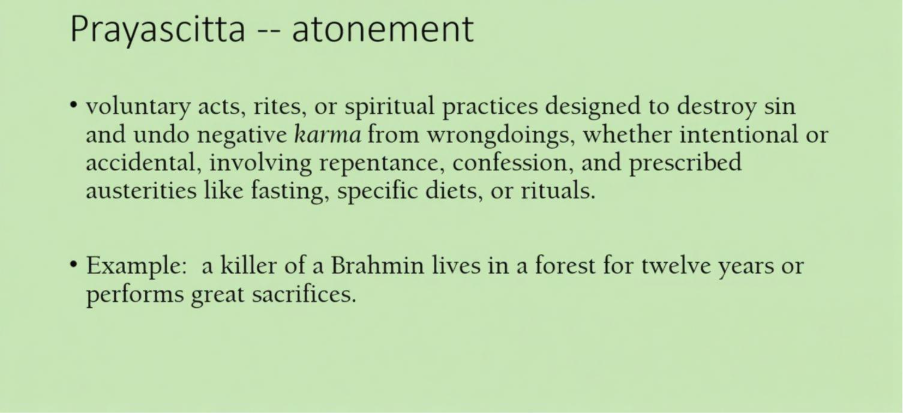
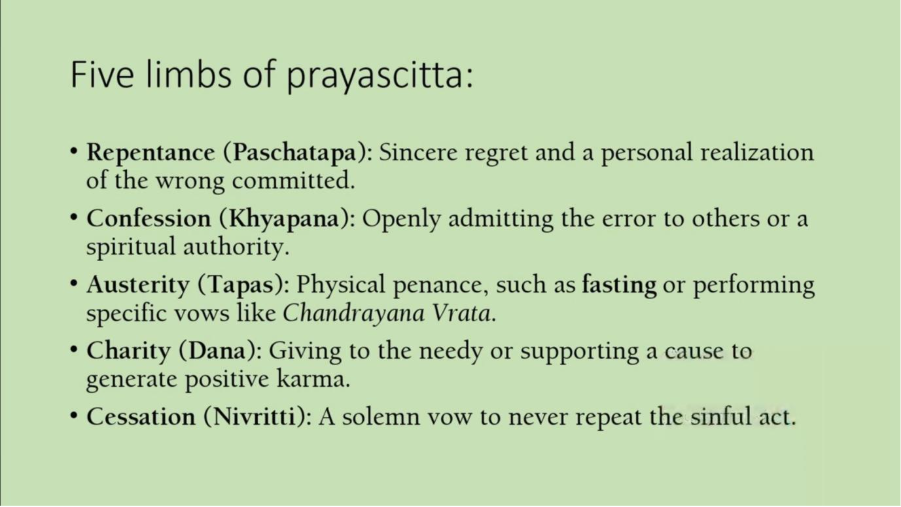
So, they have some effect because, one, you have to regret your act. One should admit the sinful act to another person and try to get some advice. The atonement involves austerities. You have to deprive yourself of sense gratification. It often involves charity, giving things. So, if you kill a cow, then you have to give some cows [Laughs]. And, of course, you have to resolve not to commit the sinful act again.
So, in the atonement, you have to become clean. You have to purify yourself. And then you can bathe in Tirtha’s, etc. You can chant mantras, like Gayatri mantra, to purify yourself. You can go on pilgrimage to a holy place. You can circumambulate the deity, or whatever.
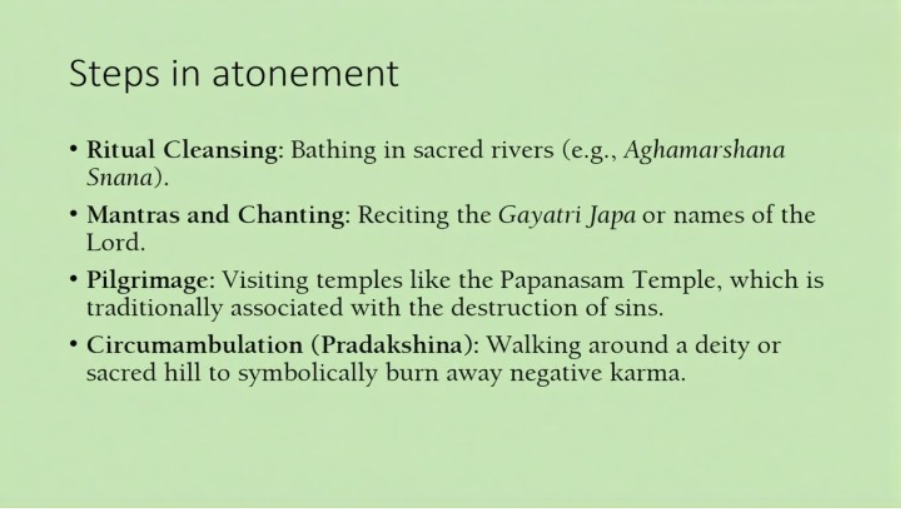
So, we’ll see that all these things are very common. We’ll see people around India are always going to these places and doing all these activities [Laughs]. And we see a big one there is what? the Kumbha Mela [Laughs]. Everybody going there to bathe and all these prayers and all this to purify themselves of sinful acts.
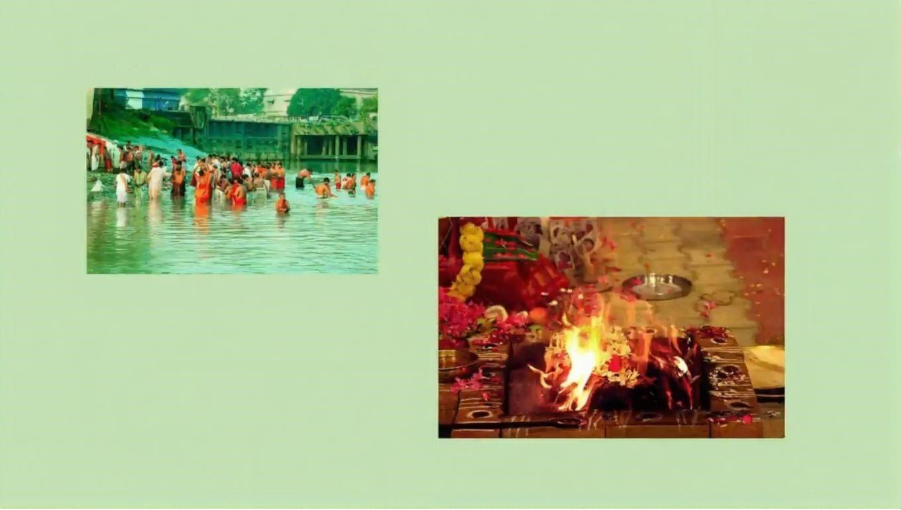
So, in one sense, it is a positive thing because people recognize they’re doing sinful acts and they should compensate for that somehow or other. It creates a sense of responsibility. All of my acts have results. And I’m responsible for the results. So, if I commit a sinful act out of sense gratification, yes, I get some immediate pleasure, but I cause suffering to another living entity. So, this atonement process helps a person become a little more responsible in his life. But these verses here are saying that for all of the sinful activities, chanting the holy name is the best atonement. And why? The answer is, it gets rid of the root of sin. If you do 12-year atonement or other type of prayaschitta, it does not get rid of the root. It only gets rid of the effect, that is the suffering. So, suffering is the final result of a long series of causes.
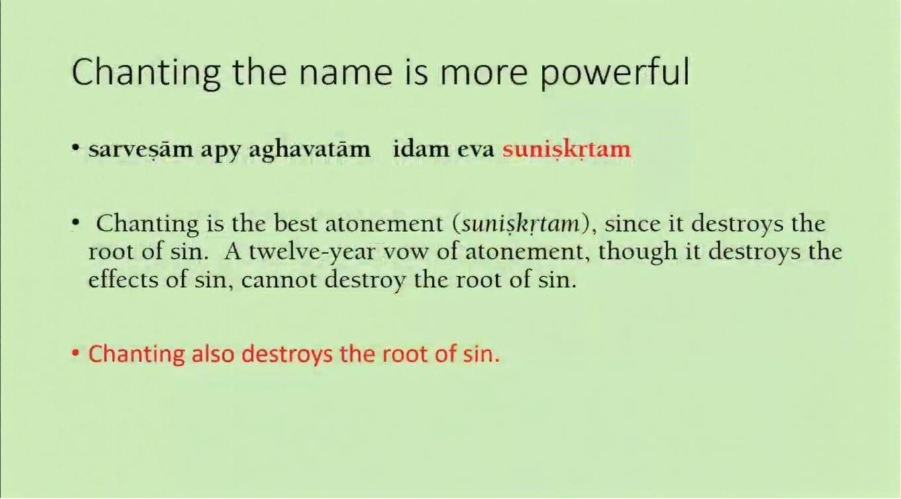
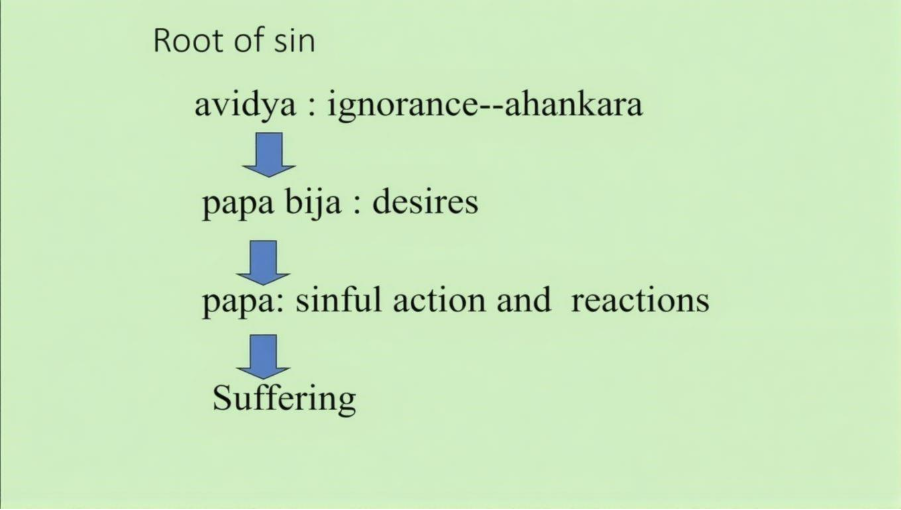
So, suffering is caused by sinful act. So, we could remove the suffering by atonement. But the sinful act has a cause. And if we don’t affect the cause, again the cause will cause another sin and again we have to suffer. So, this is the problem with the regular atonements or prayaschittas. They will remove the effect, but again you can have the cause and that will cause another sinful act and you have to suffer again and have to do another prayaschitta. So, on our own we don’t know what is the cause of the sin. But scripture tells us, suffering is caused by sinful act. What causes the sinful act? Desires. We have a desire to enjoy. We may know scripture says, don’t do this, it is sinful. But our desire is too strong, so we do it. So, if you do the prayaschitta, you get rid of the effect, you do not get rid of the desire. But what causes the desire? As scripture tells us, it is ignorance or avidya. And of course, vidya becomes manifested as ahankara. The Jiva thinks he is a material body. And then the material body naturally thinks, I have to enjoy. So, therefore we do all these different acts which cause suffering. So, prayaschitta just gets rid of the suffering, does not get rid of the desire, but does not get rid of the avidya.
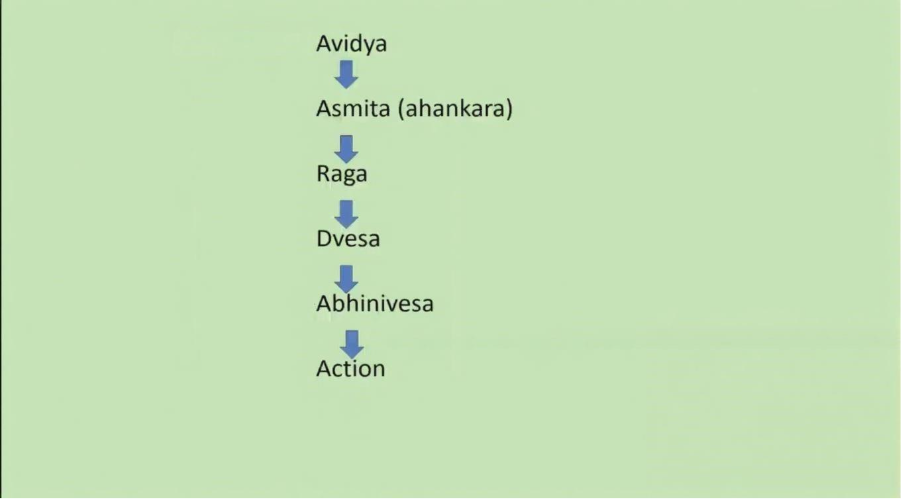
There is another analysis in yoga scriptures particularly. So, the sinful activities or the actions are caused by absorption in our material life. And these are caused by attraction and repulsion, raga and dvesha. And these are caused by asmita, identifying with our body. And this is caused by avidya, ignorance. So, of course, avidya is a very general term also. Ignorance of what? Ultimately, ignorance of Supreme Lord. So, we don’t recognize the Supreme Lord, this causes all of these things to happen.
So, the name, just chanting the name, of course any type of bhakti will destroy all these causes. But the easiest way is the name. So, the name will destroy the suffering, it will also destroy the desires and the ignorance. And all these atonements in the karma-kanda and varnashrama system do not destroy the desires or the ignorance. The scriptures will say, yes, you can get rid of your sinful reaction, but they never says, it will destroy the desires.
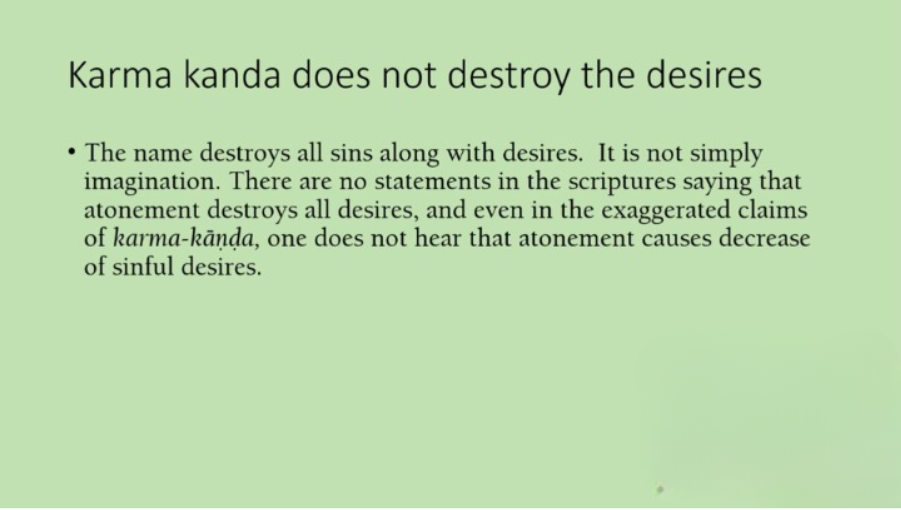
So, if you want to remove the suffering, fine, you do the atonement, but this does not guarantee that you won’t commit the sins again and cause more suffering [Laughs].
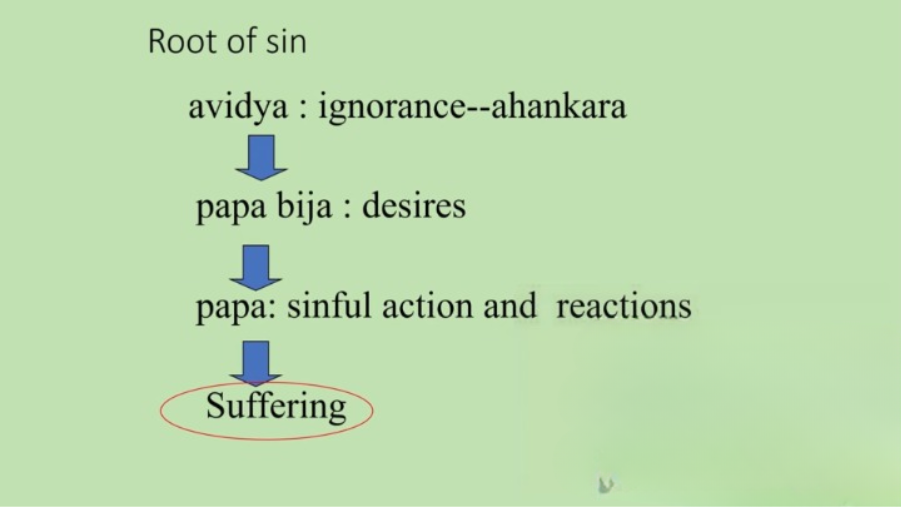
So, bhakti in general will get rid of all the causes, but the most powerful aspect of bhakti is chanting the name of the Lord. And even if it is chanted inattentively without devotion, that is namabhas. No intention of devotion, no intention even to remove sinful reactions, nothing, just [Laughs] chanting it. It is an easier way to remove not only the suffering, but all the causes.
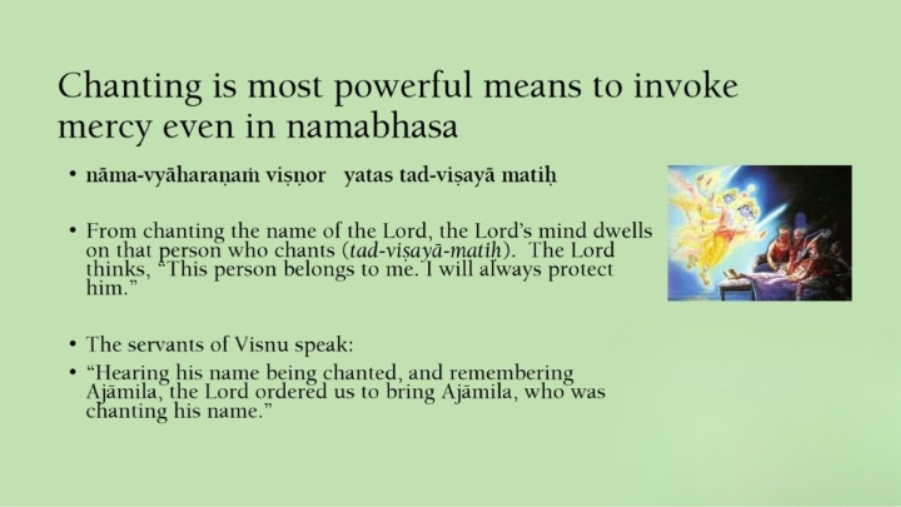
So, this verse explains the reason why the name is so powerful. And that is ‘yatas tad-viṣayā matiḥ’, the Lord’s mind becomes attracted to that person who chants. So, even if one chants accidentally, it attracts the Lord. It is very difficult to do the regular prayaschitta accidentally. There is the whole process of doing them. So, you have to intentionally do them [Laughs]. But here, unintentionally chanting the name of the Lord will have greater effect. And the reason is, it directly involves the Lord. So, the name attracts the Lord and the Lord thinks, ‘this person belongs to me, I will protect him’, even though you chant accidentally. So, in the Bhagavatam, the Vishnu dutas say, hearing his name being chanted and remembering Ajamil, the Lord ordered us to bring Ajamil, who is chanting that name.
So, this story shows the great power of the name. So, even if the person is most sinful and is chanting accidentally, it has such great power, more than any prayaschitta.
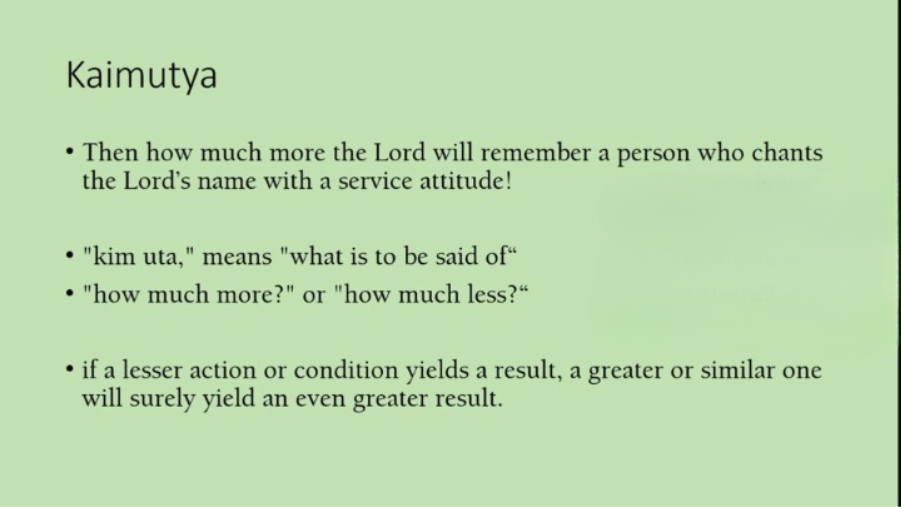
So, this is an example of Kaimutya [Laughs]. The word comes from Kimutha, which means, what is to be said about this, or how much more or how much less. So, in this case, it means, if accidentally chanting the name of the Lord is so much greater than all the prayaschittas, if you were to chant with devotion, how much more result you would get [Laughs]. So, in other words, it is a glorification of the name by giving us the minimum qualified person, a person with no qualification [Laughs]. So, indirectly, it is also glorifying the process of bhakti, how much more powerful is bhakti. So, even chanting accidentally, even once, can attract the Lord. How much more, if you chant repeatedly with devotion, how much that more is going to attract the Lord.
So, here we see that the name has this unique quality of especially attracting the Lord. All bhakti attracts the Lord, but somehow the name is very special. This also indicates that prayaschittas and all these acts in Karma Yoga do not directly attract the Lord [Laughs]. And because chanting the name does attract the Lord directly, even if chanted accidentally or whatever, the Lord is capable of not only destroying the effects, but all other causes as well.
So, the causes, that is desires and ignorance, can be destroyed, but not by Karma Yoga.
You have to do Jnana Yoga and Astanga Yoga. So, there you can destroy all the desires, all the ignorance, and you can get liberation. But, bhakti and chanting the name gives more than that [Laughs].
So, Vishwanath Chakravarti says that Ajamil chanted at death and destroyed his sins. Bhagavatam says that, servants say that. But actually, the first time he chanted, he just said, I name my son Narayana. That destroyed all the sins [Laughs]. So, because he did name his son Narayana, he repeatedly said this name of Narayana after that point until his death. So, the first chanting by naming his son destroyed all the sins. What happened after that? The chanting produced bhakti [Laughs]. We can say that this example is a little exceptional. At the same time, we should not say that, well, this is exceptional and normally the name doesn’t do this. Because then we commit the offense against the holy name, thinking the powers of the name are exaggeration [Laughs]. But, in any case, we had this remarkable example of Ajamil because he chanted accidentally once and destroyed all his sins, but the condition was he had no aparadh. I guess I should end there.
Any questions?
Q & A:
1.) Hare Krishna Maharaj. Maharaj, we see this accidental chanting. A person is not doing nama aparadha at all. He is not doing. So, there is no nama aparadha involved. But, in the case of devotees, there is a possibility of nama aparadha. Also, then we see what is the destination for them? Because they have chanted. Here, it is mentioned the Vishnudutas are sent to take him to the Lord because he has chanted Narayana. So, what is their destination when they chant accidentally?
HH Bhanu Swami Maharaj: Who?
Devotee: For the person who is chanting accidentally. Because Ajamila has chanted accidentally and the Vishnudutas came to take him to the Lord. So, what is the final destination for the person who is chanting accidentally?
HH Bhanu Swami Maharaj: Well, he chanted accidentally also. So?
Devotee: So, what is his destination? Where he goes? Does he go to Vishnu loka or he comes back to?
HH Bhanu Swami Maharaj: Well, that is described later [Laughs]. But, anyway, different people, depending on how they chant, get different destinations, whether accidental or intentionally. So, here we have the case of Ajamila. Chanted once, destroyed all of his karmas. After that he chanted, he got bhakti. But, he had no offenses also. So, if you have offenses, then all the karmas are not destroyed, all the vasanas are not destroyed. It is a gradual process. But, by continual chanting, then you can destroy the effect of the offenses and then you can get some results. So, by this accidental chanting, you can, with no offense, as in the case of this, he actually went to the spiritual world. Others who may have offense get purified, but they may also mix their devotion, if they develop devotion afterwards, and they will get different results. If it is all accidental up to the end of their life, and they still had aparadhas, then they can get purified to some degree. That’s it. But, here we see, not only he got purified immediately, because he had no aparadha, the root of sin also got destroyed. So, technically he was already liberated. And then, after that, he chanted, and that produced the bhakti. So, therefore, he was qualified to go ultimately to Vaikuntha.
2.) Hare Krishna Maharaj. So, it is many times stated, chanting destroys all sins. Is it also pious karma it will destroy? Pious, pious karma. Punya, punya. Chanting also can destroy punya as well?
So, of course, in varnashram and karma yoga, punya is the opposite of the papa. So, it is a good thing. So, by punyas, not only you destroy your bad karmas, you also get good karmas, and you can go to svarga loka [Laughs]. But, punyas, like sins, are a cause of bondage [Laughs]. And bhakti, in particular, name, will destroy all karmas, all bondage. So, whatever good results we see from bhakti are not a result of punya, it is a result of bhakti [Laughs].
3.) Maharaj, one more question. If sinful vasanas, whatever pious vasanas or sinful vasanas are still not getting vanished, if we see in ourselves the vasanas are not still getting vanished, can we infer that we are doing aparadhas or we have committed aparadhas previously?
Well, if we still have the vasanas present when we are doing bhakti, then it could be problem from offenses in this life or previous lives. Offenses with the name are difficult to remove. So, they can last for many lifetimes.
4.) Hare Krishna Maharaj. Maharaj my question is very similar to what all has been asked, just for a greater clarity of understanding. When Ajamila chanted the first time Narayana, his sins were destroyed. But we understand that it also destroys the root. So, that destruction of the root, does it also happen at the first time or is it a gradual process? Because Ajamila did not seem to have removed his avidya because of his external activities. He did after meeting the yamadutas and Vishnudutas. But before that, it didn’t appear that his avidya had been vanquished. So, is it a gradual process or avidya is destroyed also along with the sin?
So, of course, here it’s explained that even the root is destroyed, but then the question comes, well, Ajamila looked like he was still sinful afterwards, so it looks like the vasanas were not destroyed [Laughs]. So, actually this is explained later on in the commentary of Vishwanath Chakravarti. But even in I think, Shankaracharya, a person who is Jivan mukta, has all of his karmas and vasanas destroyed, but he still has a body which has karma. How is it possible [Laughs]? So, therefore, he gives an explanation that there is like a remnant there that sits there, even though it is not real karma and vasanas, etc. And then Vishwanath Chakravarti also gives another explanation, which I will explain tomorrow.
5.) Maharaj, in context of, is it that most people, including devotees, they would have accidentally chanted in the beginning, whenever they started. I mean, they may be unintentional. See, now the devotees are aware of what the offenses are and they must avoid and it may just still be committed. But what I am saying is at the beginning, for most devotees, it would be an accidental chanting when they started their devotional life or even before that. So, which means already their sins are destroyed, their vasanas are destroyed, their root cause is destroyed, but later they happen to commit some offenses. The point was that because of offenses, the vasanas and the sins and other things, avidya takes time for it to go away. What I am saying is that, there would be devotees who would have chanted accidentally, which means all of this is destroyed, but later they tend to commit offenses. So, the point was that the vasanas and all take time to go away for offensive people or devotees who are committing offenses, for them, the vasanas and all take time for purifying or for going away.
So, we don’t know if a person accidentally chanted the name or not before he became a devotee, may be he did, may be he didn’t. We don’t know. So, if he did fine and it was accidental and there was no aparadha, then he could destroy his karmas, his sins or his results and his root as well. After he becomes a devotee, then he knows about the aparadhas and he consciously avoids them. But we may see that he still has the vasanas. So, why is that [Laughs]? But it is something like the case of Ajamila. Though the vasanas may be removed if he had no aparadhas at all, there is like a shadow that continues. And it acts in such a way that, even Ajamila was not aware that all of his karmas and vasanas are disappeared and then even the yamadutas didn’t know [Laughs]. But then the Vishnudutas say, all false, everything is gone [Laughs]. And this was shocking to the yamadutas also [Laughs].The yamadutas say, we saw him commit sinful activities, even though if he chanted the holy name. How is it possible he is pure [Laughs]? So, it is all up to Supreme Lord to arrange what he wants to make for the devotees and what he appears and what he doesn’t appear like. We don’t know [Laughs].
6.) Hare Krishna Maharaj. From the story of Ajamila it looks like the effect of namabhas is very quick. Because we can see in one lifetime itself, we could see Ajamila can go to the spiritual world. But a struggling sadhaka like us in kali yuga, to do pure bhakti is really difficult and we don’t know how many life times it is going to take. So, from the incident, it looks like namabhas effect is more quick.
HH Bhanu Swami Maharaj: [Laughs] Namabhasa is easier [Laughs]. Let’s all do namabhas [Laughs].
Devotee: Looks like that for a struggling sadhaka. So, how do we really understand this perspective, Maharaj? Because looks like, especially in kali yuga, we want quick results.
HH Bhanu Swami Maharaj: So, we see that the effects of namabhas in this case were very great. And one condition, of course, is no offenses. So, if there are offenses, then we get a gradual effect. And then, the namabhas, if it is unintentional, may not be continuous, it may be three times you chant in your life. Who knows [Laughs]? And because he had associated with the Vishnudutas, his bhakti developed. So, therefore, he could do regular, you know, sadhana.
7.) Hare Krishna Maharaj. So, it is said that 10th offense is to maintain material attachments, even after understanding so many instructions on this matter of bhakti. So, do we understand that Ajamila had no spiritual knowledge, but he was a brahmana right before falling down. So, do we understand that, he did not have any material attachments after calling his son as Narayana?
So, we don’t have too many details of what he was doing, but he was a brahmana, raised by his father. So, we are assuming that, and he was also not a devotee, obviously. So, he was doing regular karmas, karma yoga. So, in karma yoga, they may worship Vishnu, but it may not be pure bhakti in that matter of worship. So, therefore, he became very sinful because he was not really protected by the Lord, because he wasn’t doing pure bhakti. But fortunately, though he was doing, let’s say, karma kanda or karma yoga, he didn’t commit any offense. And usually, it’s the opposite, because they are doing these, these karmas, they may think, okay Vishnu is just another devata [Laughs], so therefore they commit offense. But Vishwanath at the end of this commentary, actually mentions, well, why did he name his son Narayana? He said, ultimately, the cause is that, it’s, you know, previously ajnata sukriti [Laughs]. Somehow, unknowingly, he got the mercy of some devotee [Laughs].
8.) Hare Krishna Maharaj. So, like, just now as you were telling. Ajamila was chanting the first name, like when he was naming his son Narayana and he was chanting without any offenses. Like ideally we see that, because of Jiva having ignorance of Bhagavan, it is very natural that he has many wrong conceptions. So, only in devotee association, when he meets, he will, like, when he gets the knowledge, then only, after getting the knowledge only, he will be able to chant without any offenses. But in Ajamaila’s case, like, it is getting difficult to know, how it happened, without any prior devotee association, without any having prior knowledge.
Well, yes obviously, he didn’t have any knowledge [Laughs]. And thus, his naming his son Narayana was there, but he wasn’t expressing devotion by that also. So, it was not that he had any devotion [Laughs].
Devotees: HH Bhanu Swami Maharaj ki jai!!! Srila Prabhupada ki jai!!! Nitai Gaura premanande Hari Haribol!!!