Seminar on Insights of holy name – Session 4 | HH Bhanu Swami Maharaj |ISKCON Chennai | Acharya Vani Mahotsava | 26 Jan 2026
Devotee : Let us all welcome His Holiness by chanting 3 times big Haribhol !!!
Devotees : Haribhol! Haribhol! Haribhol!
nama oṁ viṣṇu-pādāya kṛṣṇa-preṣṭhāya bhū-tale
śrīmate bhaktivedānta-svāmin iti nāmine
namas te sārasvate deve gaura-vāṇī-pracāriṇe
nirviśeṣa-śūnyavādi-pāścātya-deśa-tāriṇe
jaya śrī-kṛṣṇa-caitanya prabhu-nityānanda
śrī-advaita gadādhara śrīvāsādi-gaura-bhakta-vṛnda
Hare Kṛṣṇa Hare Kṛṣṇa Kṛṣṇa Kṛṣṇa Hare Hare
Hare Rāma Hare Rāma Rāma Rāma Hare Hare
HH Bhanu Swami Maharaj :
So, we’ve been discussing Vishwanath Chakravarti’s commentary on two verses from the sixth canto. And in his commentary, he explains that chanting the holy name in any case gives great results. And if chanted accidentally, as in the case of Ajamil, it gives very great results. And if chanted with some aparadhs, it gives some results. And Of course, if we have the aparadhs along with our chanting, then we get some suffering. So, then we can ask another question. So, Vaishnavas are those who worship Vishnu. This is of course the definition given by Panini. But when devotees talk about Vaishnava, usually mean he gets initiation. So, both should get wonderful results. So, that would imply that why do we need Guru at all? If without Guru, we get similar results. So, in reply to that, Vishwanath Chakravarti says, No, Guru is necessary !
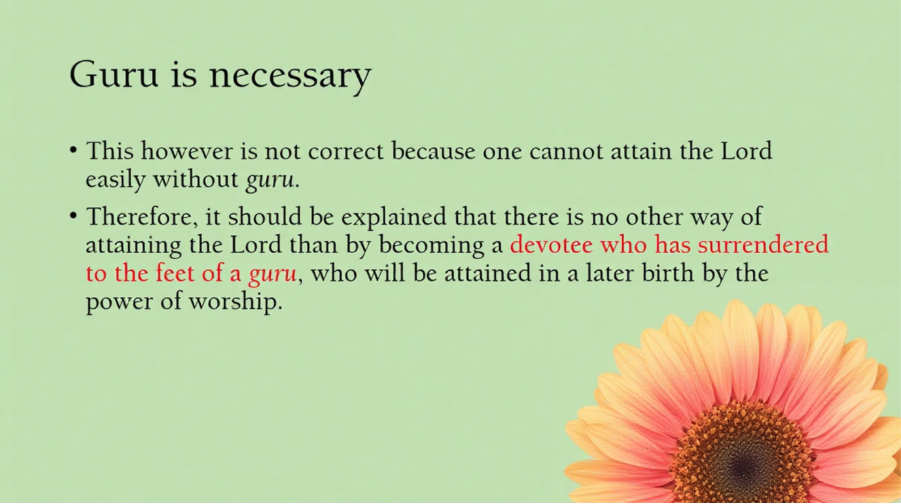
This of course means no accidental chanting anymore. You know, you are actually intentionally chanting. So, you need some Guru. So, the original question was actually about Diksha Gurus. But here, he didn’t actually mention Diksha Guru. He says, a Guru is necessary. So, even though you chant the holy name, you also should surrender to a Guru. Of course, in the beginning you are chanting accidentally, then you may chant with intention. Eventually, in some birth, then you get a Guru. So, of course, the reason for Guru is that, if you get a proper Guru, then you can very quickly get to pure chanting and pure bhakti. And thus, there is always an emphasis in the scripture on taking a Guru. And we’ll have many, many verses in Bhagavatam and even in the Upanishads talking about necessity of Guru.
So, Vishwanath Chakravarthi quotes this particular verse from the 11th Canto. So, the human body is rarely attained, but you may get it by some good fortune. So, the human body is like a boat. And the boat is in the ocean of samsara. And Guru is like the captain of the boat which is in the ocean of samsara [Laughs]. And Guru is like the captain of the boat. And the favorable wind is service to the Lord.
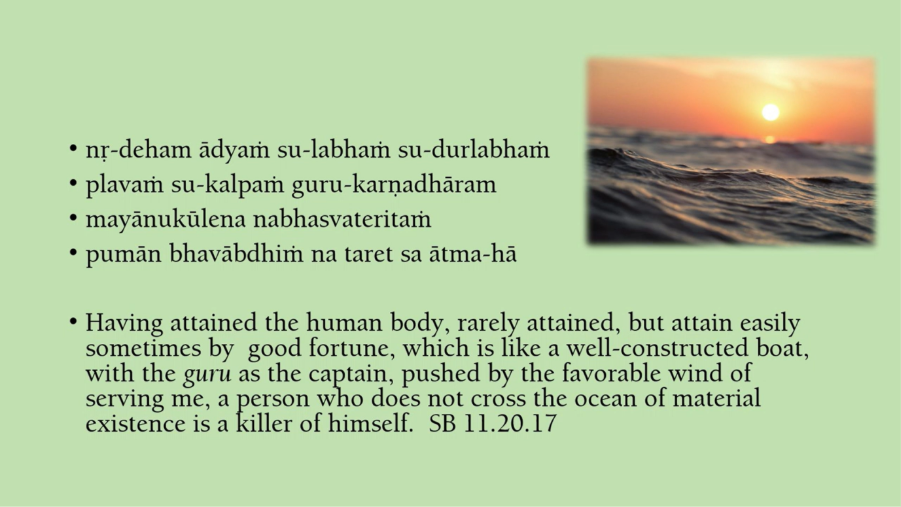
So, generally, if you are in a boat, you need someone who knows where you are going [Laughs], the captain [Laughs], to take you somewhere [Laughs]. So, therefore, generally, we say, yes, you need Guru. It doesn’t say in particularly Diksha Guru. Someone who can guide you. Of course, usually, devotees in ISKCON and maybe in general, like Gaudiya’s when they read verses, then they’ll assume this means a Diksha Guru. And when Srila Prabhupad was present, Prabhupad was the only Guru [Laughs]. But then, I think in 1974, Caitanya Caritamrita came out. And in the first Adi Lila, then there’s a description of Diksha Guru and Siksha Guru, which nobody had heard of before [Laughs]. And there the emphasis is, they are two different persons, but they are the same. They are one. They have the same goal. They have the same power. They have the same respect. Of course, when Srila Prabhupad was present, he served both these functions. But we see, historically speaking, in the Gaudiya Sampradaya, often they were different persons. So, generally, all of the devotees took Diksha. They had a Diksha Guru. But Bhaktisiddhanta Sarasvati Thakur traces a Siksha line instead. So, in this way, Bhaktisiddhanta Sarasvati Thakur was emphasizing the importance of the Siksha. So, in any case, whether it is the Diksha Guru or the Siksha Guru, you do need some guidance in serious practice in spiritual life in order to practice pure bhakti.
So, of course, in ISKCON, there is a little bit of confusion about what is the difference. And generally, we don’t really make any differentiation and nobody really explains it. And even the Diksha Gurus who do initiation don’t understand the difference. So, of course, maybe the only difference is there is a ceremony for Diksha and you get a name. And if you are a Siksha Guru, there is no ceremony, you don’t get a name. That’s the difference [Laughs]. But if the Diksha Guru gives you, you have a ceremony and gives you the name, but he doesn’t give you any teachings, and a Siksha Guru gives you the teachings, who is superior? So, therefore, it’s obvious that the one who gives the more teaching would be the more prominent Guru. And that’s why Bhakti Siddhanta Sarasvati traced a Siksha line. If we look in the Gaudiya Sampradaya, actually, the Diksha was quite simple. And by that Diksha ceremony, we understand the difference between Diksha and Siksha. Whoever gives you the Krishna Mantra, which we get at second initiation, he is the Diksha Guru. He may or may not give any teachings, but he is the Diksha Guru. And a person who doesn’t give you that mantra, but who gives you teachings, he is the Siksha Guru. That’s the difference.
So, therefore, when we talk about Guru, it could be either or both [Laughs]. But, then we can ask the question, well, if the Diksha Guru only gives you the Diksha Mantra and the Siksha Guru gives me all the wonderful teachings and explains Prabhupad’s books and everything, well, what’s the use of the Diksha Guru at all [Laughs]? And we see that when Caitanya took Diksha and Nithyananda took Diksha, all the people took Diksha, but at the same time, it doesn’t seem to be that important [Laughs]. So, of course, one answer could be given, they only continue a tradition that is there, Pancharatric tradition. So, we don’t want to break the rules. So therefore, we do that. The other reason is, of course, that that mantra, apart from using it for meditation, which we don’t do, is for deity worship, which we do. And this is the main function described by Jiva Goswami in Bhakti Sandarbha. You get the Diksha Mantra so you can worship the deity. Of course, you say, why do I worship the deity? I’m chanting Hare Krishna. So, that is true. And therefore, emphasis is upon chanting Hare Krishna and getting Siksha, rather than getting a Diksha Mantra and worshipping the deity.
So, to kind of emphasize the position of Diksha, Jiva Goswami says, Diksha is for rich householders, Grahasthas. So, why only the householders? Why not Brahmacharis, Sannyasis or poor Grahasthas? Why not [Laughs]? So, the Grahastha is a Vaishnava and he has money, hopefully. He is rich, so he has money [Laughs]. So, he uses his money for Krishna. So, a very convenient way of using money for Krishna, is to get some deities, make a temple, buy some gold ornaments [Laughs] and do puja [Laughs]. So, in other words, deity worship is a good way in which a rich Grahastha can spend up his money for Krishna. So, that’s why he says that Diksha is for rich householders [Laughs]. And thus, if you’re a Babaji with no money, then you wouldn’t have to worship the deity and then the Diksha would not be so important.
The reason for putting this Diksha in a little bit of a lesser importance is, because in Lord Caitanya’s movement, Nama Sankirtana becomes very prominent. Now, of course, in a Gaudiya Sampradaya, we don’t reject the Diksha because it’s traditional to do that. That’s one reason. And you can trace your Parampara that way quite easily. If you have a Siksha Guru, then people can ask, well, how can you prove he’s your Siksha Guru [Laughs]? How do we prove that Gaurakishore Das Babaji was the actual Siksha Guru of Bhaktisiddhanta Saraswati? We don’t have any historical records or Gaurakishore didn’t make any statements. So, in one sense, it’s difficult to prove that line. Another reason for the Diksha is that though Harinama Sankirtana is the most important element, we never reject Archana or deity worship as one of the prominent elements. And we see the Goswamis had deities and Vishwanath Chakravarti had deities [Laughs]. They all had deities [Laughs]. And it does provide a great opportunity for people to engage all of their senses. And that is one of the reasons why Srila Prabhupad established temples and established deity worship so that people could engage themselves, because they can’t chant Hare Krishna all day long [Laughs].
But, of course, that doesn’t mean that, we should emphasize the Diksha Guru because of that. And thus, in the Caitanya Caritamrta, they are considered equal and in practical terms with Bhaktisiddhanta Saraswati Thakur, then the Siksha Guru becomes more prominent [Laughs]. So, an element of the Guru, whether it’s a Siksha Guru or Diksha Guru, should be his teachings. And why we need the teachings is, because if we don’t have the teachings, we are bound to have impure Bhakti or Namabasa. If we don’t know Krishna is Supreme and He is Sarvakarana Karanam, He is Swayam Bhagavan, we think, okay, He is a Devata or even if we think He is just like Narayana and we can worship anybody, then we don’t get the same results. So, we need knowledge of Tattva or say philosophical knowledge in order to perform pure Bhakti.
Why we have to perform pure Bhakti? Why can’t we just do Namabhas? Namabhas gives results. Ajamil quickly went to Vaikuntha [Laughs]. No knowledge [Laughs]. No Guru [Laughs]. The answer is that, generally we do need knowledge to get to the stage of pure Bhakti and only with pure Bhakti we get full development of Rasa. So, though Vishwanath Chakravarthi said, okay, at least we need Guru, if not a Diksha Guru, at least we need Guru.
But then Ajamil didn’t have any Guru. He went to Vaikuntha [Laughs]. So, if one chants Namabhas without offense, then that is possible as in the case of Ajamil. So, that is the power of the name. If there is no offense and you chant Namabhas, you can actually get to Vaikuntha [Laughs].
So, this may also seem a little bit revolutionary or what for people [Laughs]. We are always saying you have to accept Guru, you have to accept Guru, but here Vishwanath Chakravarthi said, you don’t need Guru [Laughs]. And he is giving the case of Ajamil who didn’t have Guru and he wasn’t even chanting with devotion [Laughs].
So, though it has been definitely ascertained that the Lord should be worshipped. In other words, we don’t want to offend the Lord by thinking he is a Devata. That worship is the means of attaining him and the Guru is the person who teaches about worship and that those who are devotees attain the Lord.
It is also said chanting the holy name does not depend on initiation [Laughs]. So, this is a statement by Rupa Goswami in Padyavali. The name does not depend on initiation, pious activities or purushcharya. The holy name does not wait for any of these activities. Even if you don’t do them, you can start chanting and get perfection.
This also is very close to a statement in Caitanya Caritamrita, Madhya Lila. For that statement of Caitanya Mahaprabhu, then Prabhupad writes a long report. And in that purport, then he explains about Diksha and Harinam. But it is very strange in one sense and most devotees mistake the meaning. So, Srila Prabhupad begins by stating exactly what the verse says, that is Harinam – name does not depend on Diksha. He also ends the purport with the same statements. But then in the middle, he defines Diksha as ‘divyaṁ jñānaṁ yato dadyāt’. That famous verse that ‘divyaṁ jñānaṁ’ is attained through Diksha and destruction of your sinful reactions etc. And then he says Diksha is necessary. And then he also says that Purushcharya is necessary.
So, technically, of course Purushcharya literally means prior activities, activities you do before something. So, in the Haribhakti Vilas, there is a whole chapter on Purushcharya Vidhi. It is actually a very complex vrata or ceremony that you perform after you get your mantra, in order that you can chant, so you can get the perfection of that mantra. So, then the scripture says, you fast like this, you chant you know 20,000 mantras, you do some certain rituals for 5 months or 1 year, then you get your Siddhi of the mantra. So, both these statements are made in the middle of the purport that yes, you need initiation, if you don’t get initiation, your life is wasted and you have to do Purushcharya. And that’s the only way you get results from the mantra.
But then this completely contradicts the statement of Caitanya Caritamrita and what Prabhupad states at the beginning of the purport and the end of the purport. So, what does all this mean [Laughs]? So, most devotees when they read this, then they will read the middle part and they say, yes, initiation is necessary. Why are you saying we shouldn’t get initiation? Look here, it says in Caitanya Caritamrita, if you don’t get initiation, your life is wasted. But if you look closely at that middle section, actually Prabhupad is quoting from scriptures. So, because the word is mentioned Diksha in this verse and also in the Caitanya Caritamrita , then Prabhupad defines Diksha according to Jiva Goswami. And then he quotes some Pancharatra or some Purana to show that generally people have to take Diksha to become Vaishnavas. And then he quotes some other verses to show that Purushcharya is necessary to get your perfection of the mantra. So, in other words, he is simply stating in the middle section what scripture is saying to glorify Diksha and Purushcharya, that’s all. But the conclusion is that, chanting the holy name supersedes all of that. And in practical life, that’s what we do. We don’t get initiation to chant Hare Krishna. In order to get initiation, we are chanting Hare Krishna. And what is the goal of chanting Hare Krishna? Prema. So, how do we get that goal? Do we do Purushcharya ? do all sorts of vratas and ceremonies? No, just chant Hare Krishna !
So, in that way, this verse and the verse in Caitanya Caritamrita is showing that the name is the most powerful means to get us to Krishna. It’s not saying you don’t need Guru, but you may not need the Diksha Guru to do that. Nor is it denying that you should take Diksha. It’s not saying you don’t take Diksha, but that has a specific purpose also and not necessarily Prema [Laughs]. So, just as Vishwanath Chakravarti then, he’s saying, okay, yes, you need Guru, but then later on he says, no, you don’t need Guru [Laughs].
So, generally, yes, in Bhakti also you need Guru. But in chanting the holy name, then we have exceptions because we have people like Ajamil, didn’t have any Guru at all and they went to spiritual world. So, then he also makes the point of a person who will think, well, what is the benefit of taking a Guru then? Because, you know, you’re saying we don’t need Guru like Ajamil, so we don’t need Gurus. So, to have that type of reasoning also becomes offensive, because then we have offense to devotees, offense to Guru [Laughs]. So, therefore, these statements are not saying to avoid Guru, but just that the emphasis on Guru has to be put in the proper place, that’s all. And, of course, this statement does not say you don’t need Siksha Guru, it’s just talking about Diksha Guru.
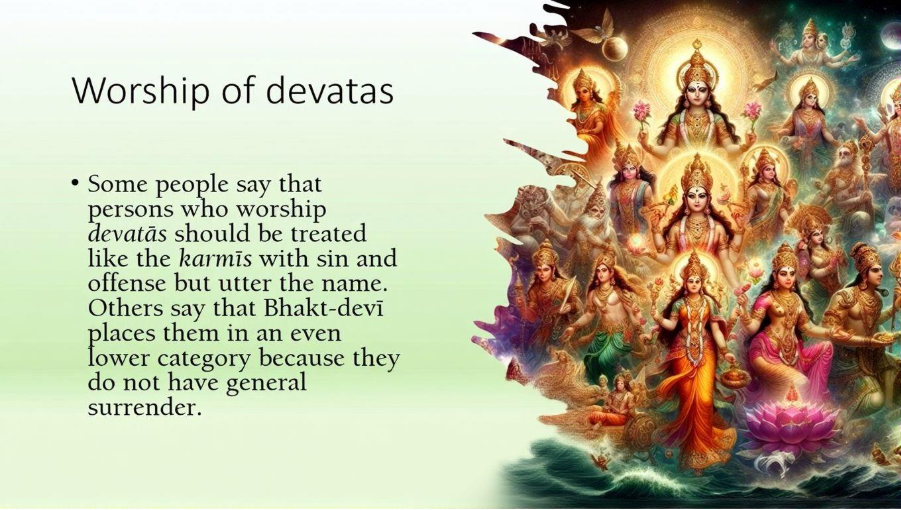
So, at the end of this commentary, then he just gives a few other things. Some people say this, some people say that [Laughs]. So, what about worshippers of Devatas? What’s their position? So, they’re worshipping Devatas and then they may chant the holy name. So, yeah, in one sense, chanting the holy name is okay, you can say. So, we have these people doing Karma Yoga and they have a little bit of Aparadha or something, but they’re worshipping the Lord. So, some people say, okay, it’s about the same thing, worship Devatas and chant the holy name. But others say that by all worshipping all these Devatas, they’re actually in a lower category, because it’s more offensive to Krishna [Laughs].
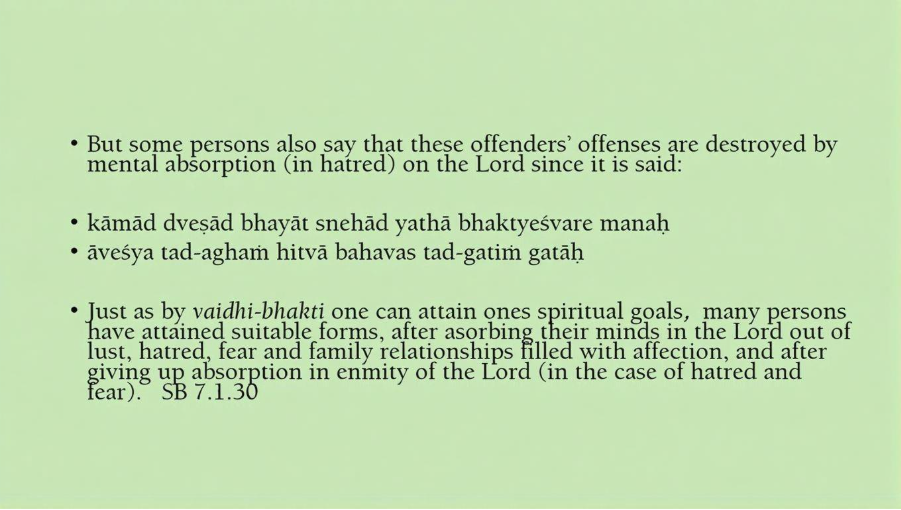
And then there are people that say, with good reasoning, that even if people are offenders, they’re very bad offenders, even they hate the Lord, they can get purified. And so, we have statements in Bhagavatam like this – “Just as by Vaidhi Bhakti one can attain one’s spiritual goals, many persons have attained suitable forms after absorbing their minds in the Lord out of lust, hatred, fear and family relationships filled with affection and after giving up absorption and enmity of the Lord.” (SB 7.1.30)
So, even if you have hatred of the Lord, which would be a very bad offense [Laughs], still you get purified [Laughs].
But then the answer, of course, is absorption means, of course, very intense meditation to be effective. Others say also that this only applies to Krishna [Laughs]. So, if you hate Krishna in this way, then you get this result. Of course, there’s another explanation. And that is given in the example of Hiranyakasipu and Ravana. There was same Jiva, three births. So, as Hiranyakasipu, he got the opportunity to see the Lord and all of his life, he was hating Vishnu [Laughs]. And he got killed by the Lord. He didn’t get liberated, didn’t go to spiritual world. Why? Answer is that he was not completely absorbed in Narasimhadev. And then, instead of getting hellish punishment, instead of going to Vaikuntha or getting liberation, he became Ravana. So, there again, he hated Vishnu and he saw Ramachandra. He got killed by Ramachandra. He didn’t get liberation, didn’t go to Vaikuntha, didn’t go to hell. He became Sishupala. Then, as Sishupala, same Jiva, he saw Krishna and he uttered Krishna’s name. But it was different. He became completely absorbed in Krishna. It was the same hatred. But why was he absorbed? And that’s because, Krishna is most attractive [Laughs]. So, in spite of hating Krishna, he could not forget the form, he could not stop chanting the name [Laughs]. And because of that intense meditation, he was able to burn up all of his offence. So, that example is given to show the superiority of Krishna over Rama and Narasimhadev. He is more attractive than even them.
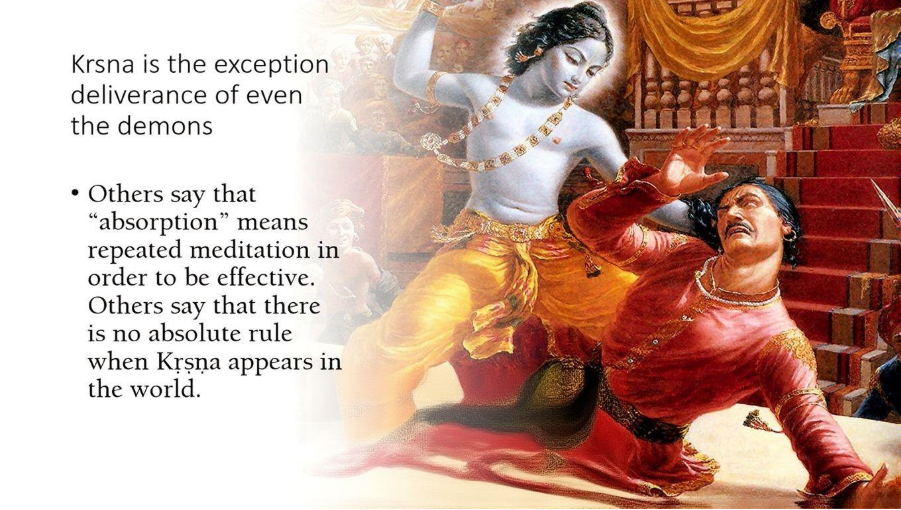
And thus, we find in Bhagavatam, it is said, “Some persons without being absorbed in the Lord, but simply by being killed by the Lord, Narakasura, Banasura and the troops of Kauravas and others, they attain the Lord.” Of course, they weren’t completely absorbed in the Lord, they at least saw the Lord [Laughs]. So, they attain the Lord, but usually what they get is liberation only. But we see Sishupala became the [Laughs] door keeper in the spiritual world [Laughs].
So, there has been talk of the name, glorification of the name. And the name of Narayana, most powerful, especially if there is no offence. And if you develop pure devotion by accepting some Siksha Guru, at least or maybe Diksha Guru, then you can actually get highest goal, Prema. But if you chant Krishna’s name, you get something even higher [Laughs]. So, it is said, of course, in the scripture, Brahma Vaivarta Purana, I think that Krishna’s name is three times, three Rama’s names. Rama’s name is one thousand Vishnu names [Laughs], so then Krishna’s name is more powerful than the other names. So, whatever power we see in chanting Narayana’s name, even Namabhas with Ajamil, you get three thousand times the result [Laughs] with Krishna’s name [Laughs].
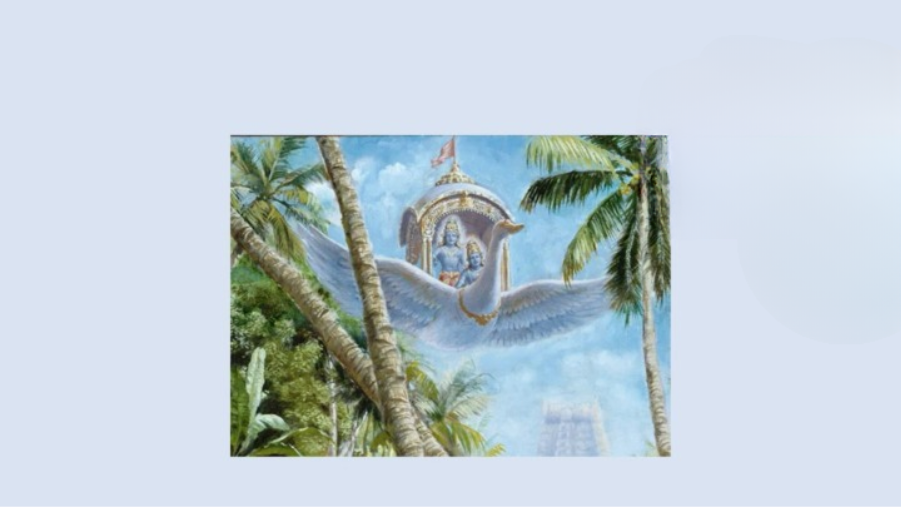
So, after this, then there is a little bit of description of what happened to Ajamil after he heard the Vishnudutas speak. So, Ajamil heard this conversation between the Vishnudutas and the Yamadutas, and then he was so surprised, he wanted to speak to the Vishnudutas, but they disappeared [Laughs]. So, Vishwanath Chakravarthi explains that actually Ajamil, of course, was about to die and the Yamadutas came. That happened, it wasn’t his actual karma. He had reduced his lifespan because of all of his sinful activity. So, his time got shortened and then the Yamadutas came to get him. But, technically, we say all of his sins were destroyed. So, the shortened life was no longer applicable [Laughs]. So, then Vishnudutas disappeared and he got life back, some lifespan back.
Yeah, so consequently, of course, then he went to Haridwar and he actually met devotees there and he performed Bhakti and then he went to Vaikuntha.
Hearing about the pure Dharma, that means Bhakti approved by the Lord from the servants of Vishnu, and the impure Dharma recommended in the three Vedas from the servants of Yamaraja, that’s normal, you know, Varnashrama Dharma. Ajamil quickly became filled with devotion to the Lord from hearing the greatness of the Lord and became repentant on remembering his sinful actions.
So, previously Ajamil had chanted the name Narayana in Namabhas, he was not technically doing Bhakti. But, he became purified of all of his sins and gradually developed some faith. And here we see that he heard, he had association of the Vishnudutas devotees, so he had his Guru in that sense, his Siksha Gurus [Laughs]. So, therefore, he began to practice Bhakti seriously.
Later on, then there is an explanation, how he named his son Narayana. So, Vishwanath Chakravarti explains that there must have been some auspicious acts to cause him to name his son in that way. How did he get a chance to see the Vishnudutas? And then Vishwanath Chakravarti explains, it had to be mercy of devotee. So, without that mercy of devotees, we can’t get Bhakti. It’s because of that mercy, which he didn’t even know about, he named his son Narayana [Laughs]. So, even accidental Bhakti, by chanting Namabhas, as in Ajamil’s case, ultimately due to mercy of devotees.
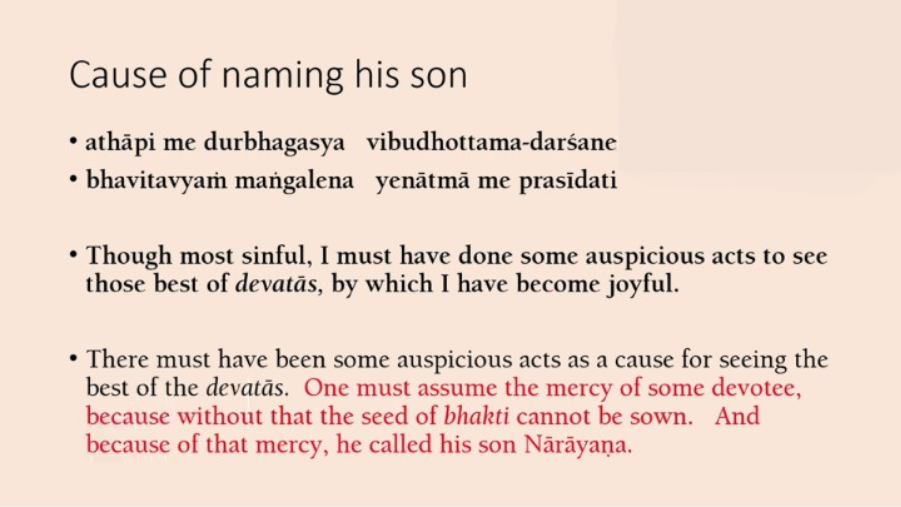
So, by chanting that name, starting out accidentally, but ultimately due to the mercy of devotees, then eventually developed Bhakti, he practiced Bhakti seriously in Haridwar, and then he went to Vaikuntha. So, he started out accidentally chanting. So, if you start out with faith chanting, how much greater result you will get [Laughs].
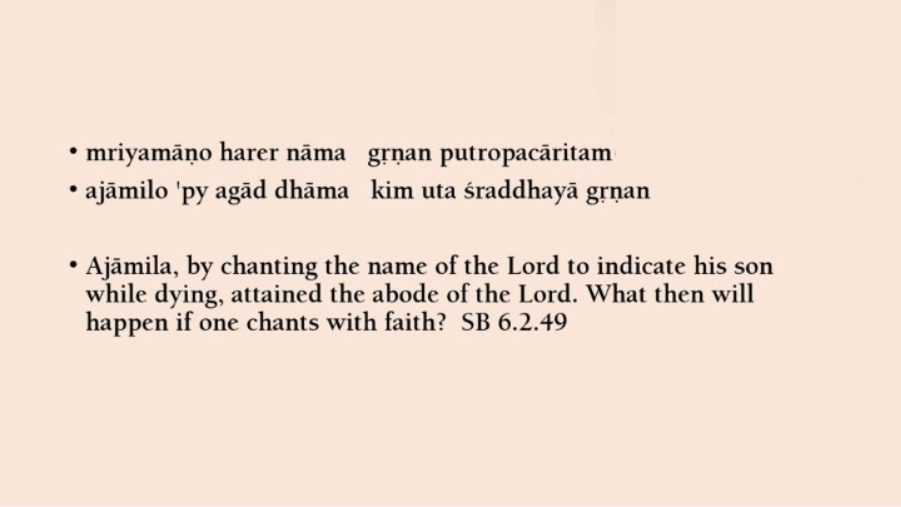
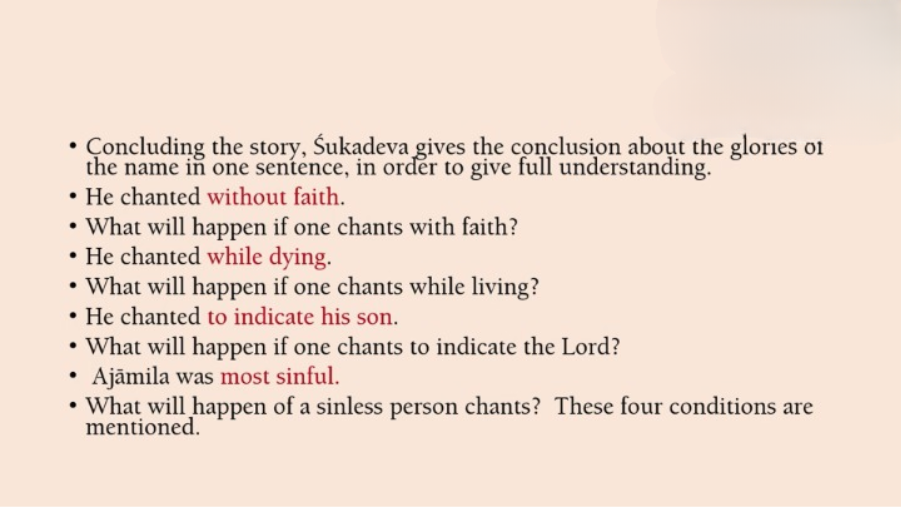
So, Vishwanath Chakravarti explains at the end of the story, that Ajamil, he chanted without faith. So, how much more result you will get if you had faith. He uttered the name while he was dying. So, what if you chant when you are living [Laughs]? He chanted to indicate his son. So, what if you chant and you are really understanding this means Supreme Lord. Ajamil chanted in the most sinful state. So, how much greater result if you chant without sin at all. So, he gives four conditions by which even then Ajamil got such a great result. So, if you chant with faith, with devotion, during your whole life to indicate Supreme Lord, with knowledge and without any sin, you get greater result. And if you chant the name of Krishna, you get even 3000 times greater result [Laughs]. So, that ends this particular glorification of the name.
Q & A:
1.) Hare Krishna Maharaj, one question. Ajamil met Yamaduta and Vishnuduta. After he went to Haridwar, he discussed about when he met Yamaduta and Vishnuduta, he discussed about this incident to anybody?
Well, it’s not stated anywhere what he said to them at all. But somehow we get this story in Bhagavatam. So, he must have told somebody [Laughs]. Because this whole experience was something internal and no one else could see it except him and the Vishnudutas [Laughs].
2.) Hare Krishna Maharaj, who is a Siksha Guru? Does it require personal relationship? We hear from many devotees in ISKCON, do they all be treated as Siksha Gurus?
So, we can take literally the meaning, Siksha Guru is anybody who teaches. But generally when we are talking about Siksha Guru equal to Diksha Guru etc, we are talking about narrow, we are giving a narrower definition. So, in Bhakti Sandarbha, Jiva Goswami describes that initially, you hear from one particular Guru and you get teachings from them. Later on, that person may become a Diksha Guru. So, such a Guru is one who is giving very significant teachings. And of course, as stated here in these verses, you surrender to Guru.
So, the question may come, well, I’ll surrender to Prabhupad. So, that’s also acceptable. So, we take Prabhupad as our main Siksha Guru. And it’s a statement by the GBC to even state that, every devotee in ISKCON from now and the future has a direct relationship with Srila Prabhupad as a Siksha Guru. Of course, people will say, ah, now you are a rithvik [Laughs]. But no, rithvik means you are directly initiated by Prabhupad, he is your Diksha Guru. We are not saying that. We are saying he is your direct Siksha Guru.
So, apart from that, then you have a living Diksha Guru who gives you the mantra and name and you can have Siksha Gurus who give you teachings. So, who is the greatest? Who gets more worship? So, Prabhupad gets most of the worship because he is the greatest Siksha Guru. And all the Siksha Gurus and the Diksha Gurus who are living and giving instructions, they also get great respect, but not the same level. You can only have one Diksha Guru, but you could have many Siksha Gurus. The different Siksha Gurus could give different teachings, some on pastimes, some on Tattva, some on other subjects whatever.
3.) Dear Maharaj, in Gaudiya sampradaya, what is the significance of Swarupa Diksha, siddha pranali? Did previous Acharyas recommend this process?
I don’t think it is ever called Diksha. Diksha is simply getting the mantra. But they do have some ceremony by which you get your Siddha Deha or Siddha Swarupa. So, this of course is part of Raganuga Bhakti. And in Nectar of Devotion, there Rupa Goswami explains that at a certain point, you should meditate on your spiritual form in serving Krishna. So, part of Raganuga Bhakti is to meditate on your particular relationship with the Lord and try to serve Him in meditation.
So, if you choose Sakhya Rasa, then you are serving Krishna in Sakhya, but you can’t come as a Brahmachari or as a Grihastha. To serve Krishna in Vrindavan, you have to be a Cowherd boy. So, you meditate on that form in serving Krishna in Vrindavan. So, it is a part of Sadhana Bhakti. But Rupa Goswami explains by meditating in that way, you more quickly attain that as your Swarupa when you attain Bhava and Prema. Otherwise, we can meditate not only on Krishna, but even Narayana in Vaikuntha. Okay, I’m serving, serving, serving, but we’re not meditating on any particular form. So, then we realize Vishnu or we realize Krishna. What form are we going to take [Laughs]? So, of course, even then Krishna will supply you with suitable form in order to worship properly. But by concentrating on your particular form in which you are serving Krishna in particular Rasa, then it kind of speeds up the process [Laughs].
So, Rupa Goswami mentions about that. He doesn’t give a particular process. But Gopal Guru Goswami and Dhyana Chandra Goswami who were I mean disciples and grand disciples of Vakreswara Pandit in Puri, they wrote some manuals on the whole system of the Guru giving to the disciple a particular, only for Madhurya Rasa, that is a Manjari Rupa. So, you go to the Guru and say, you know, I like Madhurya Rasa, so I want to aspire to be a Manjari [Laughs]. And then the Guru will give you, okay, this is the name, you’re the so and so Manjari, this is your service, this is the group you’re in, this is your goal, etc, this is your complexion, this is your dress, this is your service. He gives you eleven different things that you can meditate on in your Swarupa. And then you meditate on as a Manjari, serving the other Manjaris and the Sakhis and Krishna.
So, that system became quite popular in Bengal and in Vrindavan among the Babajis. However, even later on, when Vishwanath Chakravarti wrote Raga Vartma Chandrika, he doesn’t mention that particular system. And there he says, you could get your Swarupa internally by inspiration. From your Guru, who is may be your Diksha Guru. Or from another devotee. But even then, he doesn’t say, you have to have the eleven items, etc, etc.
4.) Hare Krishna Maharaj. If Guru is not necessary, then how do we understand the statement, Yasya prasādād bhagavat-prasādo [Śrī Śrī Gurvaṣṭaka verse 8]?
Well, as Vishwanath Chakravarti Thakur said, yes, ultimately, you don’t need Guru, as in the case of Ajamil, but then I also said, generally, if we’re practicing Bhakti, we do need at least Siksha Guru. And if you intentionally avoid taking a Guru, then it becomes Nama aparadha [Laughs]. And so with that Nama aparadha, you cannot advance in devotional service [Laughs]. So generally, if we are practicing pure Bhakti and we’re trying to develop Prema, at least we need a good Siksha Guru. So can we practice Bhakti with no scripture? Can we practice Bhakti without reading Srila Prabhupad’s books [Laughs]? No [Laughs]. And even if we have Prabhupad’s books, devotees also have questions all the time [Laughs].
5.) Our relationship with our spiritual master is eternal as he engages us and introduces us to the Lord. So my question is, will it be possible to enter into the service of the Lord without Guru, even if we chant maha mantra?
Same question [Laughs]. Guru or no Guru. Regarding eternal Guru, Guru is eternal. But at the same time, you have many Gurus. Siksha Guru, many Siksha Gurus may be, Diksha Guru. And previous lifetime, you may have Gurus. If you don’t get Prema in this lifetime, you have Gurus in your next lifetime. So they’re all eternal. Ultimately, they all have their spiritual form in the spiritual world. So therefore, it’s not just one Guru, we can say many Gurus. And because we establish a relationship, that is a spiritual relationship, that’s also eternal. But it’s quite different from the relationship you have now. The Guru may be a Manjari [Laughs]. Or many Gurus [Laughs], many different Manjaris [Laughs]. Or they could be Cowherd boys [Laughs]. So they could be various forms, so it’s not quite the same Guru we’re thinking of now [Laughs].
6.) Maharaj, can one have online Siksha Guru? As so many people are connected online through different preachers, or personal, due to our connect is necessary for Siksha Guru relationship.
Well, yeah, just as even books we have, and we read Prabhupad’s purports, we get Siksha through that. And then Prabhupad used to write letters to devotees, giving Siksha [Laughs]. People listen to Prabhupad recordings [Laughs]. Of course, in previous ages, that was not there. And even books were scarce. So there was greater dependence on physical presence and physical teaching. However, we do see that the Goswamis’ works were preserved and written, and then they come down to us. So they still have relevance, even though they were from 500 years ago [Laughs]. So now we have recordings, and we do have internet and so many other things available for teaching. That’s also another way of getting Siksha. It may not be as effective as direct teaching. That may depend on the particular person hearing, or on the particular teacher also.
7.) Dear Maharaj, Ajamil went to Vaikuntha after sincere devotional service in Haridwar, after hearing from Vishnudutas and Yamadutas, and after association with Vishnudutas. So Ajamil chanted with faith while living after giving up sinful activities, indicating the Lord. Please explain.
So, first he chanted Namabhasa, without aparadha. He destroyed all of his sins and his vasanas and his avidya. And then he kept chanting the name of his son. He started to develop some bhakti. Then Yamadutas and Vishnudutas came and he was given a new life. And he heard from the Vishnudutas and then he practiced bhakti seriously. And then he went to Vaikuntha.
Devotees: HH Bhanu Swami Maharaj ki jai!!! Srila Prabhupad ki jai!!! Nitai Gaura premanande Hari Haribol!!!